About this place
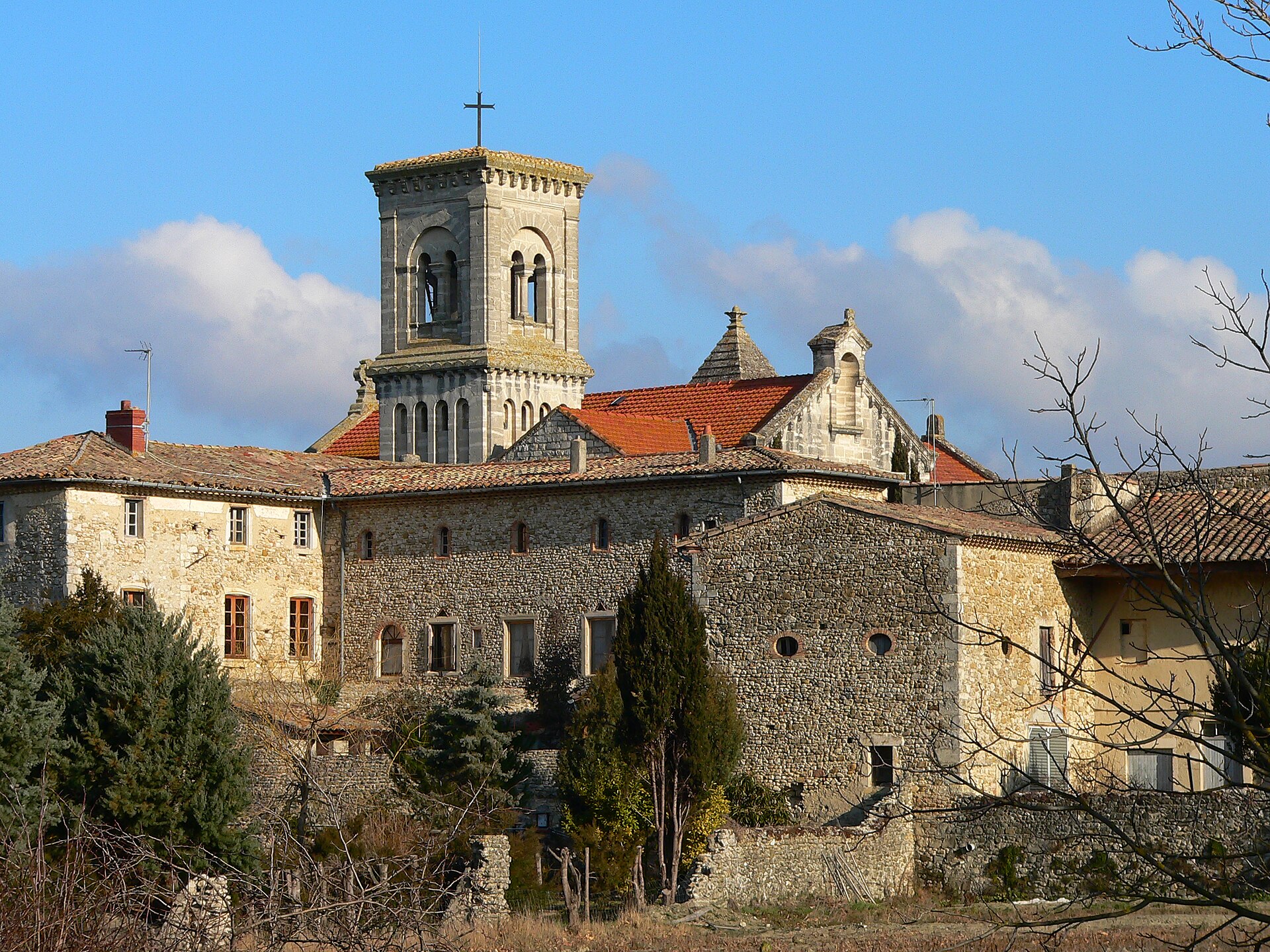
The Notre-Dame-du-Bosquet church in Bouchet is a former monastic church attached to a Cistercian abbey for nuns, standing in the small village of Bouchet in the Drôme department of southern France. Though it is valued today chiefly as a piece of Romanesque architecture, for centuries it stood at the center of the area's religious and economic life.
When was the abbey founded, and by whom?
The abbey of Notre-Dame-du-Bosquet was established in the early 1180s at the initiative of Tiburge II, Countess of Orange, as a community of Cistercian nuns. Its first prioress, Willelma, appears in a charter from 1184, standing alongside the founder during a land grant made to the new community. The church itself was built at the same time as the monastic buildings, connected to them by an upper passage — a common Cistercian arrangement that kept the nuns' quarters separate from the place of worship.
What does the Romanesque architecture look like?
The church follows a single-nave plan, with a transept and a semi-circular apse closing the chancel. Its round-arched Romanesque window openings are typical of the austere Cistercian style of the late twelfth and early thirteenth centuries, which avoided rich decoration in keeping with the order's rule of simplicity.
What made the abbey important in the thirteenth century?
The 1200s were a period of prosperity for the community, thanks to the patronage of local lords, chiefly the princes of Orange, who endowed it with landholdings stretching as far as Mornas. It was during this century that the site gained added spiritual significance: Bertrand de Garrigues, a companion of Saint Dominic, died here in 1230, and his remains were venerated in the church until they were moved elsewhere in 1414.
Why did the monastic community decline?
The fourteenth century brought hardship. The Hundred Years' War, raids by mercenary companies, and the effects of the Black Death left the abbey impoverished. By 1413 its last three nuns had left, and its estates were attached to the abbey of Aiguebelle. In 1476, on the initiative of Julien della Rovere (the future Pope Julius II), the site was converted into a secular priory whose income was meant to support the newly founded Collège du Roure in Avignon. A further blow came in 1562, during the Wars of Religion, when Baron des Adrets attacked Bouchet and destroyed part of the church.
How has the building been used since then?
In the nineteenth century, the former monastic buildings passed to the Fabre family, silk manufacturers from Lyon, who converted them into a textile mill. The factory kept operating into the 1970s. After it closed, local winegrowers from the Cellier des Dauphins cooperative took over the premises: the ground floor became an aging cellar for Côtes-du-Rhône and Coteaux-du-Tricastin wines, while the upper floor was turned into a reception hall. The commune of Bouchet became the owner of the whole complex in the early 2000s, opening the way for further study and gradual public access.
Frequently asked questions
Can visitors see the Notre-Dame-du-Bosquet church today? The former abbey buildings, including the church, belong to the commune of Bouchet and are occasionally opened to the public, notably during the Journées du Patrimoine (Heritage Days).
What religious order did the abbey belong to? It was a Cistercian convent for women, part of the female branch of the Cistercian order, founded in the twelfth century.
What is the former monastic building used for today? It now serves as a reception hall and, in part, as an aging cellar for regional Côtes-du-Rhône wines.
Where is Bouchet located? The village lies in the Drôme department, in the area known as Drôme Provençale, in southern France.
Nearby places

Earn badges for the places you visit
Download NextOnTrip, discover new places and check off your trails.