About this place
The Church of Saint John of Nepomuk stands in the Linecké suburb (Linecké Předměstí) of České Budějovice, on the road heading toward Český Krumlov and the Dolní Dvořiště border crossing. It's a relatively young, Neo-Romanesque building whose construction traces back to money originally raised for an entirely different project.
Why was this church built here?
In the late 19th century, Bishop Martin Říha started a fundraising campaign for a brand-new cathedral in České Budějovice — at the time, the city's only large cathedral-scale church was St. Nicholas. His successor, Bishop Josef Antonín Hůlka, later decided against building a new cathedral altogether and instead had the existing St. Nicholas Cathedral repaired. The leftover funds from the original collection were redirected to build a new parish church in the Linecké suburb, an area of the city that had no church of its own.
When and how was it constructed?
Construction ran from 1914 to 1915, based on a design by architect Anton Möller of Varnsdorf, with the building work carried out under Antonín Procházka. The timing put the project right at the start of the First World War, which slowed things down considerably — building materials were scarce and much of the available workforce had been called up for military service. Even so, the church was finished quickly enough to be consecrated on 12 September 1915.
What can you see inside and outside?
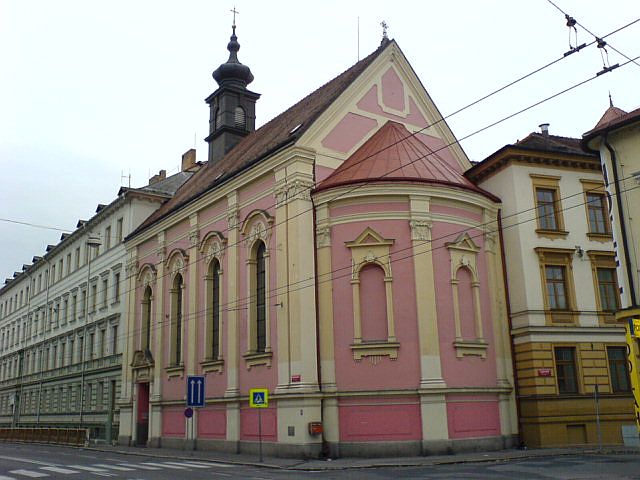
The building is a three-aisled, flat-roofed basilica with a transept and a semicircular apse on the eastern side, decorated with elements in the Beuron art style. A tall, prism-shaped tower rises in front of the western façade and is visible from a distance along the road to Krumlov. A small park surrounds the church, with a parish building standing next to it.
The main altar holds a painting depicting the celebration of Saint John of Nepomuk, painted by Franz Anton Maulbertsch in 1760. It originally hung in St. Nicholas Cathedral on the main square and was moved here as part of the new church's furnishings. Also worth noting is the organ built by the Schiffer company, with 44 stops, completed in July 1916 — about a year after the church's consecration. For its era, an unusual technical detail is the underfloor heating system, which distributed warm air rather than relying on conventional radiators, a rare feature in early 20th-century church buildings.
Can you visit the church today?
Yes — the building is accessible during religious services and remains in good condition thanks to a thorough renovation of its interior and exterior, completed in 2011 (with follow-up work continuing to 2014). The historic organ was restored separately in 2018. It's still an active parish church rather than a dedicated tourist site with fixed visiting hours, so it's best to time a visit around a Mass or combine it with a walk through this part of the city.
Frequently asked questions
Where exactly is the church located? In the Linecké suburb of České Budějovice, along the road leading out of the city toward Český Krumlov and the Dolní Dvořiště border crossing.
Who designed the church? Architect Anton Möller of Varnsdorf designed it, and Antonín Procházka carried out the construction between 1914 and 1915.
What is the most notable piece inside? The 1760 altar painting by Franz Anton Maulbertsch, relocated from St. Nicholas Cathedral, and the 44-stop Schiffer organ installed in 1916.
Is the church open to visitors? It's open during services; as an active parish, it doesn't keep fixed sightseeing hours like typical tourist attractions.
Nearby places
-

Church of the Virgin Mary of the Rosary in České Budějovice
Czeskie Budziejowice
-
Church of the Holy Family
České Budějovice
-
Chapel in Litvínovice
Šindlovy Dvory
-
Kaple Smrtelných úzkostí Páně
Czeskie Budziejowice
-
Church of the Presentation of the Virgin Mary
Czeskie Budziejowice
-
Church of the Sacred Heart (České Budějovice)
Czeskie Budziejowice
Earn badges for the places you visit
Download NextOnTrip, discover new places and check off your trails.