About this place
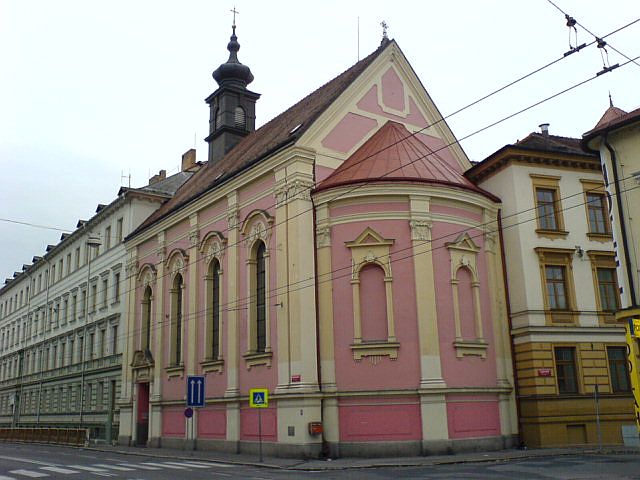
The Church of the Holy Family is a Neo-Gothic church in České Budějovice, standing on the corner of Karla IV Street on the site of a former convent and orphanage run by the Congregation of the Sisters of Mercy of St. Charles Borromeo. Smaller and less famous than the city's St. Nicholas Cathedral, it has a layered history stretching back to the late 19th century and an interior worth a stop on any walk through the city.
Who built the church, and when?
The project traces back to 1850, when the Bishop of České Budějovice, Lindauer, invited the Congregation of the Sisters of Mercy of St. Charles Borromeo (known locally as the Borromean Sisters) to the city. From the 1860s onward, the sisters gradually built a complex along today's Karla IV Street — an orphanage, a school, and eventually the church itself. Construction ran from 1886 to 1888, and the church was consecrated on June 3, 1888.
What does the church look like inside?
It's a single-nave building with a small tower, a sacristy, and a gallery; unusually, the altar sits in the southern part of the building rather than the traditional east end. The interior decoration was designed by the Benedictine monk Gislain Béthune in the Beuron style — a late-19th-century sacred art movement blending Egyptian, early Christian, and Art Nouveau elements. Walls and ceiling are covered in rich floral and geometric motifs. Above the entrance is a stained-glass window depicting the Hand of God, and against the east wall stands a Baroque statue of St. John of Nepomuk by sculptor Leopold Huber, dating from the second half of the 18th century.
What happened to the church under communism?
In the 1970s, the communist regime confiscated the building from the sisters, and for decades it served as a state archive depot rather than a place of worship. Only after a renovation completed in 2013 was the church returned to the administration of the Deanery of St. Nicholas, and in 2014 it reopened to worshippers and visitors.
What is the church used for today?
Its present-day interior reflects adaptation work overseen by architect Josef Pleskot, which made it possible for students of the neighboring Bishop's Grammar School (Biskupské gymnázium) to hold school masses and educational events on site. Today the church functions both as a place of worship and as a venue for cultural gatherings, concerts, and parish events. In 2018 it was declared a cultural monument of the Czech Republic.
Where exactly is it located?
The church stands at Karla IV 466/22 in České Budějovice, right next to the Bishop's Grammar School building, just a short walk from the historic city center and Přemysl Otakar II Square.
Frequently asked questions
Can visitors go inside? Yes. Since reopening in 2014, the church has been open to the public — used for regular masses as well as cultural and educational events run jointly with the neighboring school.
What's the most striking feature of the interior? The Beuron-style decoration designed by the Benedictine monk Gislain Béthune, with its rich floral and geometric patterns, the Hand of God stained-glass window above the entrance, and the 18th-century statue of St. John of Nepomuk.
Why was the church closed for so long? The communist regime confiscated it from the sisters in the 1970s and used it as an archive storage facility. It only returned to church use after a renovation finished in 2013.
Is the church a protected monument? Yes — it has been listed as a cultural monument of the Czech Republic since 2018.
Nearby places
-

Kaple Smrtelných úzkostí Páně
Czeskie Budziejowice
-
Church of the Virgin Mary of the Rosary in České Budějovice
Czeskie Budziejowice
-
Church of the Presentation of the Virgin Mary
Czeskie Budziejowice
-
Church of the Sacred Heart (České Budějovice)
Czeskie Budziejowice
-
Evangelical church
Czeskie Budziejowice
-
Church of Saint Wenceslaus
Czeskie Budziejowice
Earn badges for the places you visit
Download NextOnTrip, discover new places and check off your trails.