- Sacred Monuments
- Churches
Church of the Virgin Mary of the Rosary in České Budějovice
About this place
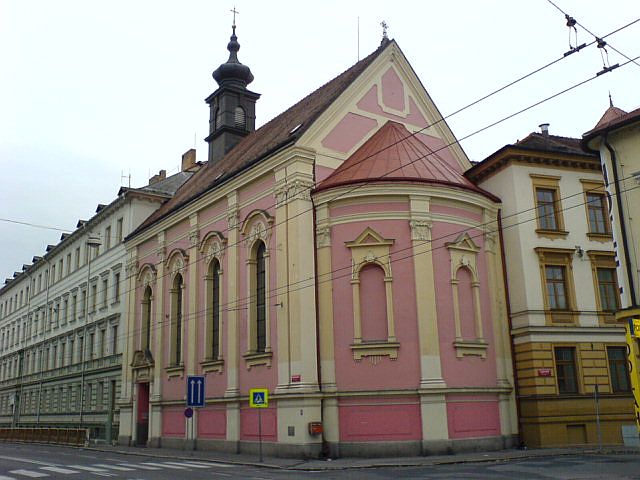
The Church of the Virgin Mary of the Rosary in České Budějovice is a small, unassuming Roman Catholic church standing on Žižkova Avenue, right next to the monastery of the Petrine congregation. It may not look spectacular at first glance, but it holds one of the more interesting examples of sacred art created in South Bohemia around the turn of the 20th century.
Why was this church built?
The building went up between 1899 and 1900 to a design by architect Jakub Stabernak, in a Pseudo-Romanesque style drawing on early Christian and Romanesque forms. It replaced an earlier, provisional Chapel of Our Lady of Lourdes, which could no longer keep up with the growing parish community. Its construction is closely tied to Father Václav Clement Petr (1856–1901), who in 1888 founded the Congregation of the Brothers of the Most Holy Sacrament in České Budějovice, popularly known as the Petrines. The new church became the order's religious house and spiritual centre, and locals still refer to it informally as "the Petrine church."
What does the church look like inside and out?
The building has a single nave, with a square choir closed by a semicircular apse, to which an additional square chapel and a sacristy are attached. This layout, typical of small monastery churches, gives the modest-sized interior a sense of order and balance despite its compact footprint.
The church's real distinguishing feature, however, is its painted and carved decoration, executed in the spirit of Beuron art — a style that originated at the German Benedictine abbey of Beuron and blends elements of ancient Egyptian, Byzantine and early medieval art into a unified, decorative liturgical idiom. The lower sections of the walls are lined with fourteen wooden Stations of the Cross, and above them runs a band of fifteen images depicting the mysteries of the Holy Rosary and scenes from the life of the Virgin Mary. This painted cycle is considered one of the finest surviving examples of Beuron art in South Bohemia — and it's this cycle that gives the church its popular name.
Both the church itself and the façade of the adjoining Petrine monastery are today listed as cultural monuments of the Czech Republic.
How do you get there and when should you visit?
The church stands on Žižkova Avenue, in an easily accessible part of České Budějovice, a short distance from the historic town centre around Přemysl Otakar II Square. It's worth pairing a visit with a walk around the old town — this isn't a site that anchors an entire day of sightseeing, but it makes for an interesting, off-the-beaten-path stop for anyone drawn to sacred architecture or Beuron-style art. Since it's an active monastery church, it's best visited outside service times, so you can take in the interior decoration undisturbed.
Frequently asked questions
Who built the church and when was it constructed? It was built between 1899 and 1900 to a design by architect Jakub Stabernak, in the Pseudo-Romanesque style.
Which religious order is the church connected to? The church serves as the religious house of the Congregation of the Brothers of the Most Holy Sacrament (the Petrines), founded in 1888 by Father Václav Clement Petr.
What's the most notable feature of the interior? The painted decoration in the Beuron style — fourteen Stations of the Cross and a band of fifteen images depicting the mysteries of the Rosary and scenes from the life of the Virgin Mary.
Is the church a protected monument? Yes, both the church itself and the façade of the adjoining Petrine monastery are listed as cultural monuments of the Czech Republic.
Nearby places
-

Church of the Holy Family
České Budějovice
-
Kaple Smrtelných úzkostí Páně
Czeskie Budziejowice
-
Church of the Sacred Heart (České Budějovice)
Czeskie Budziejowice
-
Church of the Presentation of the Virgin Mary
Czeskie Budziejowice
-
Husův sbor (České Budějovice)
Czeskie Budziejowice
-
Evangelical church
Czeskie Budziejowice
Earn badges for the places you visit
Download NextOnTrip, discover new places and check off your trails.