About this place
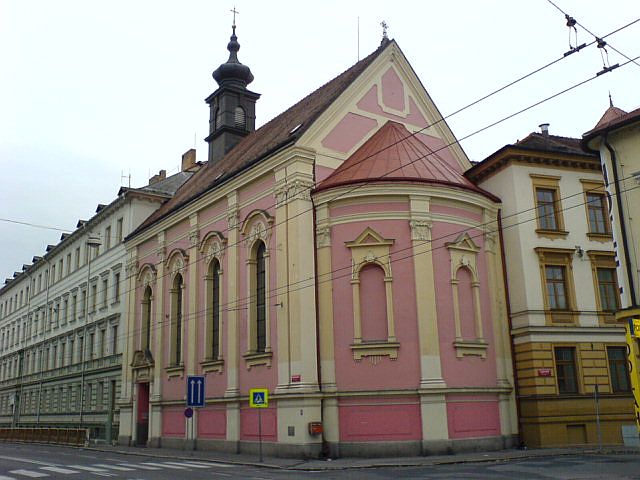
The Chapel of the Mortal Agony of the Lord (Czech: Kaple Smrtelných úzkostí Páně) stands just behind St Nicholas Cathedral in České Budějovice, tucked among the old-town buildings. It is one of the city's lesser-known sacred monuments, easy to miss for visitors hurrying toward the main square, yet its roots reach back to the medieval origins of the town.
How to get there?
The chapel sits right in the historic centre of České Budějovice, directly beside St Nicholas Cathedral, only a few minutes' walk from Přemysl Otakar II Square. The surrounding area is a pedestrian zone, so the easiest way to reach it is on foot while exploring the old town — there is no need to look for public transport connections or nearby parking.
What will you see?
The current building was constructed between 1727 and 1731 on the site of an older Gothic chapel dedicated to St James, which had stood there since before 1377. The chapel has a roughly square floor plan with rounded corners, and its façade is flanked by two small towers. The interior is covered by a dome, which painter and fresco artist Johann Adam Schöpf decorated in 1729 with a scene depicting God the Father surrounded by angels. The main altar holds a painting of Christ praying in the Garden of Gethsemane — the very scene that gave the chapel its name.
Beneath the building lies an ossuary, a remnant of the former municipal cemetery that once surrounded the site. For centuries the chapel was closely tied to burials and the memory of the town's deceased residents, before the cemetery was cleared away and the area was absorbed into the surrounding city.
The building's history has not always been peaceful. In 1785, as part of the Josephine reforms, the chapel was closed and for a time used merely as storage space. It was only reconsecrated in 1855 on the initiative of Bishop Jan Valerián Jirsík, and has served religious purposes again ever since.
Today the chapel hosts Greek Catholic services, held exclusively on holidays in the evening at 7 PM. Outside these times the interior is generally not open to visitors, so it is best approached primarily as an architectural curiosity to admire from the outside while touring the cathedral and its surrounding complex.
When to visit?
Because access to the interior is limited to specific holidays at a set hour, plan ahead if seeing Schöpf's frescoes is a priority. The exterior and its surroundings, however, can be visited year-round at any time of day, making the chapel a good stop for a short walk through the historic centre of České Budějovice — especially combined with a visit to St Nicholas Cathedral and the nearby Black Tower.
Frequently Asked Questions
Can visitors enter the chapel? The interior is mainly accessible during Greek Catholic services held on holidays at 7 PM. Outside these times, the chapel is usually closed to the public.
Where does the chapel's name come from? The name refers to the painting on the main altar, showing Christ praying in the Garden of Gethsemane during his moment of spiritual anguish before the Passion — described in Czech as "smrtelná úzkost."
What is located beneath the chapel? An old ossuary survives underneath the building, a remnant of the historic municipal cemetery that once surrounded the site before it was cleared.
What does the chapel look like from the outside? It is a small, roughly square building with rounded corners and two towers on its façade, standing right next to St Nicholas Cathedral in the heart of the city.
Nearby places
-

Church of the Holy Family
České Budějovice
-
Church of the Presentation of the Virgin Mary
Czeskie Budziejowice
-
Church of the Virgin Mary of the Rosary in České Budějovice
Czeskie Budziejowice
-
Church of the Sacred Heart (České Budějovice)
Czeskie Budziejowice
-
Evangelical church
Czeskie Budziejowice
-
Church of Saint Wenceslaus
Czeskie Budziejowice
Earn badges for the places you visit
Download NextOnTrip, discover new places and check off your trails.