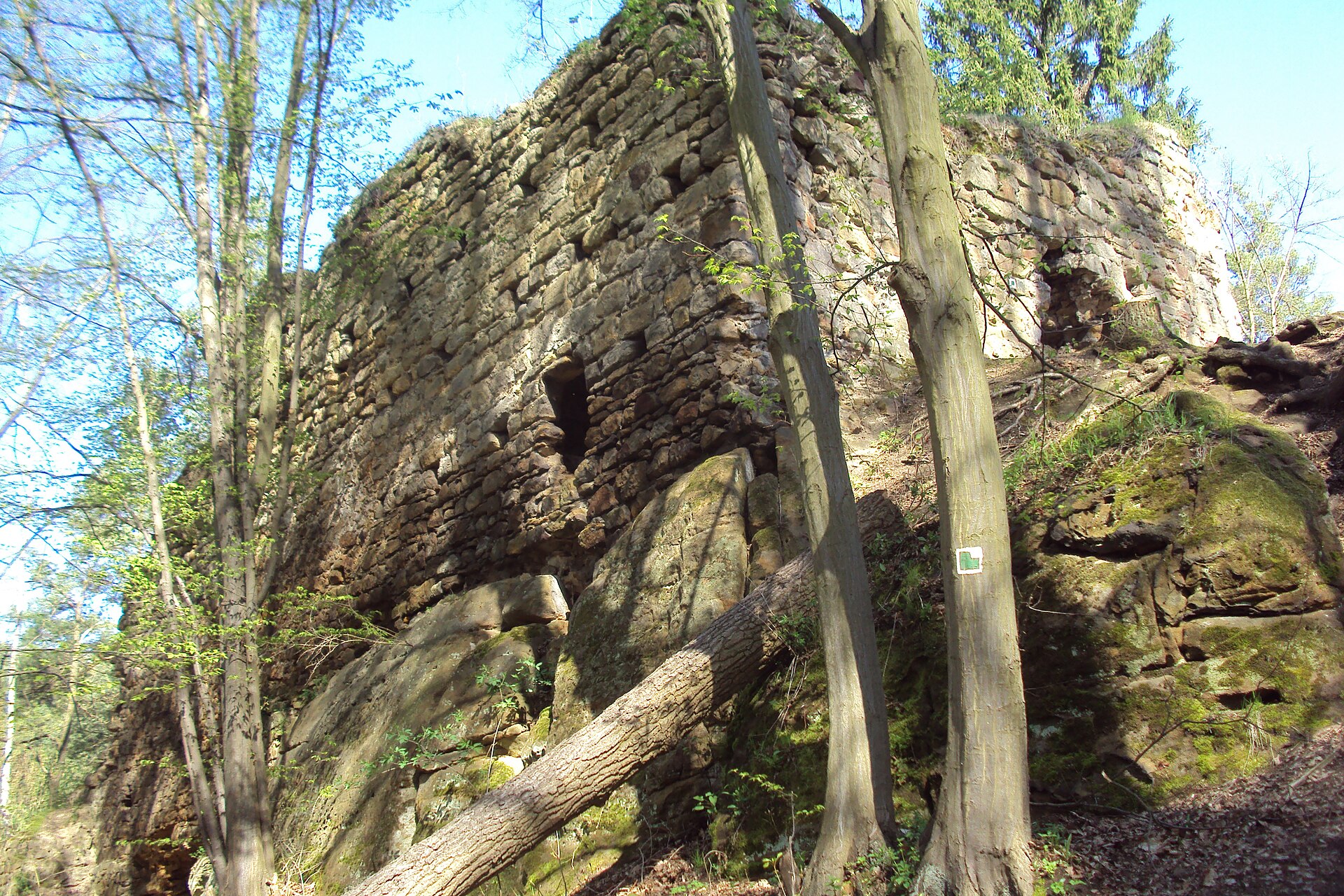
About this place
Chudý hrádek is a ruined castle near the village of Dřevčice, in the Česká Lípa district of northern Czechia, roughly 6 km northwest of the small town of Dubá. The remains sit on a sandstone rock spur above the valley of the Dolský stream, a naturally defensible position that made the site attractive to its medieval builders.
Who built the castle, and when?
The castle was founded in the second half of the 14th century by the Berka family of Dubá, one of the influential noble houses of northern Bohemia at the time. The earliest written record of the fortress dates to 1391, when it appears as the property of Jindřich Berka of Houska. Its name, "Chudý" (meaning "poor" or "humble"), hints at its modest scale compared with the grander castles nearby.
How did ownership change over time?
Around the turn of the 15th and 16th centuries, the castle passed through several hands. Between 1519 and 1522 it was home to Jiří Kaplíř Osterský of Sulejovice, a member of the lesser nobility who used the fortress as a family seat. In 1532 the estate was bought by Václav of Vartenberk, from one of the most powerful noble families in the region. Despite this acquisition, the castle was never significantly expanded — by the first half of the 16th century it had already been abandoned and left to decay.
Why was it abandoned so quickly?
The fate of Chudý hrádek was typical for many small fortresses of the era. As artillery evolved and noble life shifted toward comfort rather than defense, medieval hilltop castles lost their military relevance, and their owners moved to more spacious, representative residences instead. The small size and out-of-the-way location of Chudý hrádek meant modernizing it made little economic sense, so it was simply left behind.
What survives on site today?
Nearly five centuries after the castle was abandoned, visitors can still see the remains of its palace, the main residential building of the fortress. Beneath it lie cellars cut directly into the rock, a construction method typical of the fortified sites scattered across the Dubá Switzerland region. One of the most striking surviving features is a round water tank, roughly 14 meters deep, carved straight into the sandstone — clear evidence of how carefully the castle's water supply was planned, a matter of survival during any siege. The site is today protected as a cultural monument.
What is the surrounding landscape like?
Chudý hrádek lies within the scenic area known as Dubá Switzerland (Dubské Švýcarsko), a landscape of sandstone rock formations, ravines, and forest popular with hikers and rock climbers. The ruins rise above the Dolský stream valley, and the surrounding terrain — steep rock walls, narrow gorges, and dense woodland — is characteristic of this corner of northern Bohemia. The area sees fewer visitors than better-known castle sites in the region, which is an advantage for travelers looking for quiet and unspoiled nature.
How do you get to Chudý hrádek?
The ruins lie close to the village of Dřevčice, right alongside the marked hiking trails of Dubá Switzerland. The most convenient starting point is Dubá itself, from which waymarked footpaths lead through the region's rock formations toward the castle. Because the terrain is rocky and uneven, sturdy hiking footwear is recommended — reaching the ruins themselves involves a short scramble over natural stone ground.
Frequently asked questions
When was Chudý hrádek built? The castle was founded in the second half of the 14th century, with the earliest written mention dating to 1391.
Who owned the castle? It was built by the Berka family of Dubá. Later, between 1519 and 1522, it was home to Jiří Kaplíř Osterský of Sulejovice, and in 1532 it was purchased by Václav of Vartenberk.
Can the ruins be visited today? Yes, the ruins are accessible on foot via trails near Dřevčice and Dubá. The site is protected as a cultural monument.
What can you actually see there? The main surviving features are the remains of the palace building, cellars carved into the rock, and a round water tank about 14 meters deep, hewn out of the sandstone.
Nearby places

Earn badges for the places you visit
Download NextOnTrip, discover new places and check off your trails.