About this place
Castle Loubí is a barely visible medieval stronghold in the municipality of Holany, in the Česká Lípa district of the Liberec Region in northern Bohemia. Its earthworks sit on a sandy spur above the Loubský dol valley, east of the village of Loubí, at an elevation of roughly 330 meters. It belongs to a scattered group of small hillforts found across this part of the Czech countryside, but it stands out for having been completely forgotten for centuries.
A castle with no name
Not a single document from the time the castle was in use has survived, so its original name is unknown. Everything historians know about it comes from ceramic fragments recovered on site, which point to construction in the second half of the 13th century and abandonment by the early 14th century — meaning the stronghold was likely in use for only a few decades. It appears to have been built entirely of wood and earth: no trace of masonry construction has ever been found there, only the remains of timber defenses and earthworks.
The name of the village of Loubí itself does appear in medieval records — a nobleman called Hynek z Loubí (Hynek of Loubí) is mentioned in a document from 1418. However, nothing directly ties this reference to the abandoned hillfort on the ridge, since no written source ever describes the fortification itself.
The ruins were only identified in 1988, when researcher Petr Randus went looking for a site referred to as "Pustý zámek" (German: Wüste Schlössel), mentioned in an earlier account from 1886. His fieldwork added a previously unrecorded defensive site to the region's archaeological map.
What is there to see?
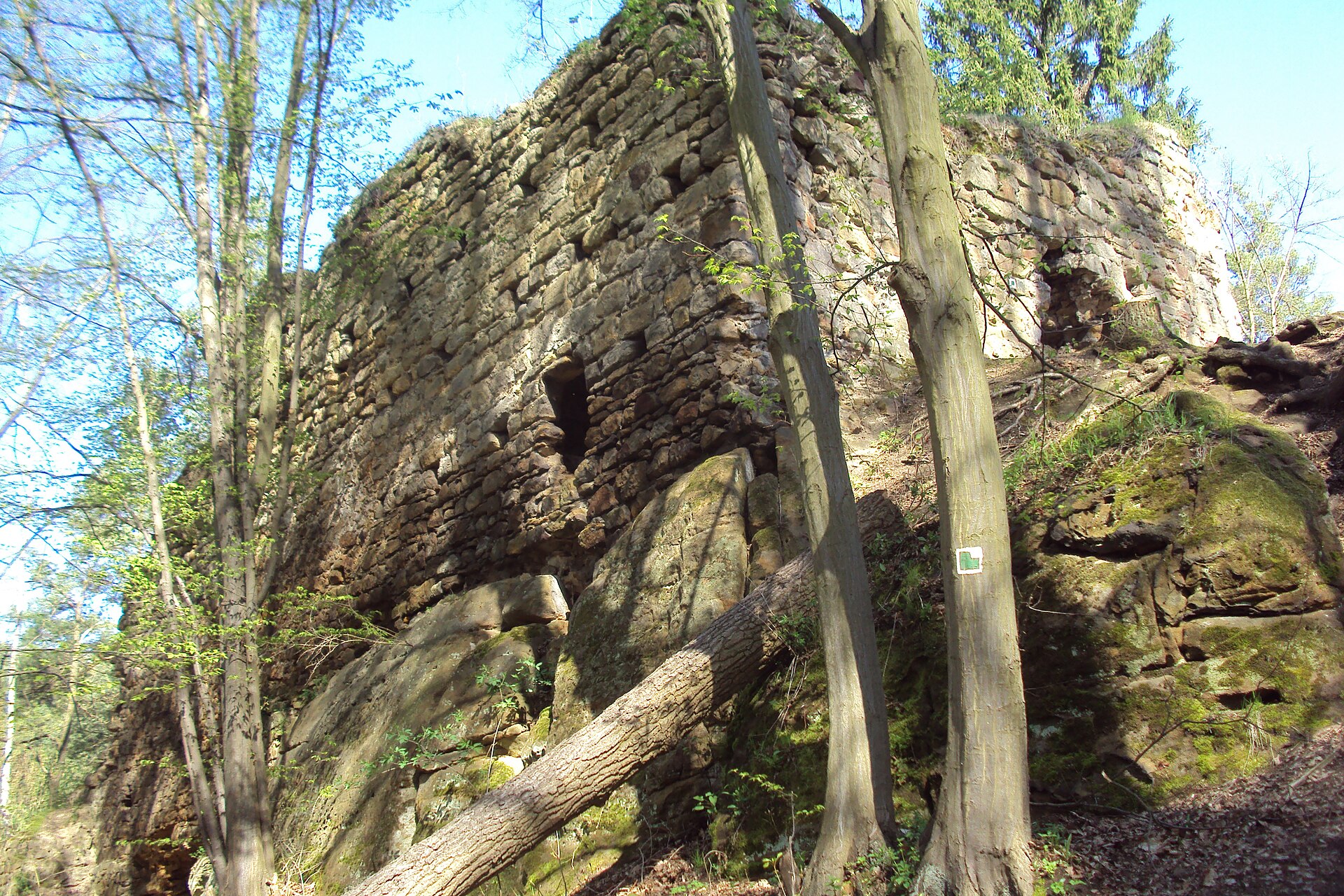
The hillfort occupies a clearly defined spur jutting out of the sandy upland, a shape that itself provided a natural defense, since steep slopes made the site hard to approach from most directions. The most visible surviving feature is a deep ditch that once ran alongside a wooden palisade encircling the site. Beyond that ditch, only gentle earthen ridges remain in the terrain — there is no masonry, no foundations, and no architectural detail to see, because none of that was ever built here in the first place.
This makes Castle Loubí a destination for people interested in field archaeology and in lesser-known corners of the Czech landscape, rather than for visitors hoping for dramatic ruins with towers and walls — it rewards reading the terrain more than admiring a monument.
How to get there?
Access to the site is free and possible year-round, although no marked hiking trail leads to it. The more convenient approach starts in the village of Loubí: follow cycle route no. 211 and then turn onto a field track that runs alongside a field and the edge of the forest. The alternative route goes from Holany through the hamlet of Dřevčice, joining the path about 300 meters before a crossroads. Several similar sites lie within a couple of kilometers, including Chudý hrádek (1.4 km), Vřísek–Žižkova hora (1.8 km), and Jiljov (2 km), making the area a good target for a longer walk exploring medieval hillforts.
Frequently asked questions
When was Castle Loubí built? Ceramic finds date it to the second half of the 13th century; it was abandoned by the early 14th century.
Are there any castle walls left? No — the stronghold was built of wood and earth, and the site today mainly shows a deep defensive ditch and traces of earthen ramparts.
Who discovered the ruins, and when? Researcher Petr Randus identified the site in 1988 while investigating references to a so-called "Pustý zámek" mentioned in an 1886 source.
Is entry free? Yes, the site is freely accessible, though reaching it requires some orientation since no marked trail leads there.
Nearby places

Earn badges for the places you visit
Download NextOnTrip, discover new places and check off your trails.