About this place
Vřísek is a small, largely vanished medieval stronghold hidden in the woods at Hradiště, part of the Chlum municipality in the Česká Lípa district, Liberec Region. Little survives today beyond faint wall traces and a hollow cut into the rock, but the site carries an unusually good story — including more than a century during which it was mistaken for an entirely different building.
Where exactly are the ruins?
The remains sit on a sandstone spur above the valley of the small Dolský stream, on the edge of the Hradiště settlement, which lies within the cadastral area of Drchlava village, part of the Chlum municipality. It is a classic promontory-type fortification typical of northern Bohemia, using steep rock faces as natural defenses. Today the surroundings are quiet, wooded, and off the beaten track — a spot better suited to hikers and regional-history enthusiasts than to crowds looking for dramatic ruins.
Where did the stronghold come from?
Pottery fragments recovered during a limited archaeological survey suggest the site was already occupied in the first half of the 14th century. Yet the first written record of the Vřísek estate only appears in 1402, in a document dividing an inheritance: Jindřich the Younger Berka of Dubé received the Chudý hrádek estate, to which Vřísek belonged at the time. The stronghold was therefore part of a wider property complex held by the Berka of Dubé family, one of the more prominent noble houses in northern Bohemia.
According to historian August Sedláček, Vřísek was split off from the Chudý hrádek estate in 1413 and functioned for a time as an independent seat. Its active life was short, however — by 1543 records already describe it as an abandoned, empty castle.
Lost, misidentified, and rediscovered
What happened to Vřísek after it was abandoned is just as interesting as its early history. As the fortress fell into ruin, both its name and exact location gradually faded from local memory. Sometime between 1633 and 1647, the settlement itself came to be known simply as Hradiště — roughly "hillfort site" — which only made later identification harder. On Heber's map from 1846, the site was even labeled, incorrectly, as "Rač."
The name Vřísek resurfaced in the 19th century, but for a long stretch it was wrongly associated with the Renaissance manor house of Vítkovec near Holany, several kilometers away. It took targeted fieldwork in the 1990s, by researchers F. Gabriel and J. Panáček, to correctly match the historical name to the actual site at Hradiště that survives today.
What can visitors see today?
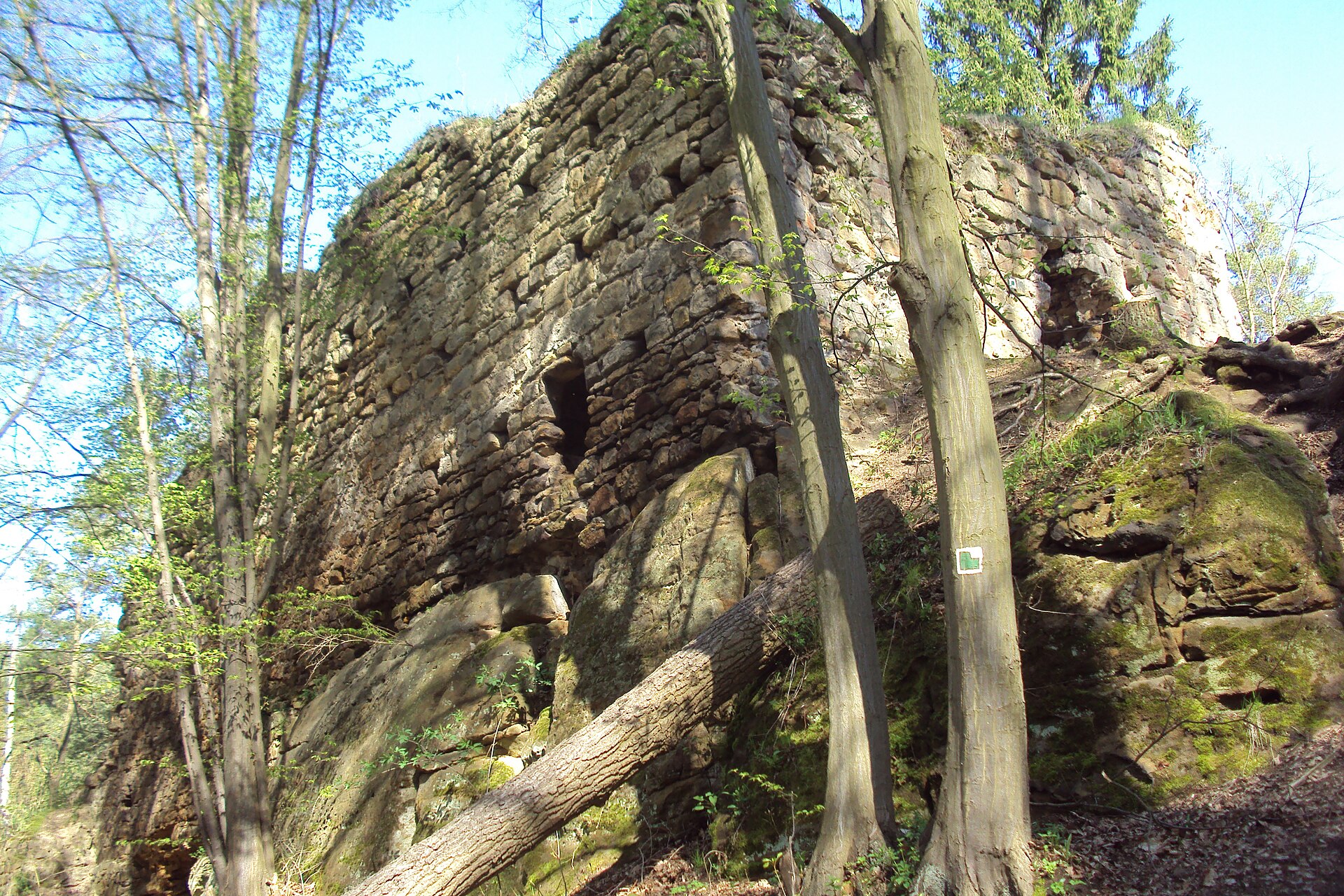
Very little of the original structure remains. The core had a roughly triangular layout, about 26 by 38 by 34 meters, enclosed by a defensive rampart. Visitors can still make out wall fragments on the southeastern and northeastern sides, a shallow moat that once separated the core from the surrounding terrain, and a depression marking a former rectangular building partly cut into the rock. The site has been altered over the centuries, not least by nearby construction — a house numbered 8 standing close by has had a particularly noticeable impact on what remains.
Vřísek suits patient history hunters more than anyone expecting monumental walls — its appeal lies in the story of being forgotten and rediscovered, not in dramatic architecture.
Frequently asked questions
Where exactly is the Vřísek castle ruin located? At Hradiště, within the cadastral area of Drchlava village, part of the Chlum municipality in the Česká Lípa district, on a sandstone spur above the Dolský stream valley.
When was Vřísek castle built? Ceramics point to occupation as early as the first half of the 14th century, though the first written mention dates to 1402.
Why was it confused with another site for so long? After the castle was abandoned in the 16th century, its name and location faded from memory, and in the 19th century it was wrongly linked to the nearby Vítkovec manor house. The correct site was confirmed only through 1990s fieldwork.
What survives of the original stronghold? Fragments of the defensive walls, a shallow moat, and a depression marking a former rectangular building — modest remains, further disturbed by later construction nearby.
Nearby places

Earn badges for the places you visit
Download NextOnTrip, discover new places and check off your trails.