About this place
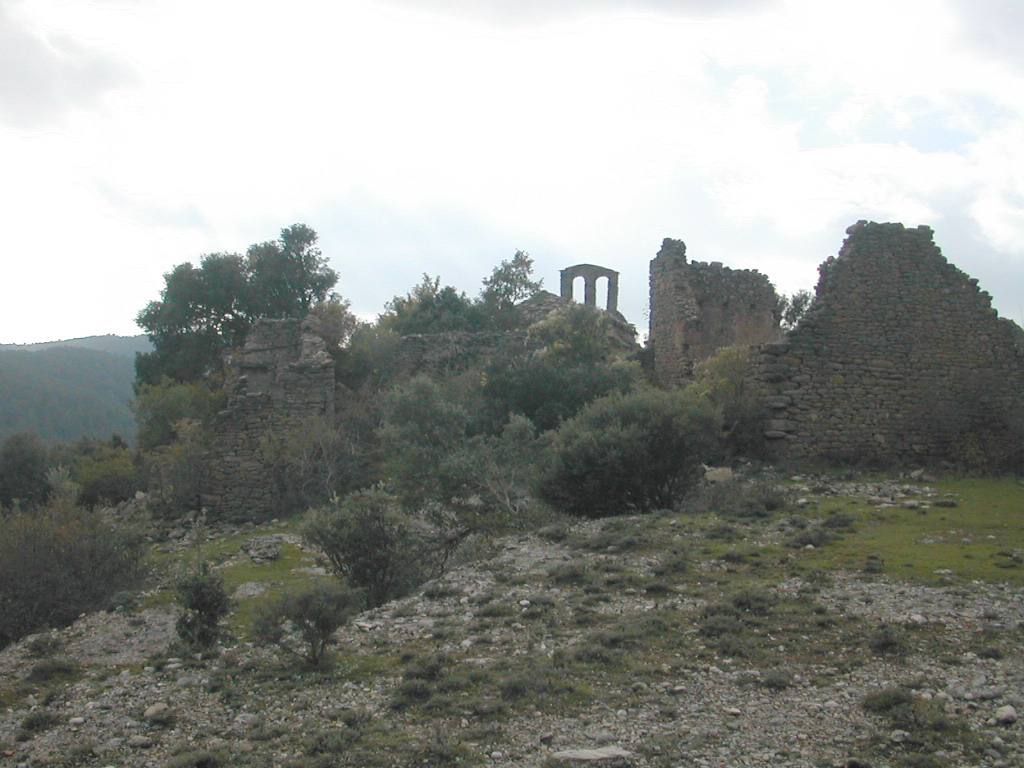
Castell de Lladurs is a medieval castle overlooking the municipality of Lladurs in the Solsonès comarca of Catalonia. Its ruins crown the hilltop of Serrat del Castell, right beside the original church of Sant Martí, and the site now holds official recognition as a cultural asset of national interest.
Where exactly does the castle stand?
The castle occupies a commanding position at the southeastern edge of the Pla de Riard plain, perched on a steep hill on the right bank of the Cardener river. The choice of site was no accident: from up here, defenders could watch over the surrounding valley and the routes running through it, which made the spot valuable for control and defense throughout the Middle Ages.
How do we know it's a thousand years old?
The earliest surviving record of the castle dates back to the year 1000. In that document, the Count of Urgell sold vineyards described as lying "in chastro Llaturci" — within the bounds of the castle of Lladurs. This single mention is what anchors the fortress's origins to the turn of the 11th century, even though a simpler defensive structure on the same spot may well predate the written record.
Who controlled the castle over the centuries?
For most of its documented history, Castell de Lladurs was tied to the Folc family. In 1314, when the viscounty of Cardona was formally established, the castle was listed as one of the strongholds under Folc lordship. That family held feudal authority over it continuously until the feudal system itself was abolished in the 19th century — a run of roughly five hundred years under a single lineage, which says something about how stable local power structures were in this corner of Solsonès.
What happened to the castle in the 20th century?
The castle's most dramatic turning point came during the Spanish Civil War. The neighboring Pla de Riard was pressed into service as an airfield, and the castle's proximity to that military installation proved costly: in 1939 it was destroyed by fire. The blaze gutted much of the structure, leaving little more than ruins for decades afterward.
Can visitors go inside today?
Yes, and the experience is an unusual one. In June 2023, the municipality of Lladurs completed the first phase of restoration work, rebuilding the castle's tower. That rebuilt tower now serves a purpose nobody in the Middle Ages could have imagined: it houses an astronomical observatory equipped with two telescopes, run in cooperation with a local astronomy group active in the Solsonès region. Medieval stone walls topped with modern stargazing equipment make for a striking combination.
What else is worth seeing nearby?
Right next to the castle ruins stands the original church of Sant Martí, which is closely tied to the fortress both architecturally and historically — the two were built and used as part of the same defensive-religious complex on the hill. The viewpoint by the tower is also worth the climb, offering a sweeping view over the Cardener valley and the surrounding hills of Solsonès.
Frequently asked questions
How old is Castell de Lladurs? The first written record dates from the year 1000, though the structure itself may be somewhat older than that document.
Why did the castle burn down? In 1939, during the Spanish Civil War, the nearby Pla de Riard was used as an airfield, and the fighting associated with it led to the castle being destroyed by fire.
What is inside the tower today? Following restoration completed in 2023, the tower now houses an astronomical observatory with two telescopes.
Which family controlled the castle the longest? The Folc family held feudal lordship over the castle from 1314 until the abolition of the feudal system in the 19th century.
Nearby places

Earn badges for the places you visit
Download NextOnTrip, discover new places and check off your trails.