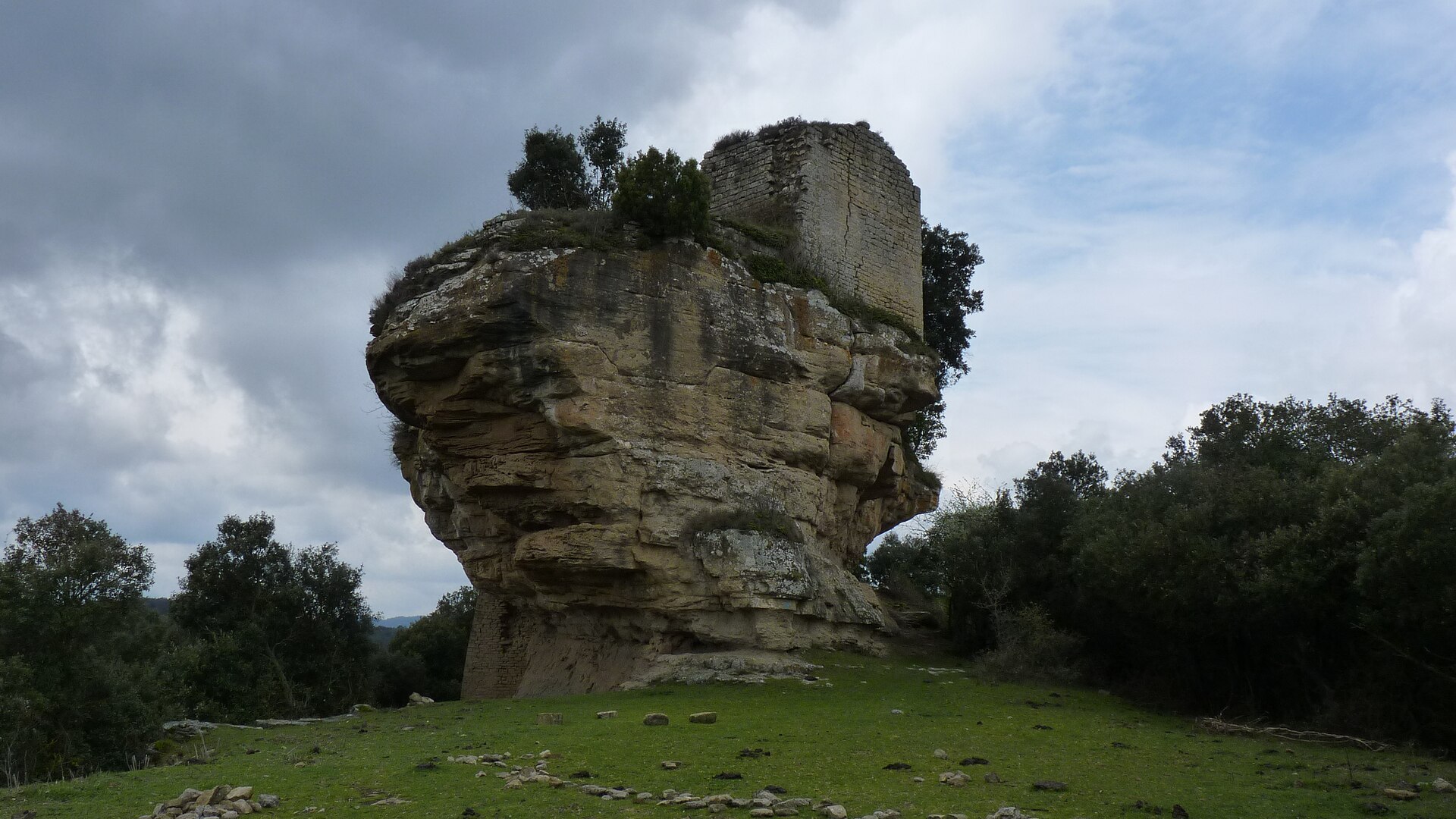
About this place
Castell de Castellcir is a Romanesque castle ruin perched above the village of Castellcir, in the Moianès region east of Barcelona. It crowns a narrow rocky ridge shaped like a ship's stern, locally known as "la Popa," right where two streams — the riera de Castellcir and the torrent de Centelles — meet below the slopes. That confluence explains why this spot was chosen for a stronghold in the first place: steep drops on nearly every side made it easy to defend.
How do you get there?
Moianès is a hilly, stone-village region best explored by car — the drive from Barcelona takes roughly an hour along local roads winding through the countryside. From the center of Castellcir a marked footpath climbs to the ruins; depending on your pace it takes somewhere between fifteen minutes and half an hour. The last stretch runs over uneven, rocky ground, so sturdy shoes are a good idea.
What will you find on site?
The remaining structures cover a modest footprint of about 570 square meters, which makes for an intimate rather than monumental visit. The earliest written record of the castle dates to 1014, though the site was already known centuries earlier — in the 9th and 10th centuries — under the name castell de Tenes. From the tower remains and surviving wall sections, the view opens onto the valley and surrounding hills, which is part of what draws hikers here as much as history buffs.
What history is tied to these walls?
In the 12th century the castle's fate became entangled with the local church: between 1113 and 1120, Bertran de Castellcir transferred lordship over the fortress to the monastery of Santa Maria de l'Estany, accompanying the move with several donations. That kind of arrangement — a feudal lord tying his holdings to a religious institution — was common practice at the time. Another documented turning point came in 1383, when the infant Joan sold the castle for 3,000 sous to Ramon de Planella, a transaction recorded in Catalan archives that illustrates how the fortress changed hands amid the political and financial dealings of the period.
Is it worth the detour?
For travelers looking for a quieter, less-visited corner of Catalonia, this is a solid pick — no crowds, just a genuinely medieval ruin set into a raw, hilly landscape. The site holds national heritage protection, listed both in Catalonia's register of Béns Culturals d'Interès Nacional and in Spain's Bienes de Interés Cultural registry, under code RI-51-0005246 — official recognition that outweighs its small physical size.
When is the best time to visit?
Spring and autumn are ideal: temperatures are comfortable for the exposed, rocky approach, and the views from the ridge are at their clearest. Summers in this part of Catalonia can get uncomfortably hot, and the ruins offer little to no shade.
Frequently asked questions
Is the castle open to the public? Yes, the ruins sit on open, unrestricted land and can be visited freely, with no entrance fee.
How long does a visit take? Walking up, exploring the ruins, and heading back usually takes about an hour in total.
Are there other sights nearby? Moianès is dotted with similar Romanesque remains and hiking trails, so it's easy to combine several stops into one outing.
Is it suitable for children? The uneven, rocky terrain and unguarded edges call for caution and close supervision of younger visitors.
Nearby places

Earn badges for the places you visit
Download NextOnTrip, discover new places and check off your trails.