About this place
Calvary, Charles Bridge
Calvary, Charles Bridge is a Crucifixion sculpture group standing on the third pillar of the north side of Charles Bridge in Prague. It is one of the bridge's most recognisable spots - not only for the crucifix itself, but above all for the gilded Hebrew inscription that surrounds it, a detail whose origin in the late 17th century is tied to a painful episode of antisemitism in the city's history.
Where exactly on the bridge does it stand?
The Calvary group stands on the third pillar of the north balustrade of Charles Bridge, at coordinates 50.086444, 14.412351. The bridge connects Prague's Old Town with Malá Strana, and a row of Baroque statues and sculptural groups lines both its parapets. Thanks to its large, distant-visible cross, the Calvary is one of the most frequently photographed points along the entire crossing.
What stood on this spot before the current cross?
A cross has stood at this location since shortly after 1361, when a wooden crucifix was first erected - it was most likely destroyed by the Hussites in 1419. A second wooden cross went up in 1629, but it too was badly damaged near the end of the Thirty Years' War, during the Swedish siege of Prague. Only after that destruction did the figure that - with later additions - survives today take its place on the bridge.
Who made the current crucifix?
The bronze figure of Christ on the cross was cast in Dresden by Hans Hillger, after a model made in 1628 by the sculptor Wolf Ernst Brohn. It was installed on Charles Bridge in 1657, in the early Baroque style typical of the period. The stone hill of Golgotha beneath the cross was added in 1707 by the sculptor Johann Georg Heermann, and the flanking figures of the Virgin Mary and Saint John the Evangelist were added in 1861 by Emanuel Max, the same sculptor responsible for other statues on the bridge.
Where does the gilded Hebrew inscription come from?
The gilded Hebrew inscription arching around the cross was added in 1696, and its story has nothing to do with devotion. Prague's authorities accused a Jewish resident of the city, Elias Backoffen, of blasphemy against the crucifix. His punishment was to fund gold-plated Hebrew lettering placed around the figure. The inscription reproduces part of the Kedusha, a Hebrew prayer drawing on the prophet Isaiah's vision - the words "Kadosh, Kadosh, Kadosh Adonai Tzevaot" mean "Holy, Holy, Holy is the Lord of Hosts." It was intended as a public humiliation of Prague's Jewish community and, at the same time, a forced acknowledgment of a Christian symbol - which is why it is regarded today as evidence of the antisemitism of the period rather than an act of religious homage.
How is this history explained to visitors today?
In 2009, following a petition to Prague's city authorities by a group of North American rabbis, explanatory plaques were installed at the crucifix, telling the story of the inscription in three languages - Czech, English and Hebrew. Visitors to the bridge can therefore learn not only the artistic history of the sculpture, but also its social history, as a site that has been both an object of religious devotion and a mark of conflict between communities in Prague's past.
Frequently asked questions
What is the gilded inscription visible around the cross? It is the Hebrew text of the Kedusha ("Holy, Holy, Holy is the Lord of Hosts"), added in 1696 as a punishment imposed on Prague resident Elias Backoffen, who was accused of blasphemy.
Who made the figure of Christ on the cross? It was cast in Dresden by Hans Hillger, after a 1628 model by the sculptor Wolf Ernst Brohn, and installed on the bridge in 1657.
Is this the first cross to stand on this spot? No - it was preceded by two earlier wooden crucifixes: one erected shortly after 1361 and destroyed by the Hussites, and another from 1629 that was damaged during the Thirty Years' War.
Who added the figures of Mary and Saint John beside the cross? The sculptor Emanuel Max, in 1861.
Where exactly on the bridge does the Calvary stand? On the third pillar of the north balustrade of Charles Bridge.
When were the explanatory plaques about the inscription installed? In 2009, following a petition to Prague's city authorities by a group of North American rabbis.
Nearby places
-

Statue of Pietà, Charles Bridge
Praga
-
Statues of Madonna, Saint Dominic and Thomas Aquinas, Charles Bridge
Praga
-
Statue of Saint Anne, Charles Bridge
Praga
-
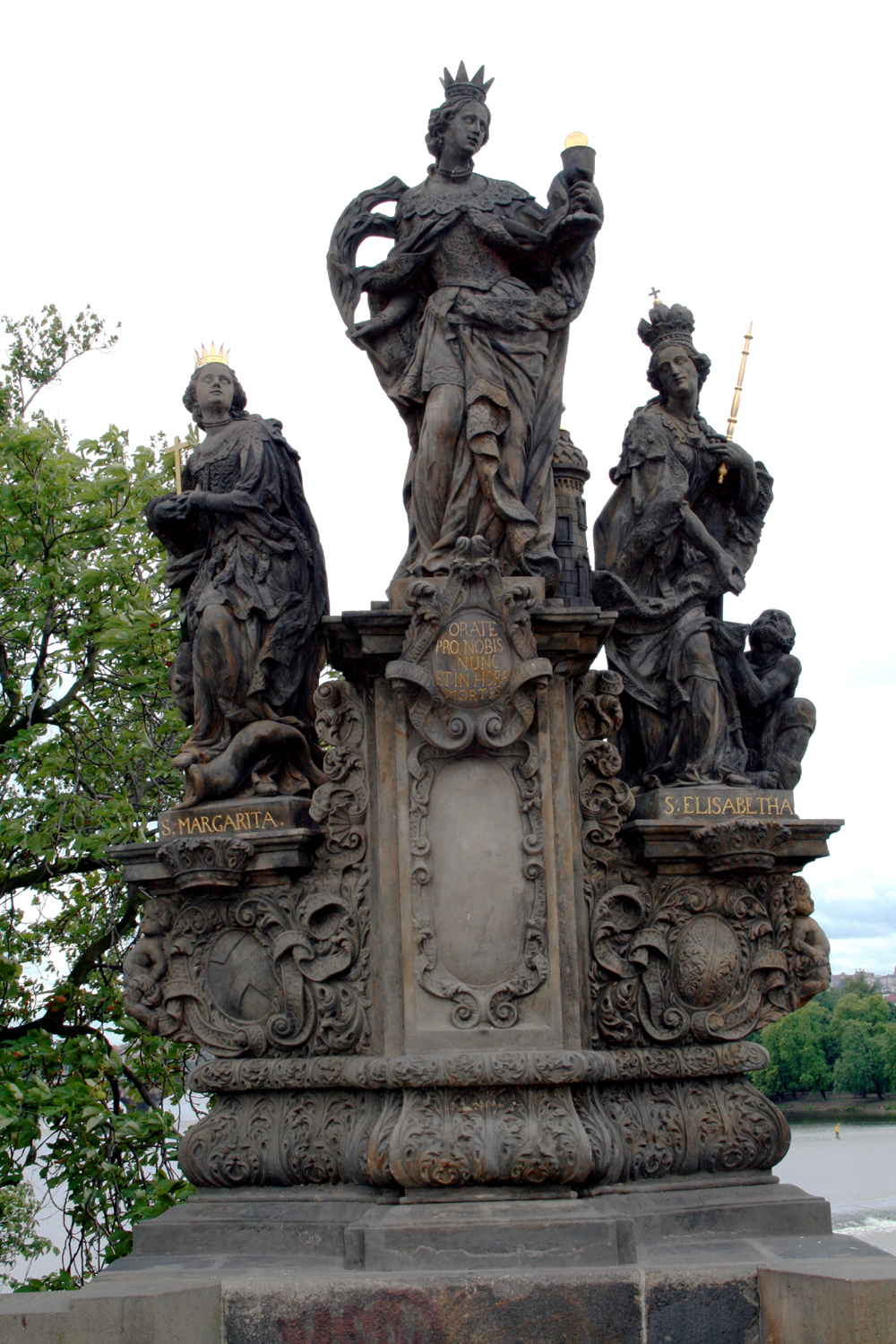
Statues of Saints Barbara, Margaret and Elizabeth, Charles Bridge
Praga
-
Statue of Saint Joseph, Charles Bridge
Praga
-
Statues of Madonna and Saint Bernard, Charles Bridge
Praga
Earn badges for the places you visit
Download NextOnTrip, discover new places and check off your trails.