About this place
Caestert plateau is a limestone headland rising above the Meuse and Jeker valleys, straddling the border between Riemst in Belgium and Maastricht in the Netherlands. It is a place where landscape and history intertwine unusually densely for such a small area — steep chalk slopes covered in grassland and woodland on one side, traces of settlement stretching back two thousand years on the other.
Where exactly is the Caestert plateau?
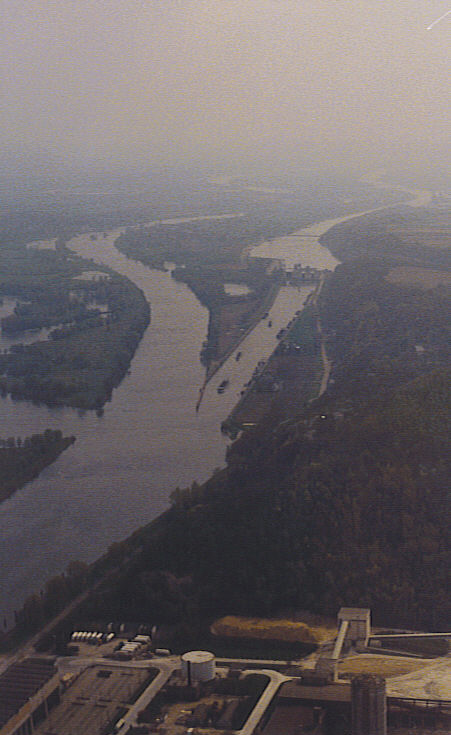
The plateau lies on the western bank of the Meuse, forming a natural southward continuation of the Sint-Pietersberg ridge, reaching as far as the Belgian town of Visé (Wezet). Over thousands of years, the Meuse and its tributary the Jeker cut deep into the limestone bedrock, carving valleys up to sixty metres deep on either side. The result is a steep, elevated headland that for centuries served as a natural defensive and observation point above the river crossings.
What does the plateau's history reveal?
On the Belgian side of the plateau, archaeologists have uncovered the remains of an oppidum — a fortified settlement dating from the Iron Age and early Roman period, roughly 250–20 BCE. Some researchers connect this site to Atuatuca, the fortified camp where Eburonian forces are said to have destroyed Caesar's Fourteenth Legion, though the exact location of Atuatuca remains disputed among historians.
The medieval chapter of the site begins in 1126, when the Prince-Bishop of Liège granted land on the plateau to a priest named Bovo, who built a chapel and a small monastery there. These were transferred in 1130 to the Abbey of Neufmoustier. In 1356, Caestert Castle was constructed, and in 1424 it was converted into a retreat for monks. Between 2007 and 2011, renewed archaeological research produced findings considered scientifically significant enough that the entire site was subsequently granted protected status as an archaeological area.
What kind of nature surrounds these historical traces?
The Caestert plateau forms a mosaic of light-permeable woodland and open grassland interspersed with scrub and hedgerows. Within the protected area, seven habitat types recognised under European conservation law can be found, including dry calcareous grasslands, ash-oak woodland, and beech forest on limestone substrate. This diversity of habitats makes the area one of the most ecologically valuable stretches of the wider Sint-Pietersberg region.
Beneath the woods and grasslands lie former marl quarries — networks of underground galleries and chambers that today provide shelter for around ten bat species, several of which are likewise protected under European law. These subterranean spaces, created by centuries of quarrying building stone, became an unexpected refuge for wildlife once extraction ceased.
Is it worth visiting?
The Caestert plateau brings together two qualities rarely found in combination: a nature landscape of genuine European ecological value, and layers of history spanning the Iron Age, the Roman period, and the Middle Ages. The terrain suits quiet walks through grassland and woodland, with views over the Meuse and Jeker valleys, and for anyone interested in the region's archaeology it ranks among the more significant sites of the Belgian-Dutch border area.
Frequently asked questions
Is the Caestert plateau in Belgium or the Netherlands? The main protected area lies on the Belgian side, in the municipality of Riemst, but the plateau borders directly on Dutch Maastricht and forms part of the wider Sint-Pietersberg complex straddling both sides of the border.
What was the Caestert oppidum? It was a fortified settlement from the Iron Age and early Roman period (roughly 250–20 BCE), whose remains were discovered on the plateau. Some historians link it to Atuatuca, known from accounts of the Gallic Wars, though this identification is not definitively established.
Why are there tunnels beneath the plateau? They are former marl quarries, worked here for centuries as a source of building stone. Once quarrying stopped, the galleries became a winter refuge for numerous bat species.
Nearby places

Earn badges for the places you visit
Download NextOnTrip, discover new places and check off your trails.