About this place
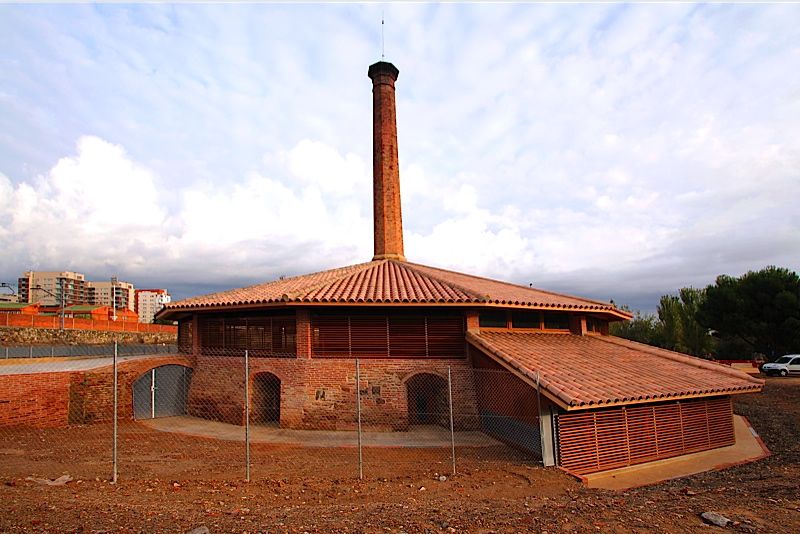
Bòbila del Sugranyes is a former brick and tile kiln in Reus, Catalonia, and one of the best-preserved pieces of industrial heritage in the Baix Camp region.
What is this place?
The Bòbila del Sugranyes is a historic kiln built in 1848 by Josep Sugranyes for firing bricks, roof tiles, and other ceramic building materials. It operated almost continuously until the 1960s, with production interrupted only during the Spanish Civil War. For well over a century it supplied bricks and tiles used across the Baix Camp area, making it a direct witness to the industrialization of Reus in the 19th and 20th centuries. Today the kiln is legally protected as an asset of local cultural interest and is listed both in Catalonia's Inventory of Architectural Heritage and on the Map of Catalan Industrial Heritage.
What does the kiln look like?
The structure has a circular ground plan roughly 23 metres in diameter, built from adobe and fired brick. Its most striking feature is the central chimney, about 19 metres tall, square at the base and octagonal higher up, rising above a partly sunken firing chamber where the ceramics were actually baked. Circular kilns of this kind were once common across Catalonia's brick-making industry, but very few examples of this scale and design have survived to the present day.
Why is it worth a visit?
In the 1990s, the Association of the Museum of Science and Technology and Industrial Archaeology of Catalonia included the Sugranyes kiln on a list of one hundred outstanding elements of the country's industrial heritage, noting it as one of the very few kilns of this type still standing in Catalonia. For visitors to Reus, it offers a rare close-up look at nearly two centuries of ceramic-building-material production, without needing to visit a large industrial museum.
How do you get there?
The Bòbila del Sugranyes stands in the city of Reus, in the Baix Camp comarca, Tarragona province. The kiln is now municipally owned and is opened to the public through guided tours organized by local cultural institutions, including the Museu de Reus. Because access is limited to these organized visits, it is worth checking the current tour schedule with the city's cultural venues before arriving.
When should you visit?
Since the interior of the kiln can only be seen on guided tours, planning ahead around Reus's cultural events calendar is the most reliable approach. The exterior of the kiln, including its distinctive chimney, can be viewed year-round from the surrounding area. Spring and autumn are the most comfortable seasons for exploring Reus generally, avoiding the summer heat and larger crowds.
Frequently Asked Questions
What is the Bòbila del Sugranyes? It is a former kiln for firing bricks, roof tiles, and ceramic building materials, built in 1848 by Josep Sugranyes and operated continuously until the 1960s.
Is the kiln a protected heritage site? Yes — it is registered as an asset of local cultural interest and appears in Catalonia's Inventory of Architectural Heritage and its Map of Industrial Heritage.
How large is the kiln? It measures about 23 metres in diameter, with a central chimney reaching roughly 19 metres in height.
Can visitors go inside? Yes, the site is owned by the city of Reus and can be visited through guided tours run by local cultural institutions.
Nearby places

Earn badges for the places you visit
Download NextOnTrip, discover new places and check off your trails.