About this place
The former Abbey of Moutons (l'ancienne abbaye de Moutons) is a historic monastic complex in Avranches, in the Manche department of Normandy. Its religious life ended long ago, but the surviving cloister and wings still tell a story that stretches back to the seventeenth century.
Who founded the abbey?
A community of Benedictine nuns was established here in the early 1630s at the initiative of the Bishop of Avranches, François de Péricard. The convent was built on the grounds of a farm known as Le Palet, on what was then the edge of town. Its first superior, Catherine de Gaston, had previously been a nun at the convent of the Holy Trinity in Poitiers. She led the new community for a decade before disputes with her sisters pushed her to return to Poitiers. She was succeeded by Marie de Froulay de Tessé, related to a Marshal of France, who governed the abbey until her death in 1685.
Where does the name "Moutons" come from?
The name attached to the abbey today actually comes from an older, separate community. Toward the end of the seventeenth century, at the urging of Bishop Pierre-Daniel Huet, nuns from a women's priory in Moutons - founded around 1120 near Saint-Clément - joined the Avranches convent. The two communities merged in 1692, and from that point the abbey became known as Sainte-Anne de Moutons, a name that has stuck ever since, even though the original priory has long since ceased to exist as a separate institution.
How did the building change over time?
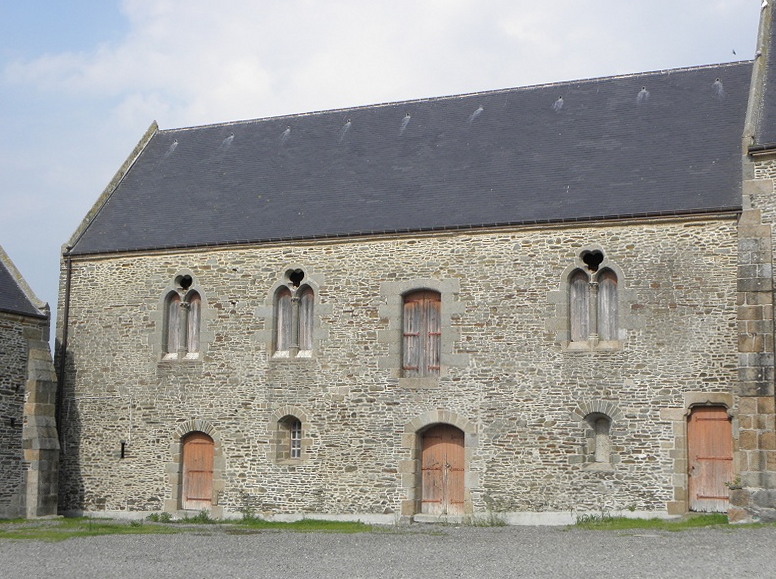
As the community grew, so did its need for space. In the early eighteenth century, under Abbess Marie de Cervon, a north wing containing the nuns' dormitory was added. Together with the cloister, this wing is the part of the complex that has survived in the best condition. The Second World War was far less kind to the abbey: Allied bombing on 7 June 1944 destroyed the chapel and the abbess's residence. Later, the construction of a coastal boulevard - now named after Léon Jozeau-Marigné - further reduced the size of the old convent courtyard.
What is the building used for now?
Once monastic life ended, the building found a new role as a cultural venue. From the 1970s it housed the Avranches municipal theatre, and it later became home to a cultural centre and a music school, both of which still operate within the former convent walls. Two galleries of the cloister, along with the abbey's old well - now relocated to the botanical garden of Avranches - were listed as historic monuments on 24 October 1935, a recognition of the site's architectural and historical value.
How can you plan a visit?
The former abbey stands in central Avranches and keeps set opening hours: Mondays from 8:30 am to noon and from 1:30 to 5:30 pm, and Tuesday through Thursday from 8:30 am to noon and from 1:30 to 6 pm. The building is closed on public holidays and during French school holidays, so it is worth calling ahead to confirm hours at +33 2 33 60 39 98 before visiting.
Frequently asked questions
When was the Abbey of Moutons founded? The community was established in the early 1630s by Bishop François de Péricard, and it took its current name after merging with the older Moutons priory in 1692.
Do nuns still live there? No, the building has not served a religious purpose for a long time. It now houses a cultural centre and a music school.
What damage did it suffer during the Second World War? Allied bombing on 7 June 1944 destroyed the chapel and the former abbess's residence.
Which parts of the abbey are protected as a historic monument? Since 1935, the two galleries of the cloister and the old well - now displayed in the Avranches botanical garden - have held historic monument status.
What are the visiting hours? Monday 8:30 am-noon and 1:30-5:30 pm, Tuesday to Thursday 8:30 am-noon and 1:30-6 pm; closed on public holidays and during school holidays.
Nearby places

Earn badges for the places you visit
Download NextOnTrip, discover new places and check off your trails.