- Sacred Monuments
- Religious monuments
Abbaye Sainte-Marie de Villelongue
About this place
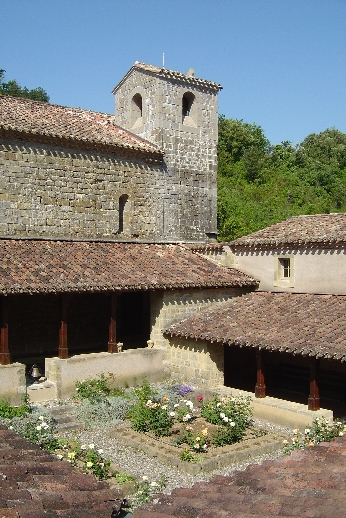
Abbaye Sainte-Marie de Villelongue is the ruined remains of a medieval Cistercian abbey tucked into a wooded valley at the foot of the Montagne Noire, in the commune of Saint-Martin-le-Vieil in the Aude department of southern France. The site pairs the story of a monastic community with sculpture unusually rich for a Cistercian house, plus a compact garden that now draws plant lovers alongside history buffs.
How did the abbey come to be founded?
The community traces back to the mid-12th century. Between 1145 and 1149, a monk named Guillaume, who had come from the abbey of Bonnefont-en-Comminges and was linked to the mother house of Morimond, settled at a spot called Compania on the slopes of the Montagne Noire to establish a small monastic house. By 1151 the priory had already been raised to the status of an abbey, with Arnaud I becoming its first abbot. Construction of the stone abbey church began in 1170, though the building visible today took shape gradually, with Gothic-style rebuilding stretching from the mid-13th century into the early 14th century.
Why does the abbey owe so much to Simon de Montfort?
The abbey's fortunes rose sharply in the early 13th century, during the crusade against the Cathars. The monks of Villelongue sided against the heretics, a stance rewarded by Simon de Montfort, the crusade's military leader. In 1208 the community was granted the castle of Saint-Martin-le-Vieil, and Simon de Montfort made the grant permanent in January 1212. These acquisitions gave the abbey land and influence that secured its standing in the region for centuries afterward.
What makes the abbey's architecture stand out?
The Cistercian rule, laid down by Saint Bernard of Clairvaux, called for austerity and plain forms, with no unnecessary ornament. Yet the cloister and church at Villelongue feature richly carved capitals and corbels in a style known as southern Languedocian Gothic, added during the 13th and early 14th centuries. This decorative flourish breaks with the order's strict rule, and it is one of the reasons Villelongue is counted among the rare Cistercian abbeys in France to display such elaborate carved decoration. The abbey complex has been listed as a historic monument since 1916, though it remains privately owned today.
What else is there to see besides the ruins?
Around the old monastic buildings lies a small, picturesque garden that has earned recognition as a notable garden. Its beds are lined with living willow hedges, and a rockery grows plants once used in the Middle Ages for medicine, dyeing, or decoration. In the section known as the blue garden, visitors find gourds, the sound of running water, and birdsong from a nearby aviary. A walk through the garden makes a natural complement to exploring the ruined church and cloister.
Frequently asked questions
Where exactly is the abbey located? In the commune of Saint-Martin-le-Vieil, in the Aude department, on the slopes of the Montagne Noire, not far from Carcassonne.
When was the abbey founded? The monastic community settled here between 1145 and 1149, and the site was raised to abbey status in 1151.
Can visitors tour the ruins and garden? Yes, the site opens seasonally, from April through November, with longer hours in July and August; it is closed on Mondays outside the summer months.
How much does a ticket cost? Self-guided adult admission costs around 5 euros, while children under 16 enter free of charge.
What sets Villelongue apart from other Cistercian buildings? Above all, its richly carved capitals and corbels, a rare feature in the architecture of an order otherwise known for austere, unadorned forms.
Nearby places

Earn badges for the places you visit
Download NextOnTrip, discover new places and check off your trails.