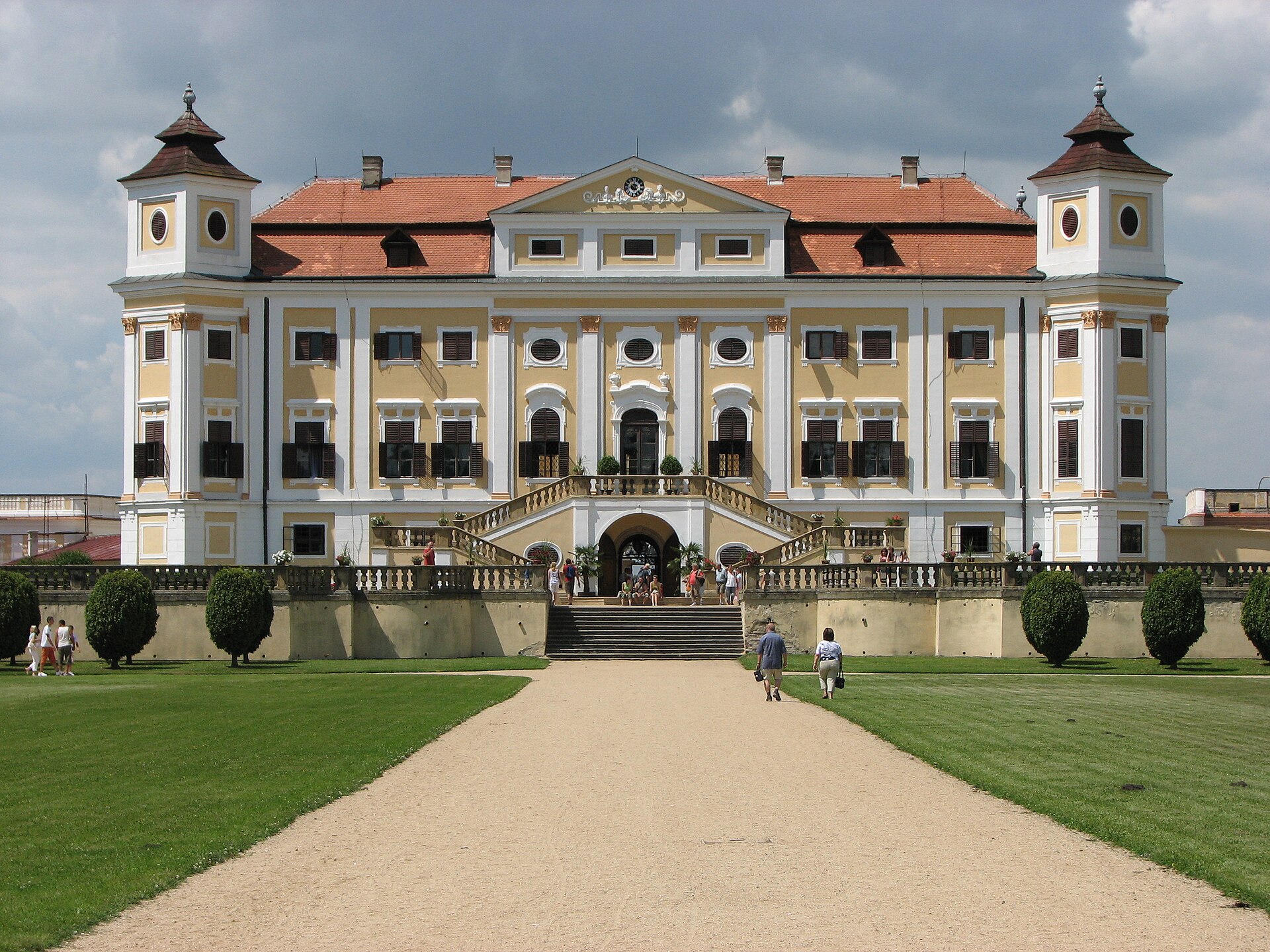
About this place
Milotice Chateau is a Baroque residence in southeastern Moravia that locals often call the region's pearl — and not just for its interiors. The sprawling gardens, crowned by a rosarium in bloom through spring and summer, are often the highlight of a visit.
How did a medieval fortress become a Renaissance manor?
The site's story begins around 1360, when the lords of Ronov built a moated stronghold here — a defensive structure typical of its era rather than a residence meant to impress. That changed only at the end of the 16th century: between 1586 and 1596 the original fortress was rebuilt as a Renaissance manor, gaining the character of a residential seat rather than a purely military outpost.
Why the Serényi family shaped the chateau you see today
After years of neglect and wartime damage, the devastated estate was bought in 1648 by Gabriel Serényi, who later became the Moravian land captain and set about restoring it immediately. The Serényi family kept Milotice until 1811, and it is to them that the chateau owes its present Baroque form. The decisive figure was Karel Antonín Serényi (1681–1746), who commissioned a thorough rebuilding of the chateau and its grounds in two phases, 1719–1725 and 1738–1743. The identity of the architect behind the project has never been settled with certainty; art historians have proposed several candidates, including Domenico Martinelli and Johann Bernhard Fischer von Erlach, without agreement on who actually oversaw the work.
Once the Serényi line ended, the estate changed hands several times: between 1811 and 1888 it belonged to the Choiseul d'Aillecourt and Hardegg families, and from 1888 to 1945 it remained in the possession of the Seilern family.
What makes the chateau gardens worth the walk?
The eastern part of the grounds is taken up by a French Baroque garden, laid out from 1716 onward, likely to a design by the Viennese garden architect Johann Anton Zinner. A two-armed staircase leads down into the garden past a rosarium with a fountain — the floral heart of the park, where rose beds mix with hydrangeas, hornbeam alleys and clipped lime trees. A separate attraction is the so-called supply garden, reconstructed in 2013 after a 19th-century model, divided into three square quarters and closed off by a small pond. In the pair of Baroque orangeries built between 1738 and 1743, once used to overwinter exotic plants, visitors today find an exhibition of Moravian Baroque sculpture.
What was life like at Milotice under the Seilerns?
The interiors open to visitors recreate the lifestyle of the chateau's last private owner, JUDr. Ladislav Seilern (1886–1976), and his family in the first half of the 20th century. The tour route was shaped in part by the recollections of his daughter, Marie Henrietta Seilern (1918–2008), giving the chateau's story an unusually personal, family-told quality rarely found at comparable residences.
Frequently asked questions
Can the chateau be visited today? Yes, it operates as a state-run chateau, with the ticket office typically open on visiting days from 8:45 am to 4:00 pm, offering both guided and self-guided tour routes.
What draws visitors besides the interiors? The French Baroque garden and its rosarium — during the rose-blooming season it is one of the most photographed corners of southern Moravia.
Who built the Baroque chateau seen today? The rebuilding was commissioned by Karel Antonín Serényi in the early 18th century, though the identity of the lead architect remains debated among historians.
Are there other exhibitions on site? Yes, the former orangeries now house a permanent exhibition of Moravian Baroque sculpture.
Nearby places

Earn badges for the places you visit
Download NextOnTrip, discover new places and check off your trails.