About this place
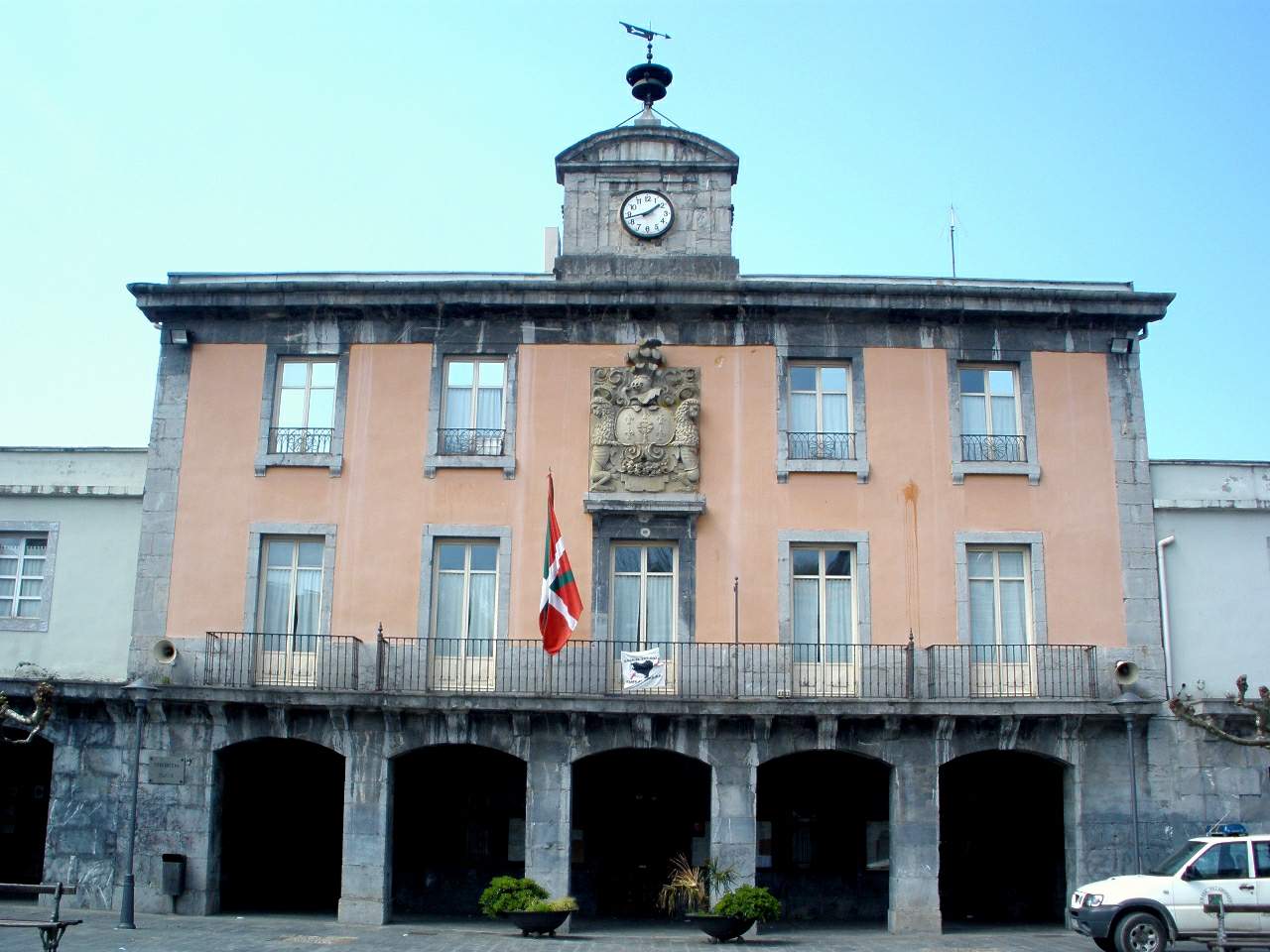
Villabona town hall stands at the heart of Villabona, a small town in the Oria river valley, in the province of Gipuzkoa, in the Basque Country. It has served as the seat of the local government for more than a century and remains one of the clearest landmarks in the town centre.
What does the town hall look like?
The current building dates from the 19th century and was designed in a neoclassical style — a symmetrical facade, restrained ornamentation, and a large coat of arms mounted above the entrance mark it out immediately as an official municipal building. It follows a pattern common to town halls built across Basque towns in that period: solid stone construction, meant to house local government for generations.
Why was the town hall rebuilt in the 19th century?
The building that preceded the current one burned down in 1812, during the Peninsular War, while it was being used as a billet for French troops stationed in the town. Occupation and troop movements during the Napoleonic campaigns left a mark on many municipal buildings across the Basque Country, and Villabona's town hall was no exception. Once the previous structure was lost, local authorities commissioned a replacement, and the building erected afterwards is the one still in use today.
What else is worth seeing around the town hall?
The town hall makes a natural starting point for exploring Villabona on foot. Nearby stands the parish church of Sagrado Corazón, built in the early 20th century and reflecting a very different architectural period from the town hall itself. The surrounding countryside is dotted with traditional Basque manor houses, including Juanzurienea and Legar Barrena. In Amasa, the rural district that together with Villabona forms the municipality of Amasa-Villabona, visitors can also find the church of San Martín de Tours, a stone building from the 16th and 17th centuries with a Latin-cross floor plan, ribbed vaulting and a bell tower.
How do you get to Villabona?
Villabona sits in the Oria valley at a point where routes linking Gipuzkoa with Álava and Navarre converge. The town is served by both a railway line and the N-1 road, making it an easy stop whether travelling from San Sebastián or moving inland through the Basque Country. Villabona itself has a strong industrial character alongside active local commerce and hospitality, so visitors passing through will find places to eat or take a short break.
Frequently Asked Questions
What is Villabona town hall? It is the seat of local government for the municipality of Villabona, in the province of Gipuzkoa — a 19th-century neoclassical building with the town's coat of arms displayed on its facade.
Why doesn't the original town hall building survive? The earlier building burned down in 1812, when it was being used to billet French troops during the Peninsular War. The structure standing today was built afterwards to replace it.
Can visitors go inside the town hall? The building is an active seat of local administration, so visitor access is generally limited to viewing the exterior from the street.
What else is nearby worth visiting? Within Villabona, the parish church of Sagrado Corazón and several nearby manor houses are worth a look, while the neighbouring district of Amasa has the 16th-17th century church of San Martín de Tours.
Nearby places

Earn badges for the places you visit
Download NextOnTrip, discover new places and check off your trails.