About this place
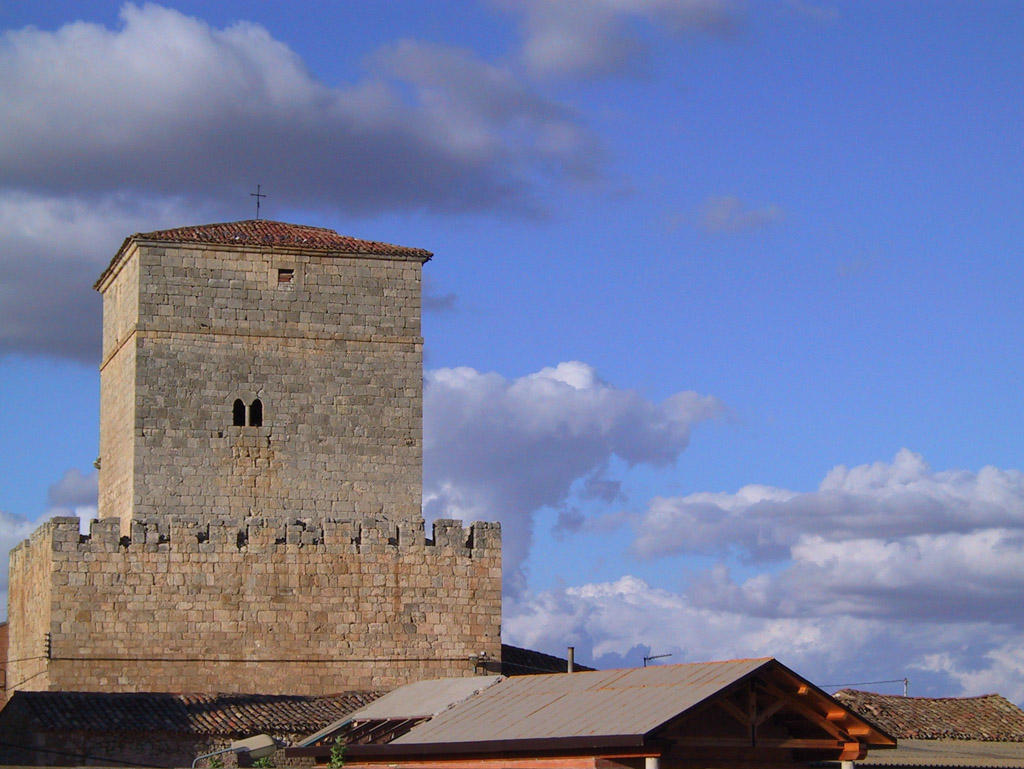
Tower of Torrecitores rises above the tiny hamlet of Torrecitores del Enebral, part of the municipality of Avellanosa de Muñó in the province of Burgos, in the historic Arlanza region of Castile and León. It's one of those forgotten corners of rural Spain where a medieval defensive tower still dominates a cluster of houses now home to only a few dozen people.
What will you see on site?
The main draw is a massive square stone tower built from rough-hewn rubble masonry (sillarejo), with corners reinforced by carefully dressed ashlar blocks. The structure rises to roughly 30 metres, making it one of the more imposing defensive towers in this part of Burgos province. Inside, the original layout was divided into three levels separated by pointed barrel vaults, further subdivided by timber flooring — a configuration typical of Castilian noble towers from the turn of the 14th and 15th centuries.
Walking around the building, look for traces of later alterations. In the second half of the 15th century, a wall was added that blocked several of the original arrow slits, likely a response to the changing defensive needs of the family controlling the estate. The deepest transformation came in the 16th century, when the top floor was raised, costing the tower its original crenellations, replaced by a four-sloped roof — a solution more typical of a residence than a fortress, and a sign of how the building evolved from a military stronghold into a more representational seat.
What's the history behind it?
The village and its surrounding lands once belonged to the Torquemada family, one of the most powerful lineages in the Burgos of their time. In the 15th century, the Catholic Monarchs granted the estate to their trusted servant Juan de Ortega, who later became the first bishop of Almería — an episode linking this small settlement to major figures of Spanish history. The Torquemada line, later joined with the Cerezo family, held lordship over the village until 1709, when the title's heiress, María Bibiana Cerezo, married Fernando de la Cerda Dentí, Marquis of La Rosa.
The place name itself has an interesting origin: "Torrecitores" combines the word for "tower" with an archaic Castilian form of "hawks" (halcones), while the later addition "enebral" points to a nearby grove of juniper trees — a name that captures the landscape well, a defensive tower among the dry, juniper-covered hills of northern Castile.
The settlement has long been sparsely populated. In the mid-19th century it counted only a few dozen residents, and in 1856 it was formally absorbed into the municipality of Avellanosa de Muñó. Population briefly climbed above a hundred in the mid-20th century, but today only a few dozen people live here — one of many Castilian villages shaped by rural depopulation.
How to get there and when to visit?
Torrecitores del Enebral sits well off the main tourist routes, roughly 50 kilometres from Burgos, the provincial capital. A visit really requires your own car, since public transport links to such small villages are minimal. It's best planned as part of a wider tour of the Arlanza region, known for its Romanesque architecture and the open landscapes of the Castilian plateau.
Spring and early autumn are the most comfortable seasons, when temperatures on the plateau are milder than in the scorching summer or the cold winter months. Bring a camera — the tower photographs particularly well in the morning and late afternoon, when low sunlight brings out the texture of the stone walls.
Frequently asked questions
Can you go inside the tower? The building sits in a very small, quiet village, so it's worth checking current access information with the local Avellanosa de Muñó municipal authorities before visiting — regular opening hours for visitors are not widely published.
How much time should I set aside? Seeing the tower and walking around the hamlet usually takes 30–45 minutes, but factor in extra travel time given the distance from Burgos and the rural access roads.
Are there other attractions nearby worth combining with this stop? The Arlanza region is known for numerous Romanesque monuments and historic villages, so it's a good idea to pair a visit to Torrecitores with a loop around the other settlements in the Avellanosa de Muñó municipality.
Do I need a car to get there? Yes — given the tiny population and the peripheral location, driving is by far the most practical, and effectively the only sensible, way to reach the site.
Nearby places

Earn badges for the places you visit
Download NextOnTrip, discover new places and check off your trails.