About this place
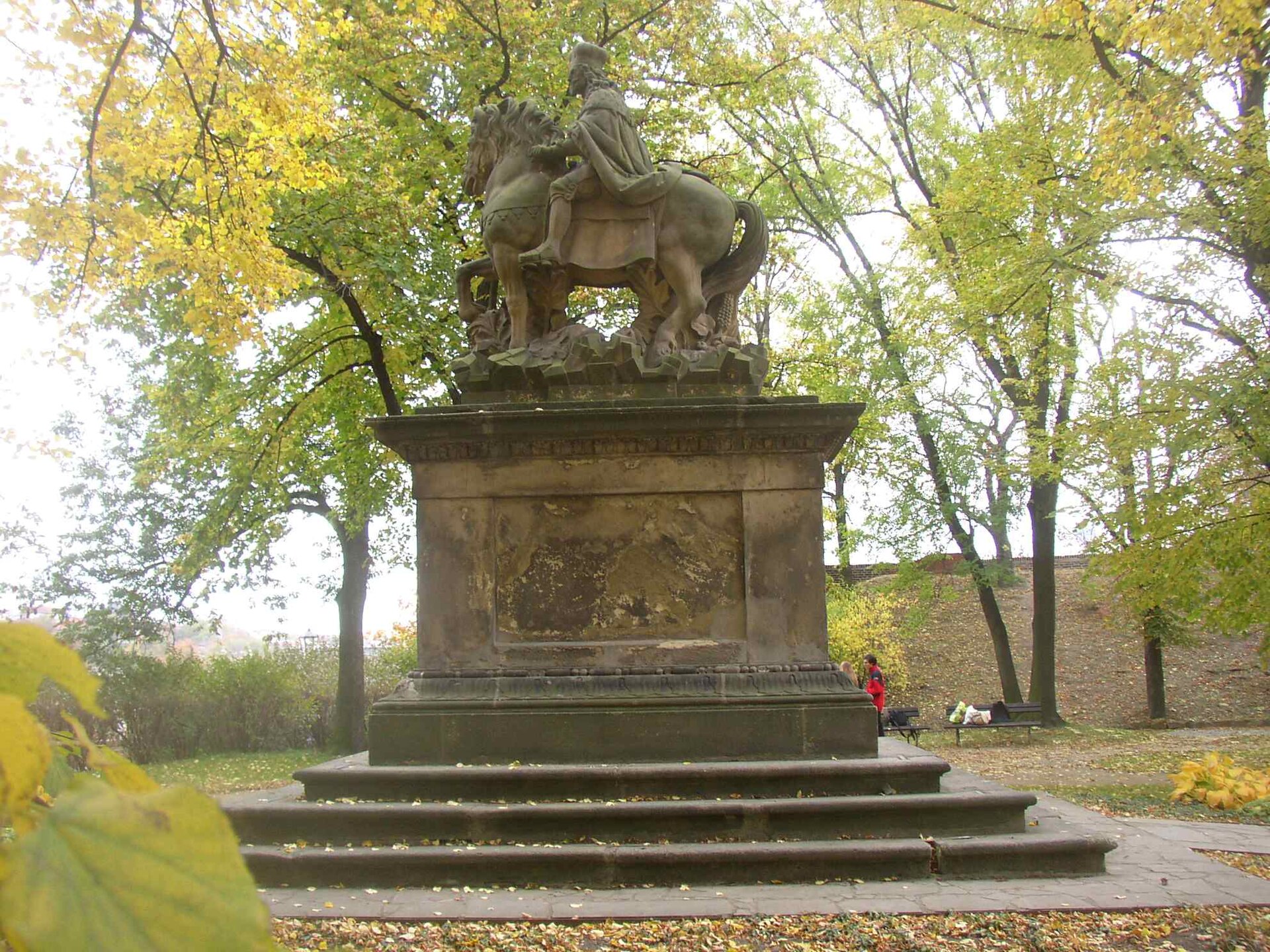
The Statue of Saint Wenceslas at Vyšehrad is a Baroque equestrian monument to the Duke of Bohemia that spent nearly two centuries at the heart of Prague before being moved to a quiet hilltop park. It is the older, lesser-known relative of the famous statue in front of the National Museum — and the very monument that gave Wenceslas Square its name.
Who created the statue?
The statue was carved between 1678 and 1680 by Jan Jiří (Johann-Georg) Bendl, one of the most respected sculptors working in Baroque Prague. He was paid 200 guilders plus roughly ten korec (about 1,400 pounds) of rye flour, a typical fee for municipal commissions of the era. Made of sandstone, the statue depicts Duke Wenceslas on horseback, dressed as a ruler, honoring him as patron and defender of the Bohemian lands.
Where did the statue originally stand?
The monument was not always on Vyšehrad. It was first installed as part of a fountain in the middle of the Horse Market (Koňský trh), a trading square in Prague's New Town where horses were bought and sold. The statue itself is the reason the square eventually took on a new name: in 1848, during the Czech National Revival, the activist Karel Havlíček Borovský campaigned successfully to rename the square in honor of Bohemia's patron saint, giving rise to today's Wenceslas Square (Václavské náměstí).
Why was it moved to Vyšehrad?
Through the 19th century, Wenceslas Square was transformed into one of Prague's grand commercial boulevards, and the older Baroque statue no longer suited the square's new, monumental character. In 1879 the statue was relocated to Vyšehrad and placed in Štulcovy sady (Štulc's Gardens), a park established by Mikuláš Karlach, then provost of the Vyšehrad chapter. Decades later, in 1912–1913, an entirely new and now far more famous monument to Saint Wenceslas — created by sculptor Josef Václav Myslbek — was unveiled at the square's original site, and it is this later statue, standing before the National Museum, that most visitors picture today when they think of Wenceslas Square.
What can visitors see today?
Exposed to the elements for well over a century, Bendl's original Baroque sculpture suffered considerable weathering. For conservation reasons, the original was eventually moved indoors to the Lapidarium of the National Museum, where it is protected from further damage. In its place, Štulcovy sady on Vyšehrad now displays a faithful sandstone copy, made in 1959 by Czech sculptors continuing the region's stone-carving tradition. The copy preserves the original composition and detail, letting visitors experience the Baroque monument much as it once appeared, set among the greenery of the park.
Why visit this spot?
Štulcovy sady lies within the historic Vyšehrad fortress complex, close to the Basilica of St Peter and St Paul and the Vyšehrad Cemetery, the resting place of many prominent figures in Czech culture. A visit to the statue pairs naturally with exploring the rest of the hill — a calmer, less crowded alternative to the busy modern Wenceslas Square in the city center. It's a rewarding stop for anyone wanting to see the lesser-known but historically original version of one of Prague's most recognizable symbols.
Frequently asked questions
How does this statue differ from the famous one at the National Museum? This is the older Baroque monument from 1678–1680 by Jan Jiří Bendl, originally standing on Wenceslas Square. The well-known statue in front of the National Museum is a separate, later work by Josef Václav Myslbek, unveiled in 1912–1913 after the old statue had already been moved to Vyšehrad.
Why is it called Wenceslas Square? The name comes directly from this Baroque statue, which stood on the former Horse Market until 1879; the square was renamed in honor of Saint Wenceslas in 1848.
Is the statue at Vyšehrad an original or a copy? The figure in Štulcovy sady is a 1959 sandstone copy. Bendl's original, heavily weathered over time, is now preserved in the Lapidarium of the National Museum in Prague.
Where exactly is the statue located? It stands in Štulcovy sady (Štulc's Gardens), within the Vyšehrad fortress grounds, not far from the Basilica of St Peter and St Paul.
Nearby places

Earn badges for the places you visit
Download NextOnTrip, discover new places and check off your trails.