Save this place and discover nearby attractions with NextOnTrip
In the app you can add it to your favorites, see what else is worth visiting nearby on the map, and earn a badge for your visit.
The app is available for iPhone and Android.
About this place
St George in the East is an Anglican church in the East End of London, standing on Cannon Street Road between The Highway and Cable Street, in the Shadwell area. It is one of the churches designed by Nicholas Hawksmoor, and it is best known for its dramatic story: a baroque landmark gutted in the Blitz and then reborn with a modern interior hidden inside the old walls.
What is St George in the East?
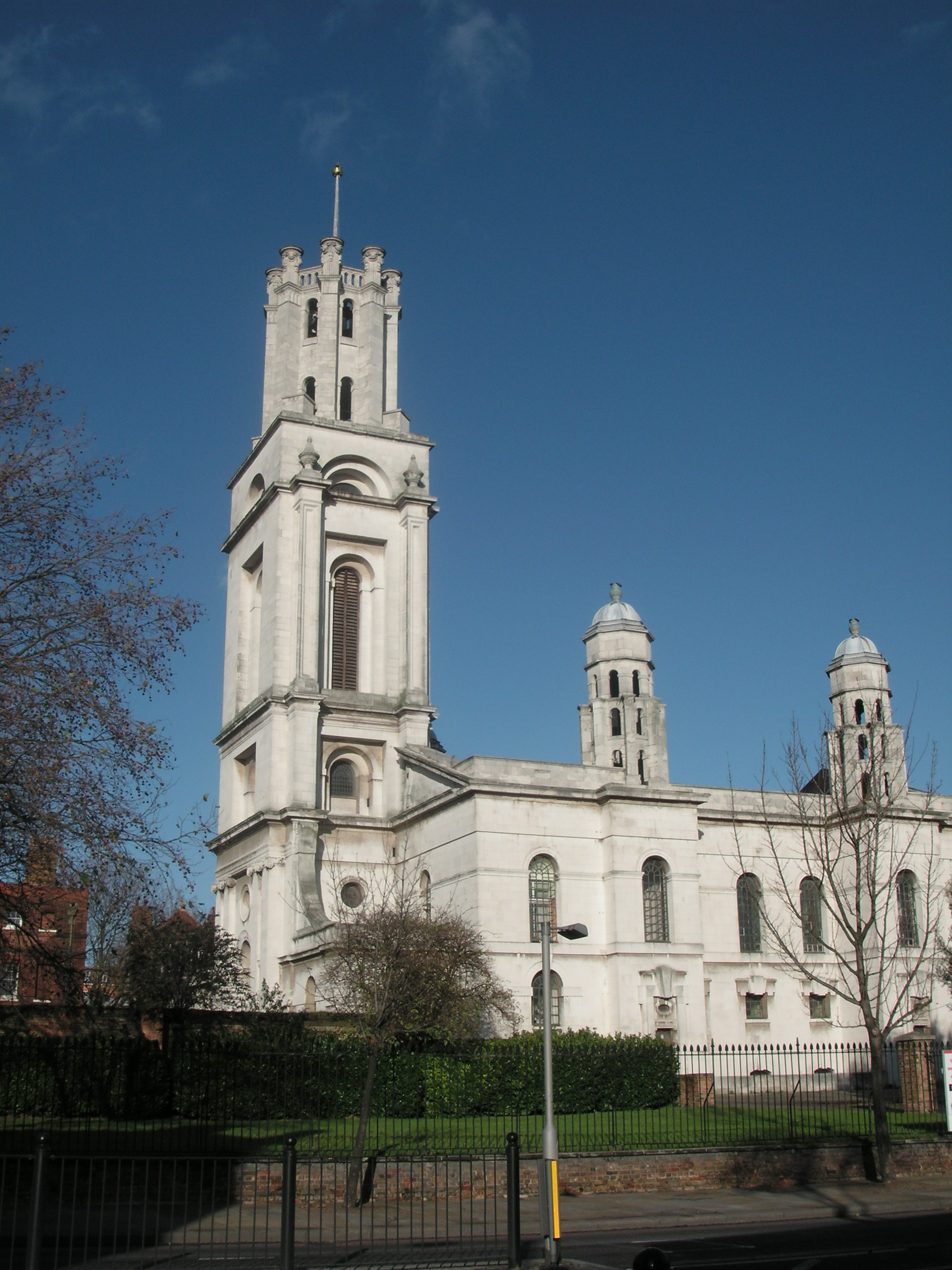
The church is dedicated to Saint George and still serves as a working Anglican church. Behind it lies St George's Gardens, which began as the church's graveyard and is now a quiet green space in a dense part of the city. Seen from the street, the building looks like a heavy stone shell, crowned with distinctive turrets.
Who built it and when?
Nicholas Hawksmoor designed the church. Work began on the foundations in 1714, the structure was roofed in 1717, and the church was dedicated on 19 July 1729. The site was cramped: on the south side, houses lining the old Ratcliff Highway (today The Highway) closed in around the building, so for a long time the southern facade was hidden from view.
Hawksmoor's original plan was a Greek cross set inside a rectangle. The exterior has two features worth looking for. The first is the "pepper-pot" turrets, which sit above the staircases leading to the galleries. The second is the tower at the west end, whose top stage is an open octagon. Together they give the church a bold, almost fortress-like silhouette that is unusual even among London's baroque churches.
What happened during the Blitz?
In May 1941 an incendiary bomb hit the church and destroyed the interior. The damage inside could not be repaired, yet the outer walls and the pepper-pot turrets remained standing. The bombing also changed the surroundings: once the buildings along The Highway were gone, the south facade became visible and the gardens opened up toward the street.
What does the church look like today?
The rebuilding took place in the 1960s. Architect Arthur Bailey designed a new, modern interior and built it inside Hawksmoor's surviving walls. It was dedicated in April 1964. At the same time the church received a ring of eight bells cast at the Whitechapel Bell Foundry. The result is a contrast that defines the place: an eighteenth-century shell wrapped around a smaller twentieth-century core.
The former rectory, built in 1726-1729 at the north-western corner of the church, also survives. It is the only part of Hawksmoor's wider plan for the surrounding precinct that was actually realised.
Visiting tips
- The church is a short walk from Cable Street and The Highway, so it fits easily into a walk through Shadwell and Wapping.
- Walk around the exterior to see the tower, the turrets and the south facade that opened up after the war.
- Combine the visit with St George's Gardens, the former graveyard behind the church.
- Check service and opening times before going, as access to the interior depends on the church's schedule.
Frequently asked questions
Who designed St George in the East? Nicholas Hawksmoor.
When was it completed? The church was dedicated in 1729, after work that began in 1714.
Is the interior original? No. The original interior was destroyed in 1941; the present one dates from 1964 and was designed by Arthur Bailey.
Where is it? On Cannon Street Road, between The Highway and Cable Street, in London's East End.
What are the pepper-pot turrets? Small domed turrets above the gallery staircases, one of the church's most recognisable features, and they survived the wartime fire.
Nearby places

Earn badges for the places you visit
Download NextOnTrip, discover new places and check off your trails.