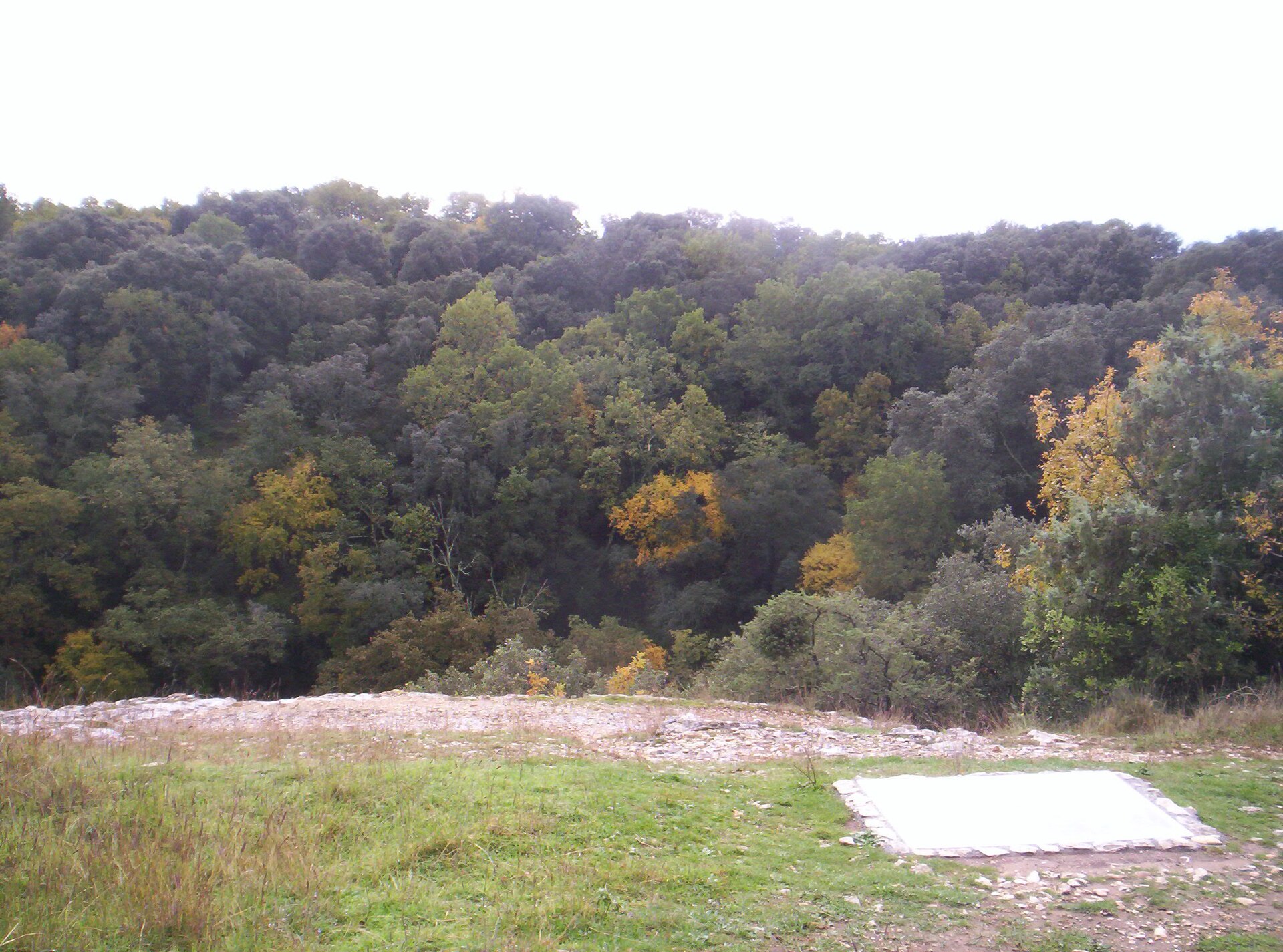
About this place
Spélonque de Dions is a vast karst sinkhole on the right bank of the Gardon river, in the village of Dions in the Gard department, roughly 25 km north of Nîmes. The name traces back to the Latin word "spelunca" (cave), which became "spélonque" in Old French — a fitting label for one of the largest collapse features of its kind in France.
What exactly is it?
Despite the name, this isn't a stalactite cave you walk through. It's a funnel-shaped karst chasm measuring roughly 140–160 by 115–120 metres across, plunging some 70–72 metres down. At the bottom sits a further shaft ("aven") about 40 metres deep, opening into a large final chamber thick with vegetation, from which side passages and partly flooded galleries connect to the underground course of the Gardon. Geologists believe the sinkhole formed when an old subterranean branch of the river — carved through soft, erosion-prone limestone — collapsed in on itself.
Who first explored it?
The site was surveyed in detail back in 1895 by cavers Félix Mazauric (1868–1919) and Gustave Cabanes, whose early mapping of the chambers and galleries still serves as a reference point for speleologists studying the Gardon valley's karst system today.
Why can't you go inside right now?
On 27 December 2022, the sinkhole was hit by a dramatic ground collapse — described by specialists as the largest natural karst collapse recorded in France in the past 140 years, since cavers began systematically monitoring underground sites. The event carved out a fresh crater several thousand cubic metres in volume and over a dozen metres deep. Because the walls are now unstable and rockfall is a genuine hazard, access to the gouffre has been completely closed to visitors, and experts estimate it could take years before it reopens. The collapse also stirred serious scientific interest: researchers are now studying the exposed sediment layers, which may date back more than ten thousand years and could reshape what's known about this corner of the Gard.
How do you get there?
From Nîmes, head to the village of Dions, then follow the route uphill through streets whose names give the game away — rue du Gardon and rue des Espélucas — until you reach the overlook above the gorge. It's rated an easy walk and takes about half a day round trip; sturdy shoes are worth packing, since the ground is rocky and uneven. The route is marked on the Vézénobres 2841E map at 1:25,000 scale.
What will you actually see?
Since entry into the sinkhole itself is banned, the draw is the view from above: an enormous green bowl cut into the rock, ringed by sheer limestone walls, with dense vegetation carpeting the floor far below. The sheer scale and wildness of the scene make an impression on their own, especially given how easy the overlook is to reach. The wider Gardon valley has other trails and viewpoints worth combining with the visit.
When's the best time to visit?
Spring and autumn bring mild temperatures and the greenest vegetation at the bottom of the sinkhole. Summer can get intensely hot and dry here, so an early-morning start pays off.
Frequently asked questions
Can you climb down into Spélonque de Dions? No. Since a major ground collapse in December 2022, access to the interior has been completely prohibited due to unstable walls and the risk of falling rocks.
How long does the hike to the site take? Walking from the village of Dions to the overlook above the sinkhole is an easy route, taking about half a day round trip.
How is Spélonque different from a typical cave? It isn't a cave in the usual sense but a giant karst chasm (gouffre) formed by the collapse of an underground riverbed — open to the sky, with vertical walls dropping tens of metres.
Who first studied the site scientifically? Cavers Félix Mazauric and Gustave Cabanes carried out a detailed survey in 1895, and their work remains a reference point for researchers studying the region.
Nearby places

Earn badges for the places you visit
Download NextOnTrip, discover new places and check off your trails.