About this place
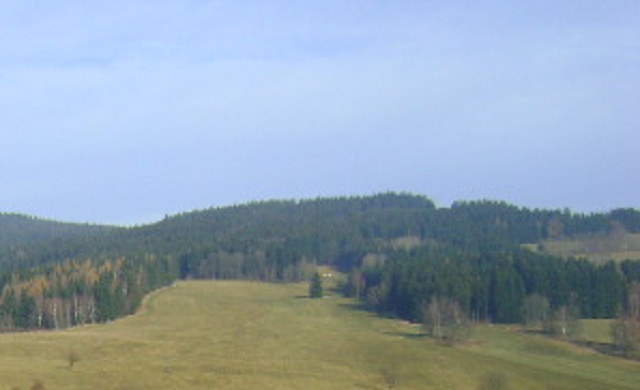
Souš is a 1,224-metre summit in the eastern part of the Śnieżnik Massif, sitting on a ridge that runs south from Podbělka right along the Czech-Polish border. The mountain's German name, Steinberg — literally "Stone Mountain" — hints at its long-standing reputation as rugged, rocky terrain. Today its slopes are split roughly in half between mature spruce forest and old clearings left by decades-old air-pollution damage, where young forest is now slowly reclaiming the ground. Higher up, hikers can also find small patches of peat bog, a feature typical of the upper reaches of this part of the Śnieżnik Massif.
How do you get to the top of Souš?
The most straightforward approach follows the blue-marked ridge trail starting from the Babuše saddle, at roughly 1,230 metres, between Podbělka and a nearby summit that — somewhat confusingly — also carries the name Babuše (1,245 m). It's at this junction, where a green trail branches off toward the Pod Babuší crossroads, that most hikers begin their final push up Souš. The hunting lodge at Babuše itself is not open to the public, but the spot still makes a convenient rest stop along the way.
Hikers coming from the south instead often use the yellow trail that climbs from Stříbrnice up to the Návrší mountain hut, perched at just under 900 metres on the eastern flank of the Mokrý Ridge — the southern arm of the wider massif. From there the path continues northwest to the Nad Adeliným pramenem junction, from which walkers can pick up the route toward the Podbělka ridge and on to Souš.
What's the view like, and why bother visiting?
Souš isn't a classic viewpoint summit — dense forest covers most of its slopes, and the top itself lacks the open exposure found on nearby Králický Sněžník. That peak, the massif's highest point at 1,424 metres, is where most view-seekers head instead: since 2022 it has carried a new observation tower, built on the site of an earlier one that was dismantled back in the 1970s. Souš works better as a quiet waypoint on a longer ridge walk, appreciated by hikers who value forest stillness and a less-trodden stretch of trail over a crowded lookout.
The broader area is classic Czech-Polish borderland scenery: rolling ridgelines, streams draining toward the Morava and Nysa Kłodzka rivers, and a network of old border paths now shared by hikers and cyclists from both sides.
Frequently asked questions
How high is Souš? The summit reaches 1,224 metres and lies in the eastern part of the Śnieżnik Massif.
What's the best starting point for climbing Souš? Most hikers use the blue trail from the Babuše saddle/lodge; an alternative is to start from the Návrší mountain hut and approach via the yellow trail from Stříbrnice.
Is there a viewpoint at the summit? No — the top is mostly forested. The best views in the area are from nearby Králický Sněžník, which has had a new observation tower since 2022.
Is there anywhere to rest along the trail? Yes, the area around the Babuše lodge at the saddle is a convenient stopping point, though the building itself isn't open to the public.
What's notable about the local nature? The slopes of Souš combine older spruce forest with land still recovering from historical air-pollution damage, and its higher sections contain small peat bogs typical of this part of the Sudetes.
Nearby places

Earn badges for the places you visit
Download NextOnTrip, discover new places and check off your trails.