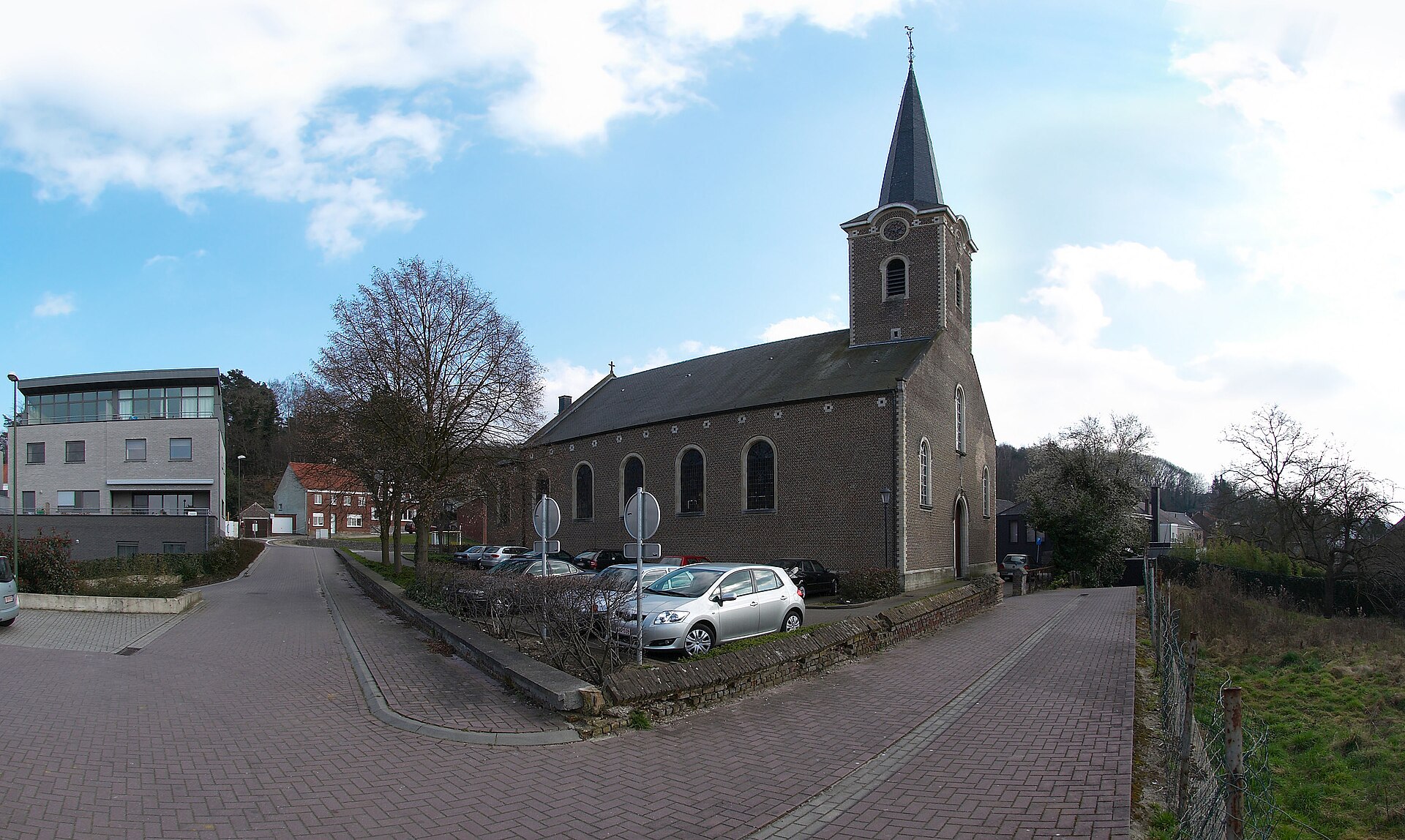
About this place
Sint-Joriskerk is the parish church of Sint-Joris-Weert, a village that belongs to the municipality of Oud-Heverlee in the Belgian province of Flemish Brabant. Dedicated to Saint George, the church shares its name with the village itself, which took its name from the same patron saint.
What does the building look like?
The present church is a neoclassical structure dating from the early 19th century. Its layout consists of a tower built into the west end of the church without any division into segments, a nave of five bays, and a three-sided choir made up of a single bay. Round-arched windows run along the facades, and on either side of the tower sit round-arched sound holes of the same shape. The tower is capped by a tapering spire covered in slate.
Where does the choir come from?
While the main body of the church is a product of 19th-century rebuilding, the choir is thought to rest on older, late Gothic foundations. It is considered a remnant of an earlier church that stood on the same site in the 16th century, before the neoclassical reconstruction replaced most of the older structure. This kind of layout — a newer nave attached to an older choir — is not uncommon among rural churches in Flanders, where successive generations of builders extended or rebuilt the church while preserving the most valuable parts of the earlier construction.
What can visitors see inside?
The interior holds several elements considerably older than the 19th-century building itself. The most valuable is a Gothic Calvary group from the early 16th century — a sculpted depiction of the crucifixion that survived the later rebuilding and now ranks among the oldest pieces of religious art on the site. Alongside it, the church houses liturgical furniture in the Louis XVI style, dated to the last quarter of the 18th century, meaning it predates the current neoclassical building and was carried over from the church's earlier furnishings.
What organ does the church have?
One feature that draws particular attention is the organ built in 1858 by Henri De Volder. Instruments by this builder were well regarded in the region during the 19th century for their craftsmanship and sound quality, and the example preserved in the Sint-Joriskerk remains an important part of the church's furnishings, used both during services and for occasional organ concerts.
Frequently asked questions
Who is the church dedicated to? The church is dedicated to Saint George (Dutch: Sint-Joris), venerated in Christian tradition as the saint who slew the dragon.
In what style was the church built? The building is neoclassical, a style typical of many rebuilt village churches in Belgium from the early 19th century, though its choir retains features of an older Gothic structure.
Where exactly is Sint-Joris-Weert located? The village lies within the municipality of Oud-Heverlee, in the province of Flemish Brabant, Belgium.
What is the most valuable historic item inside the church? A Gothic Calvary group from the early 16th century, older than the current church building, along with an organ built by Henri De Volder in 1858.
Nearby places

Earn badges for the places you visit
Download NextOnTrip, discover new places and check off your trails.