About this place
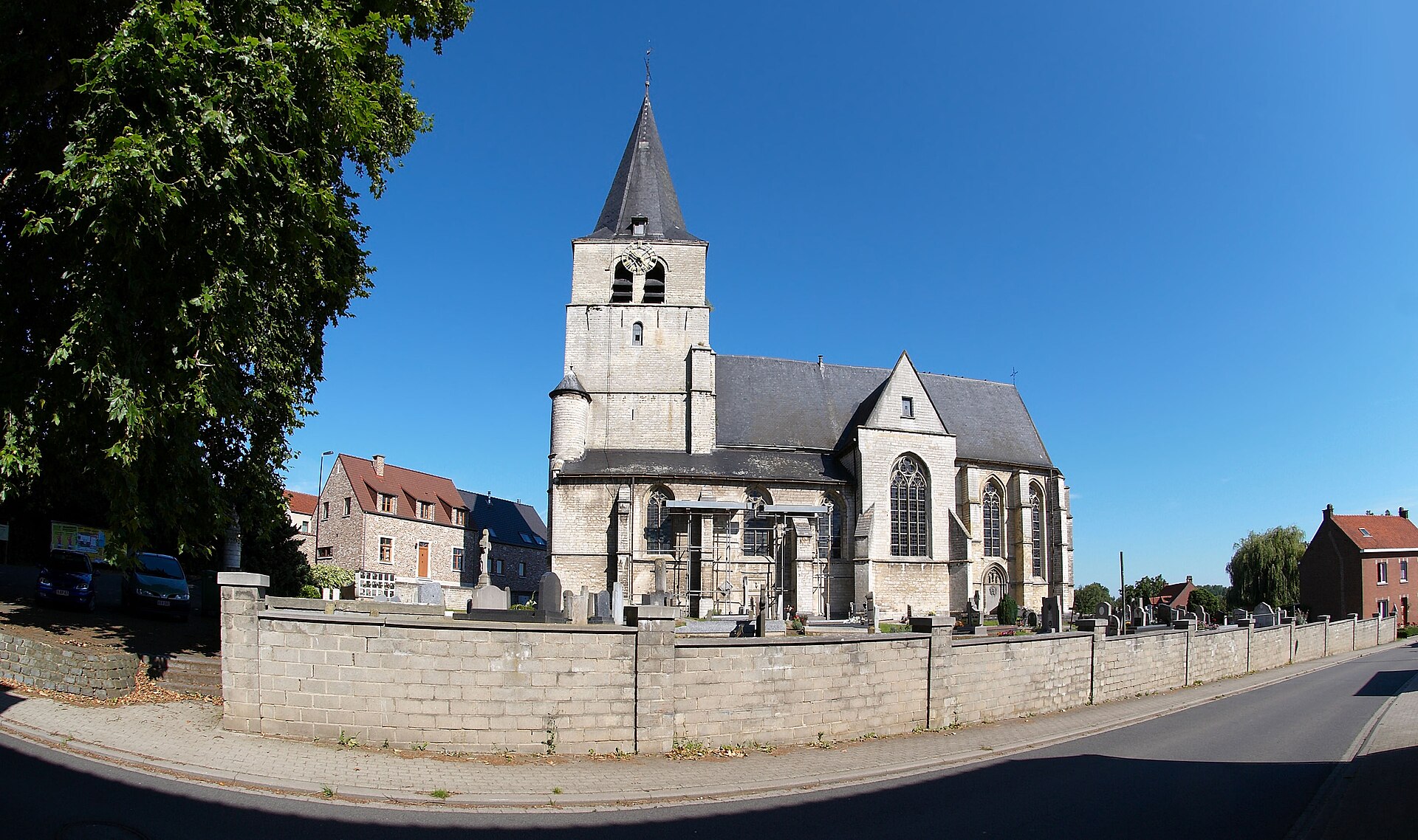
Sint-Agathakerk is the parish church of Sint-Agatha-Rode, a village that belongs to the municipality of Huldenberg in the province of Flemish Brabant. Dedicated to Saint Agatha of Sicily, the church stands at the heart of the old settlement and remains one of the oldest landmarks in the area.
How old is this church?
The story of this site goes back to the 11th century, roughly the same time the village of Sint-Agatha-Rode itself came into being. It was Godfrey I, Count of Leuven, who is believed to have had a church built here — most likely a Romanesque structure, far more modest than the building that stands today. In 1140, another count, Godfrey II, transferred the church to the chapter of the collegiate church of St. Peter in Leuven, a decision that tied the fate of the building to that powerful institution for centuries to come.
Where does the current appearance come from?
The shape the church has kept for roughly six hundred years took form around 1400, when it underwent a major rebuilding. That was far from the end of its turbulent history, though: in the late 16th century, during the religious upheavals of the period, the Geuzen — Calvinist rebels fighting Spanish rule in the Low Countries — destroyed the building. Reconstruction took over a decade, running from about 1597 to roughly 1608, and gave the church the Gothic form still visible today.
What does the architecture look like?
The Sint-Agathakerk is a good example of Gothic architecture typical of this part of Brabant. A sturdy square tower rises at the west end, followed by a three-aisled nave of three bays arranged in pseudo-basilical fashion — meaning the central aisle rises above the side aisles, though the height difference is less pronounced than in a true basilica. On either side of the nave, in line with the side aisles, sit pseudo-transepts: arms that resemble a transept without forming a full crossing with the main nave. The building ends in a three-sided, two-bay choir.
What is there to see inside?
The interior holds several noteworthy furnishings from different periods. At the back of the north aisle stands a Baroque altar together with a baptismal font topped by a hovering Eucharistic dove, both dating from the 17th century and pointing to the parish's relative prosperity at the time. The choir still contains wooden wall panelling and a north door, both dated to the late 18th century. The door panel of the west portal, meanwhile, bears the carved year 1913, likely marking a later restoration or carpentry work at the main entrance.
Is the church a protected monument?
Given its historical and architectural value, the Sint-Agathakerk has been a protected heritage monument since 3 July 1979. That legal status confirms the building's role as a witness to centuries of regional history — from its medieval foundation under the counts of Leuven, through destruction and rebuilding after the 16th-century religious conflicts, to the present day.
Frequently asked questions
Who is the church dedicated to? The church is dedicated to Saint Agatha of Sicily, whose name was also given to the village of Sint-Agatha-Rode itself.
When was the first church on this site built? The earliest known church here dates from the 11th century and is attributed to Godfrey I, Count of Leuven.
Why was the church rebuilt? The building was destroyed in the late 16th century by the Geuzen, so it was reconstructed around the turn of the 17th century, giving it the Gothic form it still has today.
Since when has the church been a protected monument? It has held protected heritage status since 3 July 1979.
Nearby places

Earn badges for the places you visit
Download NextOnTrip, discover new places and check off your trails.