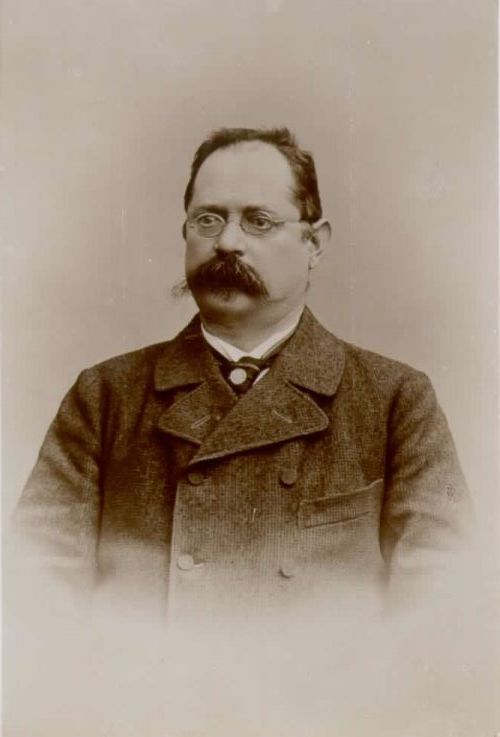
About this place
The Simon Rutar Memorial Room is a small heritage exhibit in the hillside village of Krn above Kobarid, dedicated to one of the region's pioneering historians and geographers.
Simon Rutar (1851–1903) grew up on the Mohova farmstead in Krn. He went on to become one of the founding figures of Slovene historiography, geography, archaeology, and heritage conservation. His best-known work, "Zgodovina Tolminskega" (History of the Tolmin Region), published in 1882, remains a reference point for researchers of the area to this day. On the centenary of his birth in 1951, the first memorial plaque was mounted on his family home in Krn, and the Tolmin museum later staged two smaller exhibitions there about his life and work.
What will you see at the memorial exhibit?
In 2011 the display was moved to two floors of a farm outbuilding standing near the family house, in rooms above the village's former dairy (address: Krn 9). Here you'll find documents from Rutar's own archive alongside photographs of the places where he lived and carried out his research — from the Tolmin valley to Istria and the Karst. This is a modest, community-run exhibit rather than a large institutional museum, maintained by local residents in cooperation with the Tolmin Museum.
How do you get there and visit?
Krn is a small village set high above the Soča Valley, overlooking Kobarid, reached by a winding mountain road — allow extra time for the drive. The exhibit is not permanently open: the key to the rooms is kept at house number 8 in the village, and visits must be arranged in advance by phone. The person in charge, Lidija Manfreda, can be reached at 031 546 382 to schedule a viewing. The Tolmin Museum (Mestni trg 4, Tolmin), which formally oversees the collection, can also provide additional information.
Why is this stop worth the detour?
This is a destination for visitors specifically interested in the history of the Tolmin region and Posočje, not a mainstream tourist attraction with crowds. A visit to Krn pairs naturally with a walk through the mountain village and views over the Soča Valley — the wider Kobarid area is well known for its World War One heritage trails and scenic viewpoints, making the memorial room an easy addition to a longer day of exploring.
Who was Simon Rutar?
Born in 1851 and died in 1903, Simon Rutar was a largely self-taught historian who, despite lacking formal academic training in the field, became one of the most important researchers of the Slovene Littoral's past. He wrote chiefly about the history and geography of what is now the Slovenian Littoral, the Italian region of Friuli-Venezia Giulia, and the Croatian counties of Istria and Primorje-Gorski Kotar. His work is still cited by regional historians today, even though some of the original archival material he relied on was destroyed in a fire at the Tolmin archive during the First World War.
Frequently asked questions
Is the Simon Rutar memorial room always open? No. It is a small, community-run exhibit with no fixed opening hours — visits require calling ahead to arrange access to the key.
Where exactly is the exhibit located? In the village of Krn above Kobarid, at Krn 9, on the upper floor of a farm building next to the former village dairy.
What can you actually see inside? Documents from Simon Rutar's personal archive and photographs of the places connected to his life and research work.
Who was Simon Rutar and why does he matter to the region? He was a 19th-century historian and geographer, a pioneer in studying the Tolmin region and the wider Slovene Littoral — his 1882 work "Zgodovina Tolminskega" remains one of the foundational sources on the area's history.
Nearby places

Earn badges for the places you visit
Download NextOnTrip, discover new places and check off your trails.