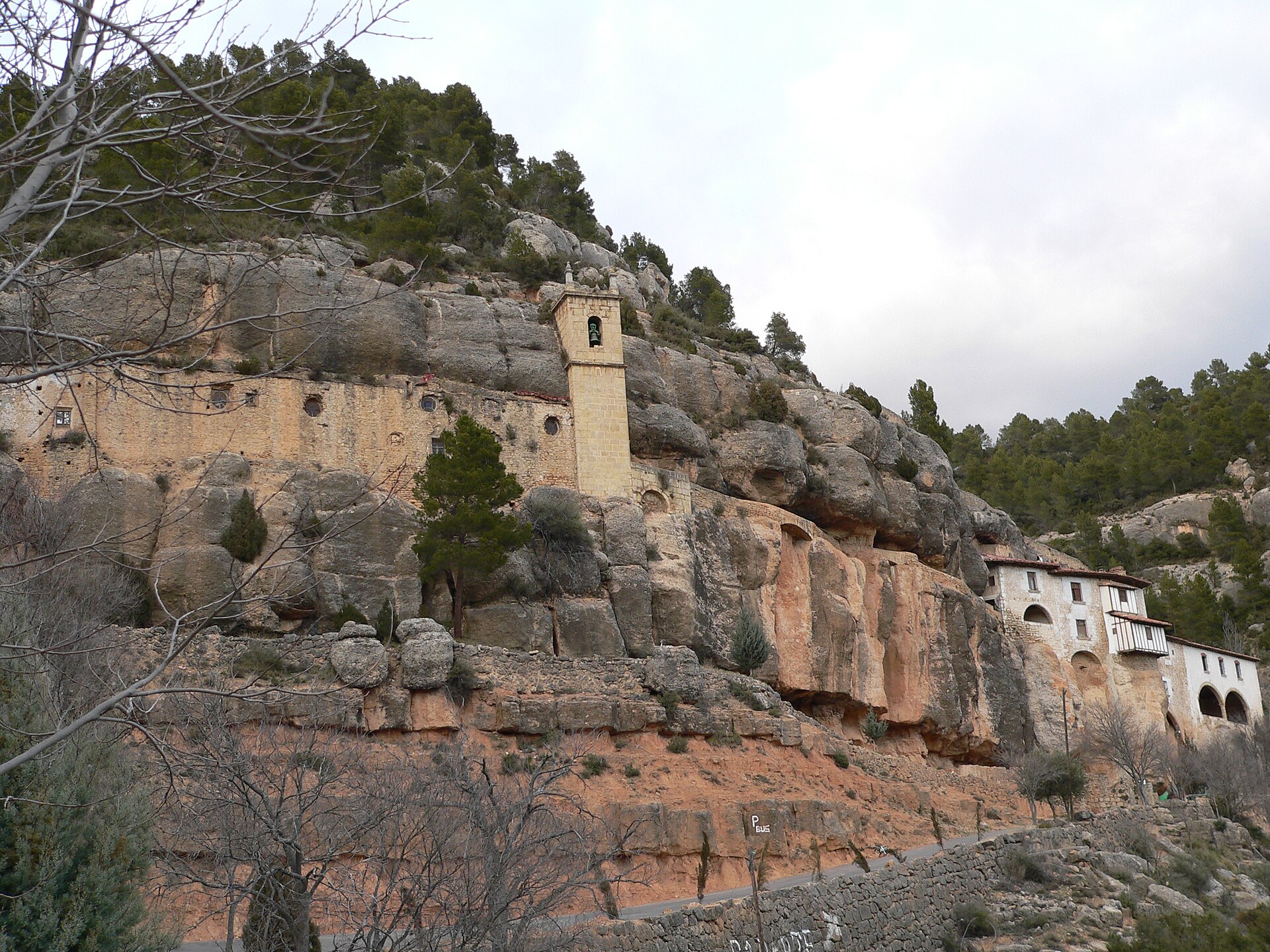
About this place
Santuari de la Mare de Déu de la Balma is a sanctuary carved into a rock face above the Bergantes river, roughly 3 km north of Zorita del Maestrazgo in the province of Teruel (Maestrazgo region, Aragon, right on the border with the Valencian Community). Set into the natural rock formation, the building creates the striking illusion that it might slide down into the river at any moment.
What will you see there?
The sanctuary's chapel, completed in 1667, is joined to a bell tower and dedicated to the Virgin of la Balma. The complex was built in stages between the 16th and 18th centuries in Renaissance style: a facade with balconies and balustrades, and walls built from wattle and lime, stand in sharp contrast to the bare rock the sanctuary is embedded in. A long staircase leads down from the buildings to the former hospederia (pilgrims' guesthouse), which houses a restaurant and visitor rooms, including a distinctive "dance hall" lined with blind arches.
How do you get there?
The easiest approach is a local road running from Zorita del Maestrazgo into the Bergantes valley — about 3 kilometers, well signposted for cars, cyclists and walkers alike. The area also sits on hiking routes linking Zorita with the nearby gorges and watchtower viewpoints (atalayas) along the river valley, so a visit to the sanctuary can easily be combined with a short walk through the Maestrazgo landscape.
When is the best time to visit?
The sanctuary's life revolves largely around pilgrimage: it draws worshippers not only from towns in Castellón but from Teruel as well, underlining its significance beyond Zorita del Maestrazgo itself. Spring and autumn are the most comfortable seasons to visit, with milder weather and fewer visitors than in high summer, when the Bergantes valley can get hot and sun-exposed for most of the day. It's worth checking the local calendar of religious feast days before travelling, since the sanctuary gets notably busier — and more atmospheric — during those celebrations.
Why is this place worth a stop?
The combination of religious architecture and dramatic rock scenery above the river sets La Balma apart from other sanctuaries in the Maestrazgo region. It's a place where pilgrimage tradition meets the scenic pull of the Bergantes gorge — the sight of a building seemingly grown into the cliff face is memorable even for visitors with no particular interest in the history of Marian devotion behind it.
Frequently asked questions
Where is the La Balma sanctuary in relation to Zorita del Maestrazgo? About 3 km north of the town, on the left bank of the Bergantes river, in the valley leading further into the Maestrazgo region.
When was the building constructed? The sanctuary took its current form between the 16th and 18th centuries in Renaissance style, and the chapel next to the bell tower was completed in 1667.
Can you eat or rest at the sanctuary? Yes — the former hospederia at the site has a restaurant and visitor rooms, including a "dance hall" featuring blind arches.
Who is this sanctuary important to? It's a pilgrimage center that draws worshippers not just from Castellón but also from the neighboring province of Teruel, reflecting its regional religious significance.
Nearby places

Earn badges for the places you visit
Download NextOnTrip, discover new places and check off your trails.