About this place
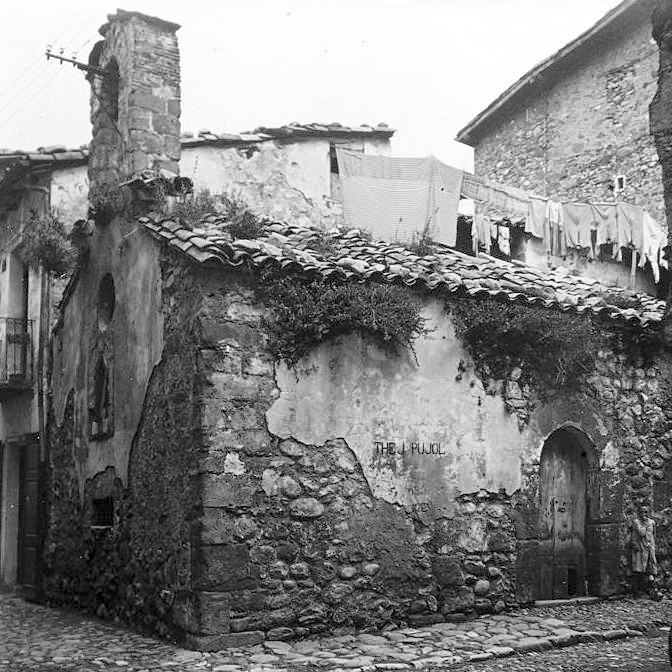
Santa Maria del Pòpulo is a former church in Vallfogona de Ripollès, and the one part of it that has survived to the present day is its bell tower, now listed in Catalonia's inventory of architectural heritage. It stands in the historic centre of this small town in the Ripollès comarca (Girona province, Catalonia), and even though the church itself vanished long ago, the tower still shapes the skyline of Vallfogona.
What is the history behind it?
The church was founded at the end of the 12th century by the lords of the local castle, known as Castell de Vallfogona or de la Sala. The earliest surviving written mention dates from 1282, when Dalmau de Palol bequeathed several fields to the church. Inside stood a carved image of the Virgin, made in the late Romanesque style during the first half of the 13th century.
Pastoral visitation records from 1387 and 1432 confirm the church was in active use for worship. The 1432 record also notes that the roof and vault had recently been repaired, after being damaged by the 1428 earthquake known locally as "de la Candelera," whose epicentre lay near Camprodon.
What happened to the original furnishings?
In 1778, the altar and the statue of the Virgin of Pòpul were moved to the sanctuary of Mare de Déu de la Salut, located closer to the parish church. They remained there until 1936, when they were destroyed during the turmoil of the Spanish Civil War. The abandoned church building itself gradually fell into ruin and has essentially disappeared today.
What can you actually see there now?
Of the original structure, only the inner north wall of the nave, the start of its vault, and the bell tower attached to that wall have survived. The tower — known locally as the Campanar del Pòpul — is the main feature visitors can still admire. It now houses the town clock, dated to the late 17th or early 18th century, making it both a medieval relic and a piece of Vallfogona's working infrastructure.
How do you get there and when should you visit?
The remains sit right in the centre of Vallfogona de Ripollès, near Puig Estela, so they're easy to fold into a short walk around town. Since it's an outdoor monument — a wall and a tower visible from the street — you can view it at any time of day, with no set opening hours. For further details, the town hall (Ajuntament de Vallfogona de Ripollès) is the point of contact. It pairs well with a visit to other Ripollès landmarks nearby, such as the monastery of Santa Maria de Ripoll or the remains of Vallfogona castle itself.
Frequently asked questions
Does the church of Santa Maria del Pòpulo still stand? Not in its original form — the church building itself has almost entirely disappeared. What remains is a fragment of the nave wall and the attached bell tower, known today as the Campanar del Pòpul.
Where does the name "del Pòpulo" come from? It refers to the church's dedication to the Virgin of Pòpul (del Pòpulo), whose statue and altar stood inside until 1778, when they were transferred to the sanctuary of la Salut.
How old is the bell tower? The tower itself dates back to the church's origins before the 13th century, while the clock currently housed in it was added in the late 17th or early 18th century.
Do you need a ticket or booking to visit? No — it's an open-air monument in the town centre, free to view at any time without a reservation.
Nearby places

Earn badges for the places you visit
Download NextOnTrip, discover new places and check off your trails.