About this place
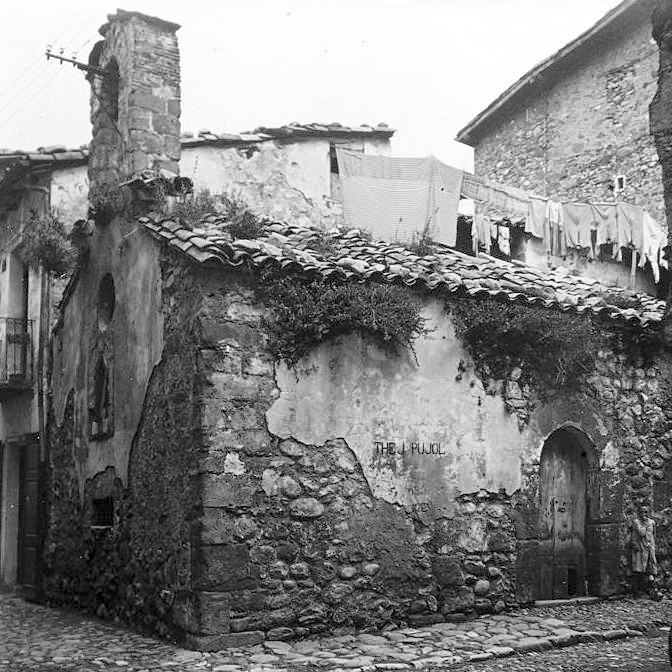
Sant Miquel de la Infermeria is the ruined Romanesque chapel of the former infirmary attached to the monastery of Sant Joan de les Abadesses, in the Ripollès region of Catalonia, Spain. Little of the original building survives, but the site is listed in Catalonia's inventory of architectural heritage, and its name still points to its original purpose: caring for the sick within the monastic community.
Where did the chapel stand?
The chapel stood inside the monastic precinct, tucked behind the abbot's palace, on the side facing away from the square in front of the monastery's main façade. Sant Joan de les Abadesses itself is a small town on the Ter river, its historic core built up over centuries around one of Catalonia's most significant medieval monasteries. The infirmary chapel occupied a separate structure, deliberately set apart from the strictly cloistered part of the complex — it served people who were not monks but were housed and cared for by the community.
Where does the chapel come from?
The building was commissioned by abbot Ponç de Monells, who by the time it was built was already serving as bishop of Tortosa rather than abbot of Sant Joan. It was consecrated on 2 November 1164, in a ceremony attended by the bishop of Vic, Pere Gausfred, and the bishop of Girona, Guillem de Monells — Ponç's own brother. The presence of two bishops, one a close relative of the founder, reflects how tightly local noble families and church hierarchy were interwoven in 12th-century Catalonia.
What did the building look like?
Sant Miquel de la Infermeria was a single-nave chapel on a rectangular plan, closed at the east end by a semicircular apse narrower than the nave — a common layout for small Romanesque churches in this part of Catalonia. Only a section of the north-western wall has survived, later incorporated into a house built on the site. Everything else disappeared over the centuries, so what remains today reads more as a trace embedded in later construction than as a recognizable church.
Why does it matter to visitors?
The chapel is a reminder that a major medieval monastery like Sant Joan de les Abadesses was more than its main church and cloister — it also ran a facility for the poor and infirm, kept at a physical remove from the monks' own quarters. For anyone visiting the town, it adds a lesser-known layer to a trip built mainly around the monastery church and its museum, hinting at the everyday welfare work carried out behind the abbey walls. Its listing in the Inventari del Patrimoni Arquitectònic de Catalunya confirms its recognized historical value despite the fragmentary remains.
When to visit?
Since only fragments of the chapel survive, built into a private house, the best approach is to combine a look at the site with a visit to central Sant Joan de les Abadesses and its monastery. Spring and summer make for pleasant walking weather in town, while autumn brings fewer visitors and a quieter pace. It is worth checking with the local tourist office beforehand about which parts of the remaining wall can be viewed from the outside.
Frequently asked questions
What was Sant Miquel de la Infermeria? A Romanesque chapel attached to the infirmary of the monastery of Sant Joan de les Abadesses, built to serve the sick and elderly cared for by the community.
Who founded the chapel, and when was it consecrated? Abbot Ponç de Monells commissioned it while already serving as bishop of Tortosa; it was consecrated on 2 November 1164.
What survives of the original building? Only part of the north-western wall remains, reused in the construction of the house that now occupies the site.
Can the chapel be visited today? The remains form part of a private property, so viewing is generally limited to the visible wall fragments as part of a wider visit to Sant Joan de les Abadesses.
Nearby places

Earn badges for the places you visit
Download NextOnTrip, discover new places and check off your trails.