About this place
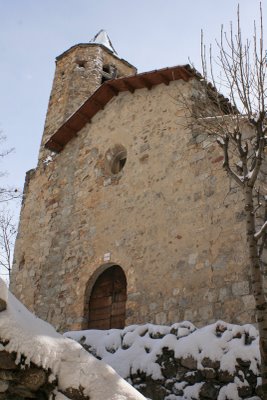
Santa Maria de Corroncui is a ruined Romanesque church in the municipality of El Pont de Suert, in the Alta Ribagorça region of Lleida province, Catalonia. It stands on a small hillside at a spot called Pla del Mont, right next to the abandoned village of Corroncui, deep in the Pyrenees.
Where exactly are the ruins?
The site sits in a remote corner of El Pont de Suert, within the former district of Viu de Llevata, at coordinates 42.333815, 0.852366. The village of Corroncui itself was abandoned, and its population relocated downhill to a place known as Pla de Corroncui, where a new church under the same dedication - referred to as Santa Maria de Corroncui II - was built in the 1960s. The ruin described here is what remains of the original settlement's parish church.
What did the building look like?
The church was built from ashlar stone laid in regular horizontal courses. It follows a single-nave plan closed by a semicircular apse. A barrel vault covered the nave, while a quarter-sphere vault covered the apse, both reinforced by transverse arches resting on stone corbels. A chapel closed by a semicircular arch opens off the south wall, and a rectangular bell tower once stood by the western entrance. The style points to the first half of the 12th century and shows the influence of Santa Maria d'Alaó, one of the region's key Romanesque reference points.
What is the history behind it?
The area is mentioned in records from around 1070 in connection with a breach of the Truce of God (pau i treva) - among the oldest written references to this valley. The church itself was raised in the first quarter of the 12th century under the patronage of the barons of Erill, who also funded the churches of Viu, Massivert and Boí around the same period. Later in the Middle Ages, Corroncui came under the barons of Claret, and the church was ecclesiastically dependent on Sant Gil de Pinyana. By the 1960s the building was already badly ruined - only the apse walls stand today, heavily overgrown with vegetation. Decorative elements, including the portal and carved fragments, were removed and reused in the new church built at Pla de Corroncui for the relocated villagers.
How do you get there, and when is the best time to visit?
The ruins lie in the mountainous, sparsely populated terrain of Alta Ribagorça, so reaching them means walking in from the nearest access road toward the former village of Corroncui - plan the route in advance and bring proper hiking footwear. Late spring, summer and early autumn are the best times to visit, when trails are dry and passable and vegetation doesn't block access to the ruins. In winter the high terrain can be snow-covered and hard to reach.
Frequently asked questions
What's the difference between Santa Maria de Corroncui and Santa Maria de Corroncui II? The first is the 12th-century Romanesque ruin standing by the abandoned hillside village. The second is the church built in the 1960s at Pla de Corroncui for villagers relocated from the old settlement, partly using stone salvaged from the original building.
Can you still see parts of the original church? Yes, though only in part - the apse walls and some of the nave structure survive, while the decorative elements were moved to the newer church.
How do we know what the church originally looked like? From the surviving walls and architectural details (arches, corbels, vaulting), together with regional historical documentation such as the Catalunya Romànica survey.
Is the site marked for visitors? The ruins lie in the rural area of El Pont de Suert, a municipality known for its concentration of Alta Ribagorça Romanesque monuments - local tourist information points in El Pont de Suert can help plan a route to less accessible sites like this one.
Nearby places

Earn badges for the places you visit
Download NextOnTrip, discover new places and check off your trails.