About this place
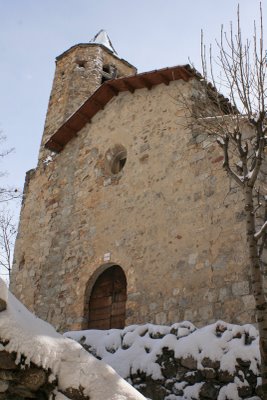
Sant Genís de Bellera is the ruined medieval monastery of Senterada, in the Pallars Jussà region of Catalonia. The stone walls of its Romanesque church, set into a mountain slope, are today the oldest and best-preserved fragment of what was once a monastic complex.
Where is it and how do you get there?
The ruins sit in an enclave of the Senterada municipality, between the areas of Sarroca de Bellera and La Torre de Cabdella, on the ridge of a broad slope between the Diable and Llenguadera streams. The best-known approach starts at Bastida de Bellera and crosses the Pont del Diable ("Devil's Bridge") — a name rooted in local legend, common to many old stone bridges in the Pyrenees. This is a route for people ready to walk into mountain terrain; there is no road access right up to the ruins.
What will you actually see there?
The main surviving structure is the church itself, the oldest part of the complex and built in Romanesque style. The rest of the monastic buildings have fared far worse: in the 1920s the former conventual structures were converted into animal enclosures, and that repurposing largely defines the site's current, much-reduced appearance. The whole place is now known locally as "les Bordes de Sant Genís" (or "de Torres") — "bordes" being the Pyrenean term for pastoral sheds, which says a lot about how far the site has drifted from its original religious purpose.
What's the history behind it?
The earliest written record of the monastery dates to 840 and names abbot Vulgarà; some researchers suggest the community could be somewhat older, possibly with Visigothic roots, though this isn't firmly established. The monastery grew under the patronage of the counts of Pallars, but from the mid-11th century it entered a decline. Over the following decades the community was reorganized as a canonical house, and around the turn of the 11th–12th century the monastery became dependent on the nearby monastery of Santa Maria de Lavaix. Its status kept shifting afterward — from the 14th century it operated as a parish under Lavaix — until it eventually lost its religious role entirely and its buildings were taken over for pastoral farming use.
Who is this place for?
It suits visitors interested in Romanesque architecture and the medieval history of the Pallars region, as well as hikers looking for lesser-known trails in the Pyrenees. There's no tourist infrastructure here — no ticket booth, marked car park, or information point. The appeal is the raw, unrestored character of ruins set in the mountain landscape between Sarroca de Bellera and Torre de Cabdella.
Frequently asked questions
Can you drive up to the ruins? No — access is on foot, usually starting at Bastida de Bellera and crossing the Pont del Diable. Expect a walk through mountain terrain.
What actually survives from the monastery? Mainly the walls of the Romanesque church, the oldest and best-preserved part of the complex. The remaining buildings were converted into pastoral sheds.
Why is it called "les Bordes de Sant Genís" today? After losing its religious function, the former monastic buildings were used as "bordes," the Pyrenean term for animal shelters — hence the site's current name.
Is it worth combining with other stops nearby? Yes — the surrounding area near Sarroca de Bellera and Torre de Cabdella allows for a longer walking route through the Pallars Jussà valley, passing other sites of similar historical character.
Nearby places

Earn badges for the places you visit
Download NextOnTrip, discover new places and check off your trails.