About this place
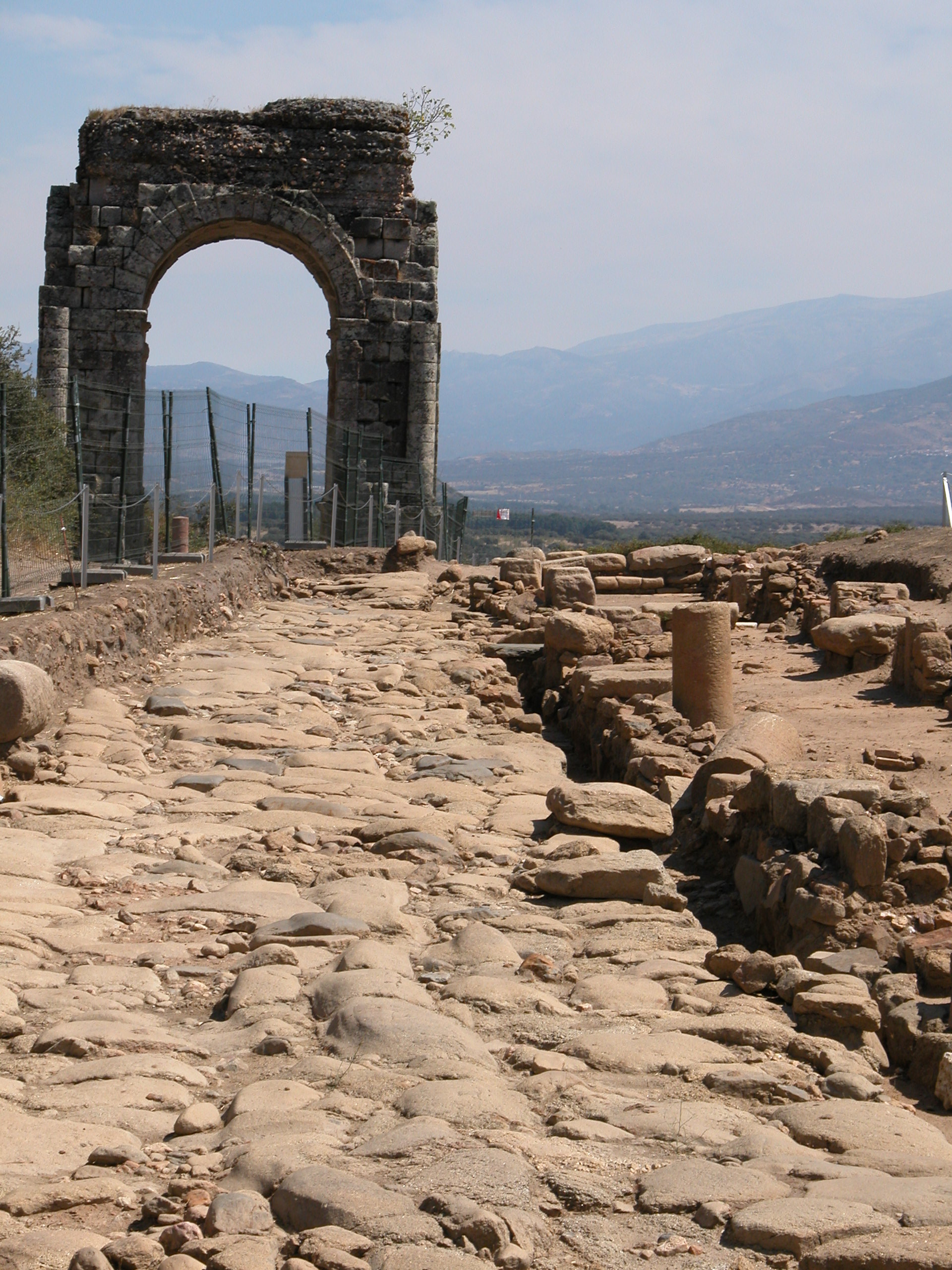
The Roman Arch of Cáparra (Arco de Cáparra) is a four-sided tetrapylon standing within the ruins of the ancient city of Cáparra, on the border between the municipalities of Guijo de Granadilla and Oliva de Plasencia, in the province of Cáceres, Extremadura. It is the only monument of its kind surviving on the Iberian Peninsula — an arch with four openings facing all four directions.
What makes this arch different from a typical Roman gate?
A classic Roman triumphal arch usually has one or three passageways set along a single line. The tetrapylon at Cáparra works differently: four granite pillars arranged in a square support four semicircular arches, creating a passage open on every side. Each pillar rests on a base topped with a cornice, and the whole structure rises at the point where the city's two main streets — the cardo and the decumanus — crossed. The pedestals once held statues; the ones on the north side, judging by their elongated, narrow plinths, are thought to have carried equestrian figures.
Who built it, and when?
The arch was raised at the end of the 1st century AD. Inscriptions on the monument identify the sponsor as Fidus Macer, a wealthy member of Cáparra's local aristocracy. Construction coincided with the city's peak economic period, when it profited from its position on a major trade route.
Why was Cáparra such an important city?
Cáparra sat on the Vía de la Plata, the ancient route linking the south and north of the Iberian Peninsula, along which caravans carrying gold, silver and other valuable goods moved under the protection of Roman legions. The city belonged to the Conventus Emeritensis in the province of Lusitania, whose capital was Augusta Emerita, present-day Mérida. This strategic position on a trade and military route allowed Cáparra to grow into a center wealthy enough to finance monumental public architecture like this arch.
What else is there to see nearby?
The arch stands within a larger archaeological site — the ruins of the city of Cáparra — open to visitors as part of the Vía de la Plata route, which today also functions as a popular pilgrimage and hiking trail through Extremadura. Built from local granite, the structure has survived nearly two thousand years in a condition that still lets visitors read the proportions and building technique of its Roman engineers.
Frequently Asked Questions
Is the Arco de Cáparra the only arch of its kind in Spain? Yes, it is the only surviving four-sided arch (tetrapylon) on the Iberian Peninsula — with four archways facing outward in every direction, unlike classical triumphal arches built along a single axis.
Which municipality is it actually in? The Cáparra archaeological site, where the arch stands, sits on the boundary between two municipalities — Guijo de Granadilla and Oliva de Plasencia — in the province of Cáceres.
How old is the monument? The arch was built at the end of the 1st century AD, making it nearly two thousand years old.
Who paid for its construction? According to inscriptions on the monument, the sponsor was Fidus Macer, a member of the local aristocracy of the Roman city of Cáparra.
Nearby places

Earn badges for the places you visit
Download NextOnTrip, discover new places and check off your trails.