About this place
Puente del Cadí in Granada is a modest but telling fragment of a medieval bridge that once linked two of the city's most iconic quarters — the Albaicín and the hill of the Alhambra. Little survives of the original structure today, yet the site still draws travelers curious about Granada's Muslim-era past, long before the Catholic Monarchs arrived.
Where exactly is Puente del Cadí?
The remains stand beside the Darro river, at the foot of the Alhambra hill, right along Carrera del Darro — one of the most walked streets in Granada's historic core. The surviving structure sits on the left bank of the river, next to the Bosque de la Alhambra (the Alhambra Forest), which puts it directly on the natural walking route between the Albaicín and the entrance to the Alhambra grounds.
Why is it called the "Cadí" bridge?
The name refers to a cadí — a Muslim judge from the era of Zirid rule in Granada — on whose initiative the bridge was built back in the 11th century. For centuries it served as one of the key river crossings tying the Albaicín to the Alhambra, and it also functioned as a city gate known as the Puerta de los Tableros. The bridge is mentioned repeatedly in historical accounts describing the layout of Muslim Granada, a sign of how important it once was for getting around the city.
The structure outlived the golden age of Nasrid Granada and the Christian conquest that followed it: in 1501 the Catholic Monarchs even ordered the bridge to be paved, proof it was still in active use at the time. It was finally demolished in the first half of the 17th century, and only a fraction of the original construction has come down to us.
What remains to see today?
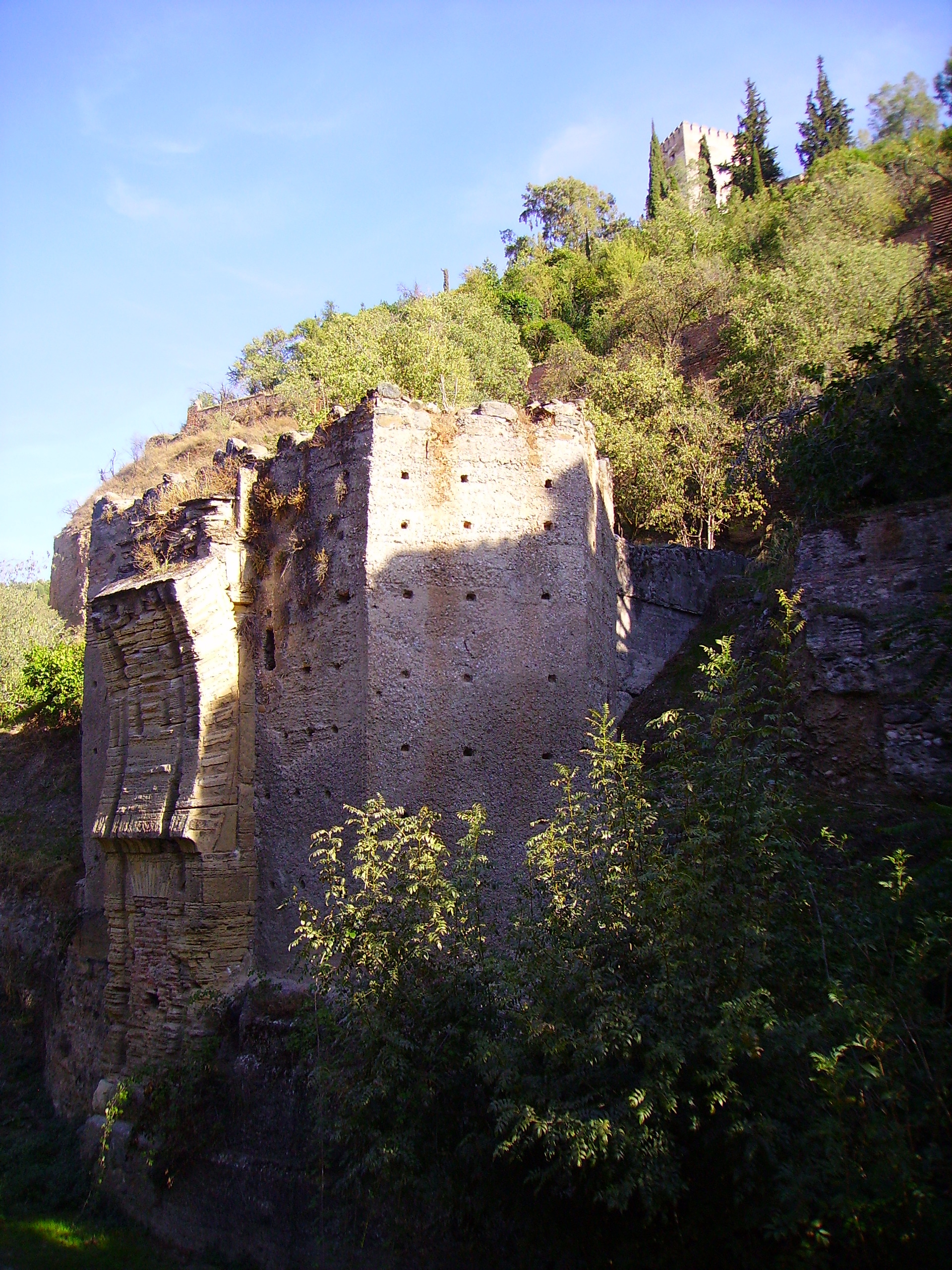
Of the two original abutments, only one still stands — the one on the side facing the Alhambra Forest. It takes the shape of a hexagonal tower, and the start of a large horseshoe-shaped vaulted arch, typical of Andalusi architecture from that period, is still visible within it. The voussoirs forming the arch alternate in rhythm between recessed and projecting blocks, and traces of the original polychrome painting are still discernible. Concave cornice mouldings and an alfiz frame — a hallmark of Islamic art in Al-Andalus — complete the surviving decoration.
Look closely at the sandstone ashlar blocks and you can spot grooves left behind: some from the wooden scaffolding used during construction, others from a metal grate that once sealed off river access at the bridge. In 1931 the remains were declared a historic-artistic monument, a designation that today translates into legal protection as a listed heritage asset in the Monument category.
How to fit it into a Granada visit?
Because the ruins sit right on Carrera del Darro, the easiest way to see them is simply to fold them into a walk from the cathedral and city center toward the Albaicín, continuing on up to the Alhambra hill. This is the route most visitors to Granada already follow on foot, so the bridge can be taken in along the way rather than as a separate excursion.
Frequently Asked Questions
Is there more left of the bridge than a single pillar? No — of the two original abutments, only one survives, shaped like a hexagonal tower, together with the springing of its vaulted arch. The rest of the structure was torn down in the 17th century.
Where does the name "Puente del Cadí" come from? It refers to a cadí, a Muslim judge from the Zirid period, on whose initiative the bridge was built in the 11th century.
Is there an entrance fee to see the ruins? The remains sit in a public space along the open Carrera del Darro, so viewing them from the street doesn't require a ticket.
Is it worth a dedicated visit, or just a stop along the way? Given how small the surviving remains are, it's best treated as a stop on the walk connecting central Granada, the Albaicín, and the Alhambra, rather than a destination in its own right.
Nearby places

Earn badges for the places you visit
Download NextOnTrip, discover new places and check off your trails.