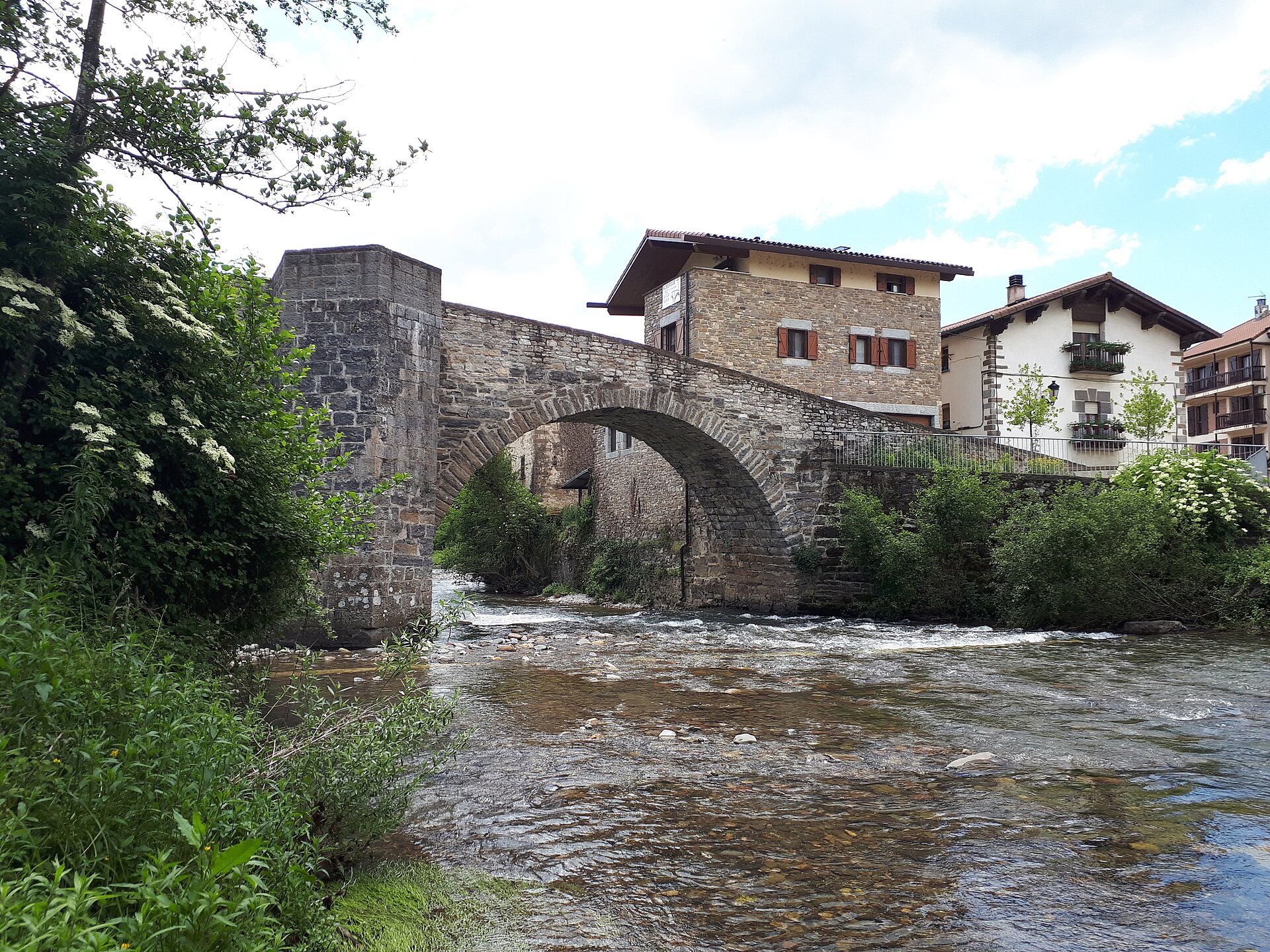
About this place
Puente de la Rabia is a medieval bridge in Zubiri, the main town of the Esteribar valley in Navarre, sitting directly on the Camino Francés, the most popular route of the Camino de Santiago. Spanning the Arga river about 20 km from Pamplona, it has been one of the defining landmarks of this stretch of the pilgrimage for centuries.
What will you see there?
The bridge dates back to the 11th century and still shows the classic "camel-back" profile typical of medieval river crossings, with the roadway rising in a gentle arch and dropping steeply on either side. It rests on two semicircular arches — the one on the right slightly pointed — and a central pier reinforced with a stone breakwater that protects it from the current. The rough-cut stone surface and austere lines make the bridge look much as it must have looked to the earliest pilgrims who crossed it.
Its name, "Bridge of Rabies," comes from a local legend. While building the central pier, workers reportedly ran into difficult ground, and when they finally broke through the rock beneath the foundation, they are said to have found the remains of Saint Quiteria, a saint traditionally invoked against rabies. From that discovery grew a popular belief that leading a rabid animal three times around the pier could cure it. Locals and guides in Zubiri still tell the story to visitors today.
How do you get to the bridge?
The bridge sits right at the entrance to Zubiri, on the side pilgrims reach after descending from the Roncesvalles pass. It's one of the first notable landmarks on the Camino Francés after crossing the Pyrenees, and most walkers pass it on their first or second day on the trail. By car, Zubiri is roughly a 25–30 minute drive from Pamplona through the Esteribar valley. Local public transport also connects Zubiri with Pamplona, so the bridge is easy to reach without walking the pilgrim route.
When should you visit?
The bridge and the valley around it are pleasant year-round, but the busiest months are spring and summer (May to September), when pilgrim traffic on the Camino peaks. That's the best time to see the bridge in full use, with groups of walkers crossing the river and stopping at nearby bars and albergues. Autumn and winter bring fewer crowds but cooler, occasionally rainy weather typical of northern Navarre.
What else is worth seeing nearby?
The Esteribar valley is known for several other bridges along the Arga river, together forming an informal "bridges route" popular with walkers and cyclists exploring the area's medieval river crossings. Zubiri itself, whose Basque name means "village by the bridge," has kept the layout typical of towns along the Camino, with stone houses and narrow streets leading down toward the river.
Frequently asked questions
Is Puente de la Rabia still in use today? Yes, the bridge still serves as a pedestrian crossing in the center of Zubiri and is used daily by both locals and pilgrims walking the Camino Francés.
Where does the name "Bridge of Rabies" come from? It comes from a legend about Saint Quiteria, whose remains were said to have been found while building the central pier, and from the belief that circling the pier with a rabid animal could cure it.
Do you have to walk the Camino to see the bridge? No, the bridge can be reached by car or local public transport from Pamplona; walking the pilgrim route isn't required.
How old is Puente de la Rabia? The bridge dates from the 11th century, making it one of the older surviving bridges on the Camino Francés in Navarre.
Nearby places

Earn badges for the places you visit
Download NextOnTrip, discover new places and check off your trails.