About this place
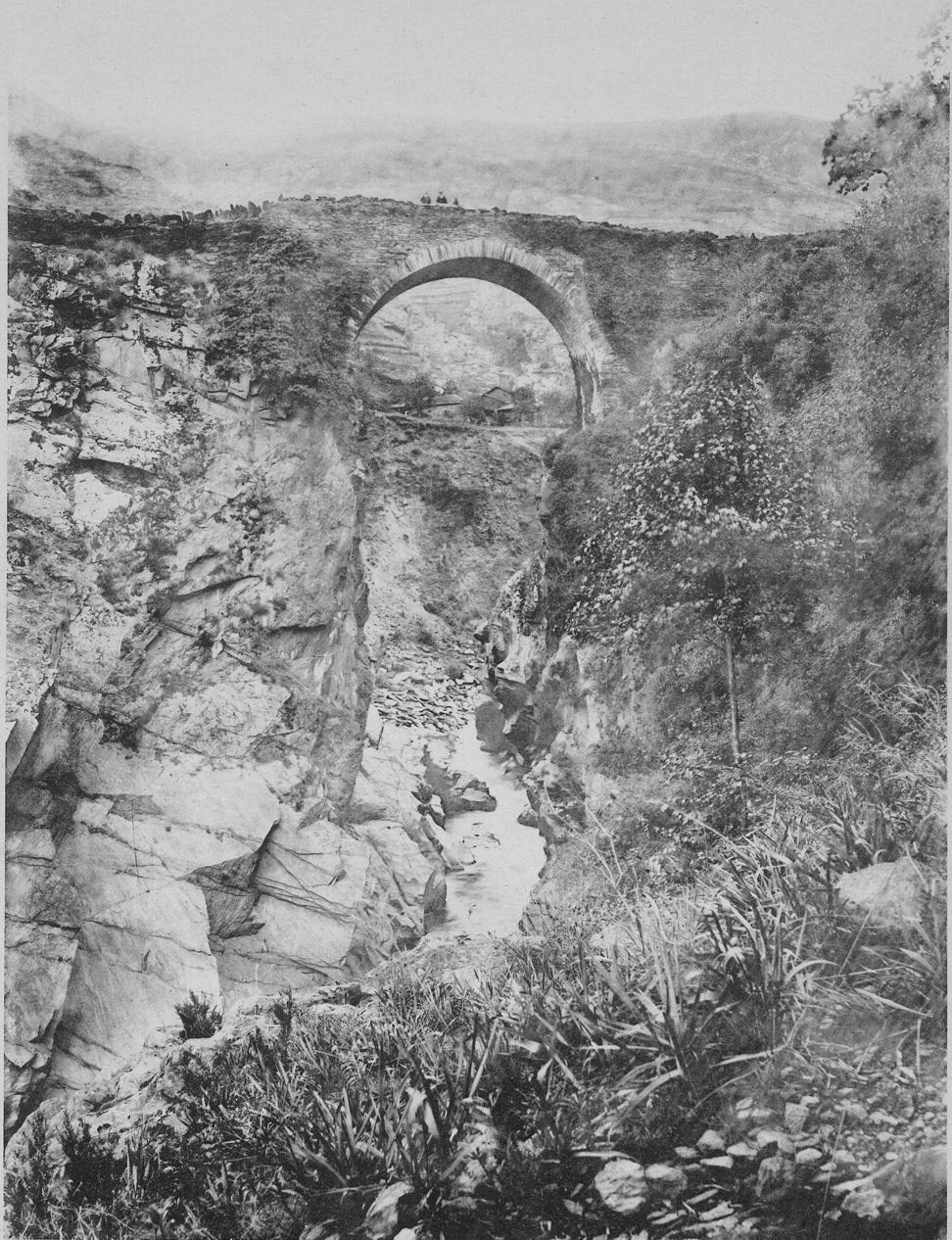
Ponte de Salcedo is a former bridge over the Navia River near Grandas de Salime, in western Asturias, Spain — a crossing whose entire structure has rested underwater since 1953, submerged by a hydroelectric reservoir.
What is the history behind this bridge?
The bridge was built in the late 19th century as part of a road connecting Grandas de Salime with La Puela, forming a link in the route joining Lugo, in Galicia, with Oviedo, the Asturian capital. The original structure spanned 36 metres, resting on two masonry abutments joined by a metal truss section.
It did not survive the Spanish Civil War. In late July 1936, retreating Republican militiamen blew up the bridge to slow the advance of Nationalist forces. For a period afterward, locals relied on a makeshift wooden footbridge, until a new bridge was built in 1940: a two-hinged arch design, 34 metres long, with a deck standing roughly 4 metres above the river, built from a wooden lattice frame fastened with nails.
That postwar bridge lasted little more than a decade. In 1953, once the Embalse de Grandas de Salime reservoir filled behind the newly built dam on the Navia River, the bridge disappeared beneath the water. The old road was replaced by a new 33-kilometre route between Grandas and Verducedo, leaving Ponte de Salcedo as a submerged relic of the valley's former transport network.
What else is there to see nearby?
Grandas de Salime is a small council in the Navia river valley, bordering the Galician province of Lugo to the south. Its dam, completed in the mid-1950s — it marked its 50th anniversary in 2004 — houses a large mural by architect Joaquín Vaquero Palacios inside the structure. The former manager's house at the dam now holds an ethnographic museum devoted to traditional rural life in Asturias.
The area also lies on the Camino Primitivo de Santiago: it forms the last stretch of Asturian territory before pilgrims cross into Galicia via the Acebo Pass, which makes it a fairly common stop for walkers following that route.
How do you get there?
Grandas de Salime sits in western Asturias, close to the Galician border. Most visitors approach through the village of Grandas itself, from where local roads lead toward the reservoir valley and the former course of the historic road. A car is the practical option — public transport in this mountainous part of the region is limited, and distances between villages are considerable.
When is the best time to visit?
Given the mountain climate, spring and summer offer the easiest travel, with dry roads and green valleys. Autumn brings good colour to the hillsides, while winter weather in the higher parts of the council can turn unpredictable. Reservoir water levels shift with the seasons too, which is worth factoring in if the valley itself is part of the plan.
Frequently asked questions
Can you actually see the Ponte de Salcedo bridge today? No — the original structure has lain underwater since 1953, when the Grandas de Salime reservoir filled, so it cannot be visited in a conventional sense.
Why was the bridge destroyed in 1936? Retreating Republican militiamen blew it up during the Spanish Civil War to hinder the advancing Nationalist troops.
What replaced the road after the valley was flooded? A new 33-kilometre road between Grandas and Verducedo took over from the old route through La Puela.
What else can visitors see in Grandas de Salime? The Navia River dam, featuring a mural by Joaquín Vaquero Palacios, and an ethnographic museum housed in the dam's former manager's residence.
Nearby places

Earn badges for the places you visit
Download NextOnTrip, discover new places and check off your trails.