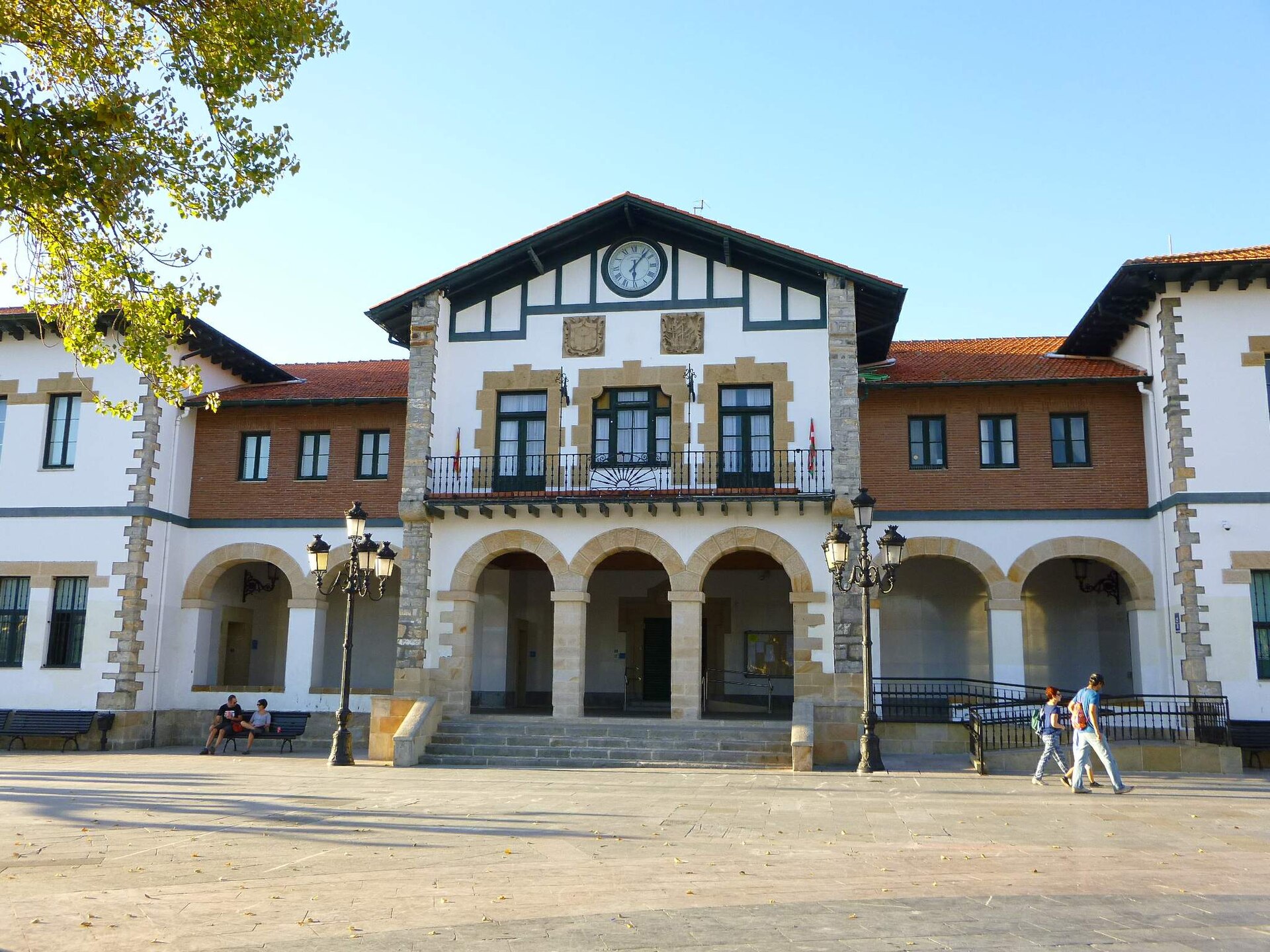
About this place
Plentzia town hall stands at the heart of Plentzia, a small coastal town in Biscay where the Butrón river meets the Bay of Biscay. The building is a working seat of local government, but it's also a compact lesson in early 20th-century Basque civic architecture, and it fits easily into a stroll through the old quarter.
What does the building look like, and who designed it?
The current town hall was designed by architect Antonio de Araluce in the neo-Basque style (neovasco), a movement popular across the Basque Country in the early 1900s. Construction dates to the 1920s — the town marked the building's centenary in 2022. Araluce laid the structure out in three parts: a central block for municipal administration flanked by two side wings, each with its own separate entrance. Unusually, the building was designed from the outset to serve three purposes at once: town hall, nautical school, and primary school. That multi-use brief shows in the symmetrical, representative facade and in how the interior is divided, both typical of civic buildings from that period.
Where did the town hall used to be?
Before the council moved into the current building, local government was based at number 25 Goienkale street, in a house-tower dated to 1562. Together with the parish church, it's one of the oldest surviving buildings in the old town. That older building was refurbished in 1986, and in 1988 the Plasentia de Butrón Foundation opened a museum inside it dedicated to Plentzia's history. Today visitors can see exhibits covering the town's past, its maritime traditions, and the wider region.
What else is worth seeing nearby?
The town hall sits in Plentzia's historic centre, close to the parish church and other period buildings of the old quarter. The town is also known for its beach and marina at the mouth of the Butrón estuary, a popular spot for sailors and water-sports fans. Walking from the town hall toward the waterfront, you get a clear contrast between the dense stone architecture of the old town and the open space of the estuary. It's a worthwhile short stop while exploring the Biscay coast, especially on a route linking the coastal towns toward Bilbao or Getxo.
When is the best time to visit?
Spring and summer are the best times to visit Plentzia, when the weather suits walking around the old town and the beach, and the town's everyday life — cafés, markets, events around the marina — is most visible. The town hall building itself can be viewed from the outside year-round, since it functions as an active council office rather than a museum, unlike the old house-tower.
Frequently asked questions
Can tourists go inside the town hall? The building is an active municipal office, so visitor access is generally limited to public areas during administrative opening hours. For a proper visit, the old house-tower town hall on Goienkale, now home to the town museum, is the better option.
What architectural style is the building? It's an example of the neo-Basque style (neovasco), typical of public buildings raised across the Basque Country in the early 20th century, blending traditional regional architecture with a formal civic look.
What is Plasentia de Butrón, and how does it relate to the museum? It's a historical name tied to the town's founding and the Butrón family, who played a significant role in Plentzia's history. The foundation carrying that name has run the museum inside the old town hall building since 1988.
Are there other landmarks near the town hall? Yes — the parish church and the old town's historic buildings sit right nearby, and the marina and beach at the mouth of the Butrón river are just a few hundred metres away.
Nearby places

Earn badges for the places you visit
Download NextOnTrip, discover new places and check off your trails.