About this place
Peñaflor Castle stands in the town of Cuerva, in the province of Toledo, in the Castile-La Mancha region of Spain. Though little more than a ruin today, it was once the seat of one of the region's most influential noble families, and it remains a rewarding stop for anyone drawn to medieval history and defensive architecture.
Why was a castle built here?
The fortress was most likely raised in the 13th century, during the reign of Alfonso X the Wise, the Castilian king celebrated for his patronage of science and culture. Its original purpose was defensive: to help secure and control land and settlements in an area being reclaimed from Muslim rule as part of the Reconquista.
What noble family is linked to the castle?
In the 15th century the castle passed into the hands of Juan Carrillo, who held the office of adelantado of Cazorla, a royal governor-style position in the region. Shortly after, it was sold to Garcilaso de la Vega, father of the famous poet of the same name and one of the towering figures of the Spanish Renaissance. The estate then passed to the eldest son, Pedro Laso de la Vega, who settled permanently in Cuerva. His descendants continued to live there until the 17th century, turning the town into a local center of the Laso de la Vega family's power and influence.
Why did the castle fall into ruin?
The building's fortunes turned once ownership passed to the counts of Oñate. As early as 1576, records describe the castle as already badly damaged and neglected, with its new owners investing little in its upkeep. The final blow came much later: in 1881, the entire main façade was torn down, and the resulting rubble was used to build the road running past the site — a practical but irreversible use of the stone that sealed the monument's fate.
What can you actually see today?
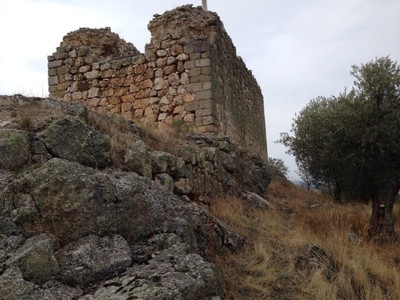
Only three of the original façades survive; the interior has essentially disappeared. Despite the advanced state of decay, the remaining walls are still imposing enough to give a real sense of the scale of the original stronghold. The site appeals most to visitors with an interest in regional history, along with photographers drawn to its raw, atmospheric setting against the Castilian countryside.
The castle is now owned by the municipality of Cuerva and is legally protected under a decree dated April 22, 1949, as well as under Spain's Historical Heritage Law 16/1985. That protection means the ruins, despite their condition, are safeguarded against further deterioration or the removal of building material.
How do you get there?
Cuerva sits in the province of Toledo and is an easy drive from both the city of Toledo and Madrid. The castle stands within the town itself, so once you arrive in Cuerva a short walk is all it takes to reach the walls. It's worth pairing the visit with a stroll through the town, which still retains the feel of a historic Castilian settlement.
When is the best time to visit?
Castile-La Mancha has hot summers and cold winters, so spring and autumn are the most comfortable seasons for exploring the ruins, with milder temperatures and better light for photography. Since there's no visitor infrastructure on site, plan to visit during daylight hours.
Frequently asked questions
Can you go inside the castle? There is effectively no interior left to enter — only the outer façades remain, so a visit means viewing the walls from the outside.
Is there an entrance fee? As a municipally managed ruin rather than a commercial attraction, the castle has no formal ticketing — it's an open, modestly maintained heritage site.
Why is the castle in ruins? Centuries of neglect by successive owners from the 16th century onward, combined with the demolition of the main façade in 1881 for road-building material, left the castle in its current state.
What else is worth combining with a visit? A walk around Cuerva itself, and if time allows, a look at other Toledo-province sites connected to the Reconquista and Renaissance periods.
Nearby places

Earn badges for the places you visit
Download NextOnTrip, discover new places and check off your trails.