About this place
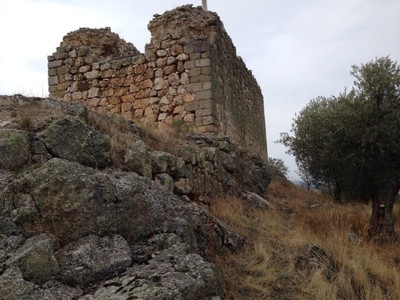
Torre Tolanca is a solitary watchtower of Muslim origin, standing on a small rocky rise in the municipality of Sonseca, in the province of Toledo. It belongs administratively to Sonseca, yet it sits well outside the town itself, isolated on high ground — a location that reveals its original purpose: watching the surrounding land and passing on warnings of danger.
Where exactly does the tower stand?
The tower is located roughly 3.5 kilometres southwest of Sonseca. It can be reached on foot from town along a route known as the Camino de la Estrella, which crosses the Montes de Toledo, the range of low, scrub-covered hills stretching south of the city of Toledo. The hilltop position is no accident: it commands a wide view over the surrounding countryside, and the tower itself stayed within sight of other fortified points in the region.
An Andalusí origin
Historians trace Torre Tolanca back to the 10th century, during the period of Muslim rule over this part of the Iberian Peninsula, known as al-Andalus. It was never an isolated post — it formed part of a wider network of lookout points scattered across the Montes de Toledo, built to protect the city of Toledo itself during the internal conflicts that troubled the region at the time.
A network visible across the hills
Towers of this kind depended on being seen from one another: a watchman stationed at one point needed a clear line of sight to signals from the next. From Torre Tolanca, the view takes in the castles of Almonacid, Mora, Orgaz, and Ventas con Peña Aguilera, confirming that it operated as one link in a coordinated chain of surveillance and territorial control.
A Christian addition, then slow abandonment
At some later point, a barbican was added onto the tower's eastern side — a small defensive structure shielding the main access point. Its construction style differs noticeably from the original tower walls, which points to a Christian-era build, likely in the 12th or 13th century, when the surrounding territory was being defended against Almohad and Almoravid incursions. The tower therefore kept its defensive role for several more centuries after it was first raised. That changed only once resettlement of the area gathered pace from the 14th century onward: as the frontier moved further south and the region stopped being a contested border zone, the tower lost its strategic purpose and was gradually left to decay.
What survives today?
The standing structure measures about 23 metres long, 9 metres wide, and 10 metres tall, though researchers believe it may originally have stood 4 to 5 metres taller before its upper section was lost. What remains today is the tower itself together with the attached barbican on its eastern flank. The site is listed under Spain's heritage protection rules, covered by the generic declaration from the decree of 22 April 1949 and by Law 16/1985 on Spanish Historical Heritage.
Frequently Asked Questions
Where is Torre Tolanca in relation to Sonseca? About 3.5 km southwest of the town centre, on a rocky rise within the Montes de Toledo.
How do you get to the tower? On foot from Sonseca, following the Camino de la Estrella trail through the surrounding hills.
How old is the tower? Its core dates to the 10th century, from the Muslim al-Andalus period; the barbican was added later, during the Christian era.
What was it used for? It formed part of a chain of watchtowers guarding the approaches to Toledo, kept in visual contact with the castles of Almonacid, Mora, Orgaz, and Ventas con Peña Aguilera.
Can visitors see the tower up close? It is a legally protected heritage site, accessible along the walking trail that leads out from Sonseca.
Nearby places

Earn badges for the places you visit
Download NextOnTrip, discover new places and check off your trails.