About this place
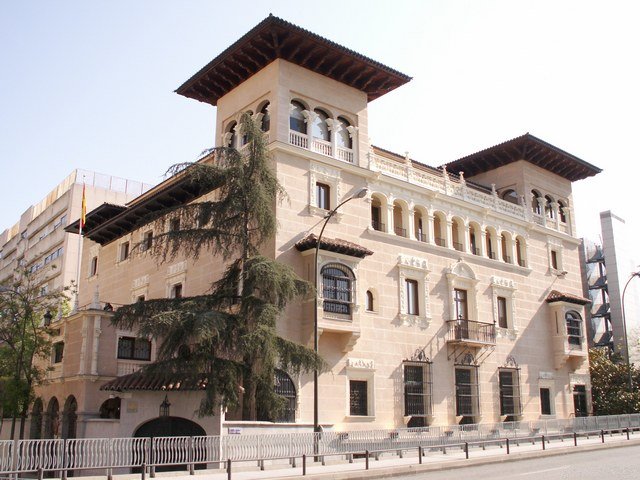
Palacete del duque de Plasencia is a compact yet strikingly elegant townhouse at Calle Monte Esquinza 48 in Madrid, tucked into the quiet Chamberí district just a short walk from Paseo de la Castellana. Today it houses the Norman Foster Foundation, making it a small but rewarding stop for anyone interested in architecture and design history.
Where does the palacete's name come from?
The building was raised in 1912 at the request of María del Pilar Gayoso, Duchess of Plasencia — despite the name pointing to a duke, it was the duchess herself who commissioned the residence. She hired architect Joaquín Saldaña y López, known at the time for his refined, French-influenced town palaces in Madrid.
What can you actually see when you visit?
The façade is a showcase of Saldaña's signature style: richly carved window moldings with floral motifs, meticulously worked wrought-iron railings and balconies, and a distinctive corner balcony whose shape echoes a nineteenth-century theatre box. That corner feature is what makes the building stand out among its neighbors, so it's worth walking around the block to appreciate how the façade reads from both streets.
The interior isn't open to casual visitors since the building now functions as the foundation's working headquarters, but the exterior details can be admired freely from the street at any time of year.
How has the building's role changed over time?
After its early decades as an aristocratic residence, the palacete took on a very different life. For a period it served as the Turkish Embassy, and later, until 2011, it housed Altae, the private bank first owned by Caja Madrid and then by Bankia. In 2013, architect Norman Foster and his wife purchased the property for 9 million euros, intending it as the home for his foundation. Since 1 June 2017, the building has officially served as the headquarters of the Norman Foster Foundation, an institution dedicated to architecture, urban planning, and sustainable city development.
How do you get there?
Monte Esquinza 48 sits right in central Madrid, in the Chamberí district near the border with Salamanca and Justicia. The metro is the easiest option — the closest stations are Alonso Martínez and Rubén Darío (lines 4, 5, and 10), both just a few minutes' walk from the building. The area is also well served by bus routes, and for visitors exploring the city center on foot, it makes a natural stop between Paseo de la Castellana and Plaza de Alonso Martínez.
When is the best time to visit?
Since the main draw is the exterior architecture, the palacete can be enjoyed year-round regardless of season. Spring and autumn make for the most pleasant walks, as Madrid's summer heat can be intense for strolling through the neighborhood. It's worth pairing a visit with a stroll through the surrounding Chamberí streets, which hide many similarly elegant residences from the turn of the twentieth century.
Frequently Asked Questions
Can you go inside the palacete? No, the building serves as the working headquarters of the Norman Foster Foundation, so the interior is not open to tourists.
Who built the Palacete del duque de Plasencia? It was designed by architect Joaquín Saldaña y López in 1912, commissioned by the Duchess of Plasencia, María del Pilar Gayoso.
Why is the palacete associated with Norman Foster? Because the architect and his wife bought the building in 2013, and since 2017 it has been the headquarters of his foundation focused on architecture and urbanism.
What's the best way to get there? Take the metro to Alonso Martínez or Rubén Darío station, both just a few minutes' walk from the building through the Chamberí district.
Nearby places

Earn badges for the places you visit
Download NextOnTrip, discover new places and check off your trails.