About this place
The New Jewish Cemetery in Prague-Smíchov is a small, quiet burial ground tucked next to the better-known Malvazinky cemetery, with its entrance on Peroutkova street. It was established in the early twentieth century to serve the Jewish community of Smíchov, a district that had grown rapidly on the west bank of the Vltava as an industrial hub, outpacing the capacity of earlier burial sites.
When was the cemetery founded?
The cemetery was founded in 1903. It served the Smíchov Jewish community for most of the twentieth century, though burials grew increasingly infrequent over time, with the last ones taking place sporadically until 1990. Today it functions more as a heritage site than an active cemetery, drawing local historians and visitors interested in traces of Prague's pre-war Jewish community.
How large is the cemetery, and how many gravestones remain?
The site covers roughly 6,205 square meters. About 800 gravestones survive today, a relatively modest number for a Jewish cemetery of this footprint, partly a result of changes made to its layout during the second half of the twentieth century.
What can visitors see on site?
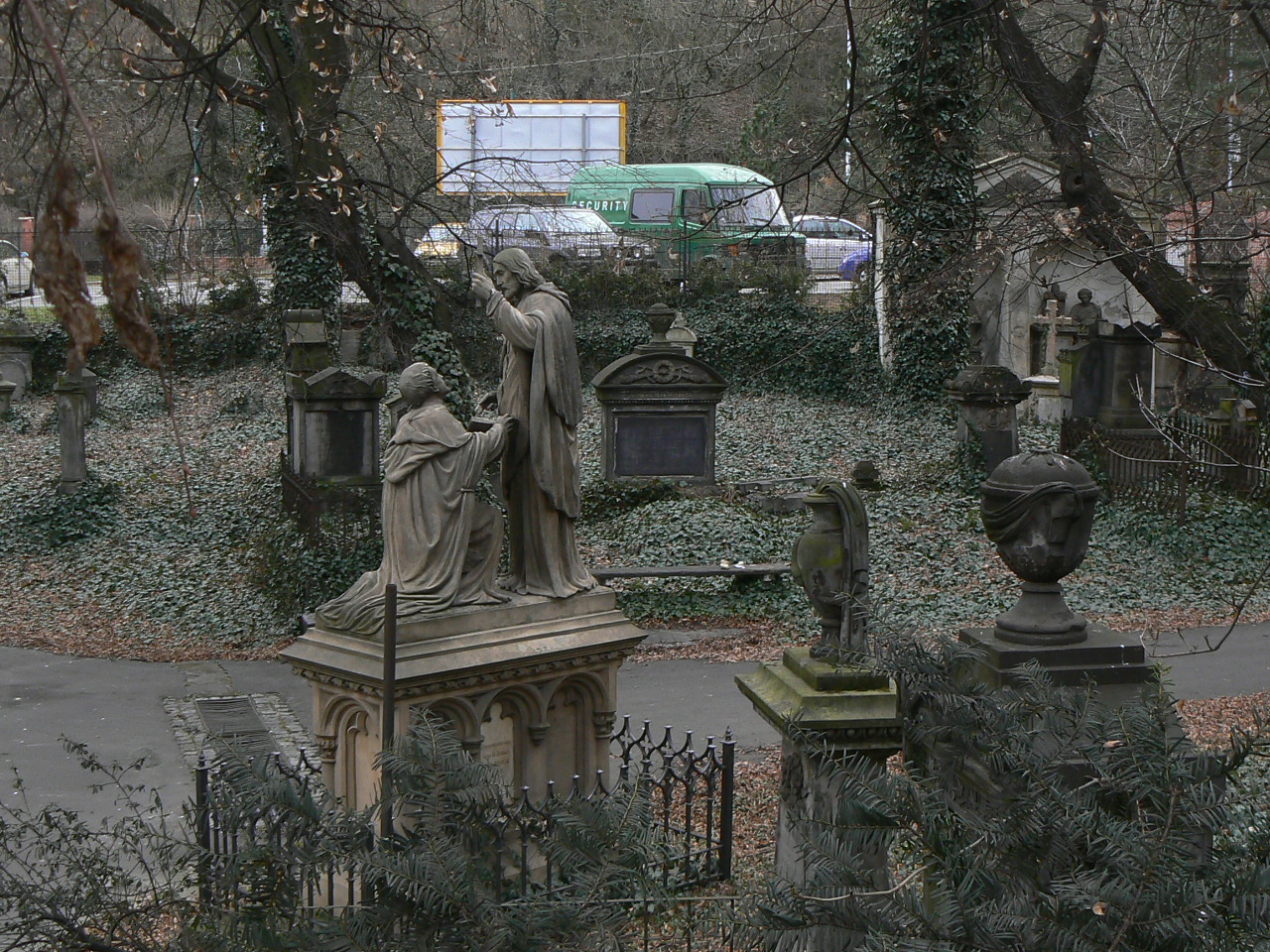
The eastern section of the cemetery is dominated by an elaborate Baroque Revival tomb belonging to Josef and Rosa Porges from Portheim, one of the most striking funerary structures on the grounds. Scattered among the simpler, more modest gravestones elsewhere on the site are the graves of individuals connected to the cultural and intellectual life of German-speaking and Jewish Prague.
A memorial plaque near the entrance commemorates the cemetery's founders, offering visitors unfamiliar with its history a brief account of its origins.
What changes did the cemetery undergo after World War II?
After 1980, the northern section of the cemetery, which contained children's graves, was reduced. A new building for the Seventh-day Adventist Church was constructed in 1982–1985 on the site of the former ceremonial hall, a change typical of the era, when many religious minority buildings in Czechoslovakia were repurposed or scaled back.
Who is buried here?
Among those buried at the cemetery is the poet and translator Fridrich Adler (1857–1938), a figure tied to Prague's German-language literary scene at the turn of the century. In 1956, the urn of poet and prose writer Rudolf Fuchs (1890–1942) was interred here; Fuchs had died during a bombing raid in London, where he had lived in exile after fleeing the Nazi regime.
Frequently asked questions
Is the cemetery open to the public? As a historic burial site, it's best visited with the respect due to a place of burial. Check current opening hours on site or with the administration of the neighboring Malvazinky cemetery.
How is this different from the famous New Jewish Cemetery in Žižkov? These are two entirely separate sites. The Žižkov cemetery, known for Franz Kafka's grave, is far larger and better known. The Smíchov cemetery is a smaller, local burial ground founded over a decade earlier, established specifically to serve the Jewish community of that district.
How do you get there? The entrance is on Peroutkova street, right next to the Malvazinky cemetery, which is served by several tram and bus lines running through Smíchov.
Nearby places

Earn badges for the places you visit
Download NextOnTrip, discover new places and check off your trails.