About this place
The New Jewish Cemetery in Kolín sits on Zálabí, across the Elbe from the historic town centre, at the end of Veltruská street. Established in the late 19th century once the medieval Jewish cemetery could no longer serve the growing community, it remains a key site of memory for one of the oldest Jewish communities in Bohemia.
How to get there?
Kolín lies in Central Bohemia, roughly 60 kilometres east of Prague, right on the main railway line connecting the capital with Brno and Ostrava, so the town is easy to reach by train. The New Cemetery is located on the opposite bank of the river from the old town, in the Kolín V (Zálabí) district, at the far end of Veltruská street — a walk of about fifteen minutes from the main square. Visits must be arranged in advance through the Municipal Information Centre, since the site is normally closed to casual visitors.
What will you see?
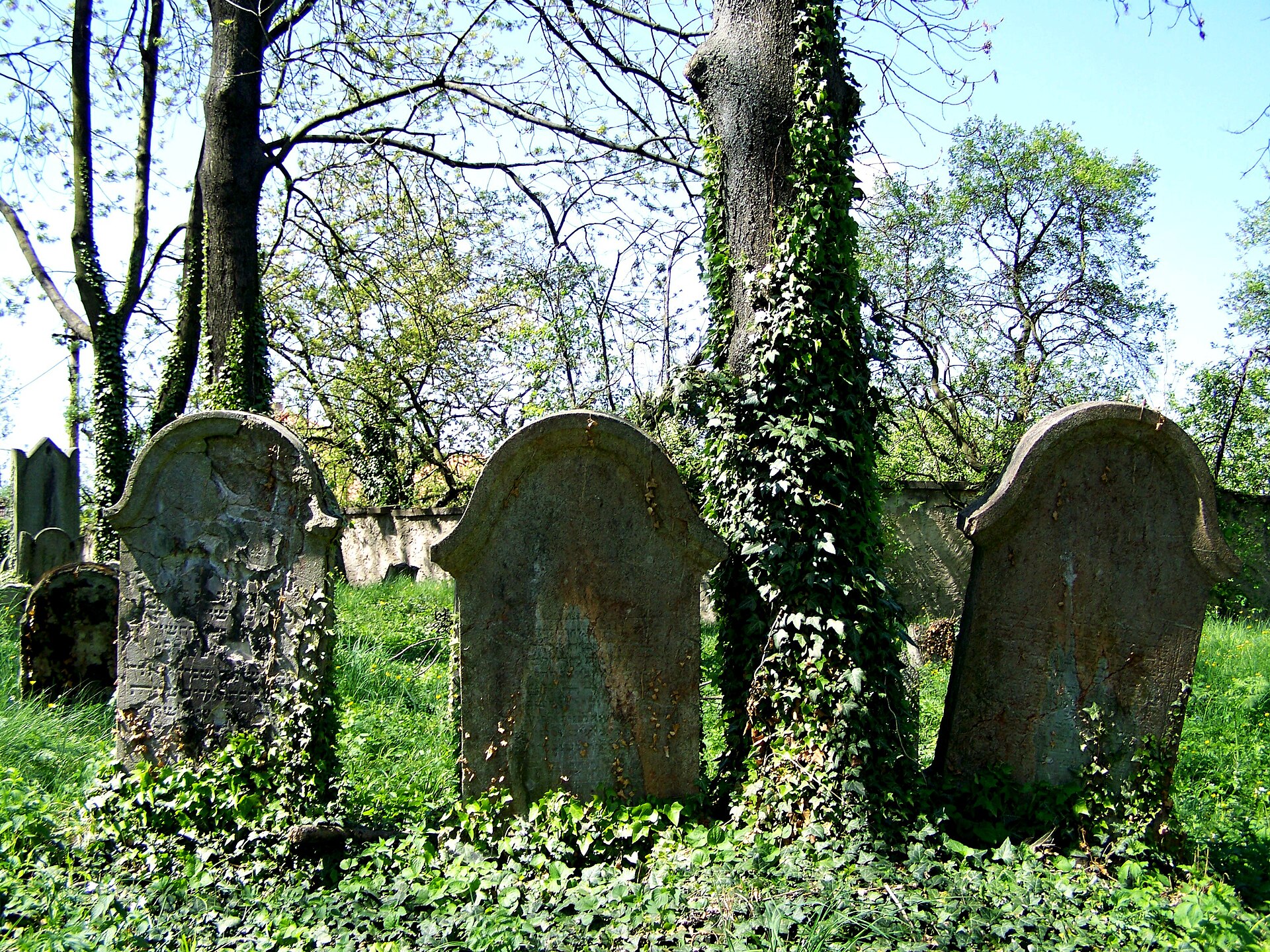
The cemetery was built between 1886 and 1887, after the old Jewish cemetery on Pražské předměstí, in use since the Middle Ages, ran out of space. It now holds close to a thousand graves across roughly three-quarters of its grounds, with the last burial taking place in 1979. The tombstones reflect the typical style of Central European Jewish cemeteries from the turn of the 20th century, ranging from modest matzevot to more elaborate monuments belonging to prominent merchant and industrialist families.
At the centre of the cemetery stands a memorial to the victims of Nazism, unveiled on 23 April 1950. It was designed back in 1948 by sculptor Věra Bejrová and architect Jaroslav Křelina, and consists of a central obelisk surrounded by eight plaques bearing the names of 487 residents of Kolín who perished in the Holocaust. Ashes brought from the Terezín ghetto, the national cemetery in Terezín, and the camps at Auschwitz, Majdanek, Łódź and Warsaw were interred within the monument, making it one of the more significant memorials to the destruction of the Czech Jewish community.
Among those buried here are opera singer Bedřiška Reichnerová, industrialist and large landowner Bernard Mandelík, and several local rabbis. Along the cemetery's left boundary wall lie the graves of Clara and Philip Kafka, relatives of the writer Franz Kafka, linking the site to a wider chapter of Czech-Jewish history.
The history of Kolín's Jewish community
The Jewish community of Kolín was among the oldest and, for a time, the second largest in Bohemia after Prague. The need for a new cemetery in 1887 was a direct consequence of how large and active this community had become by the 19th century — after several centuries of use, the old cemetery on Pražské předměstí simply had no room left for further burials. The site is today protected as a cultural monument of the Czech Republic.
When to visit?
Spring and summer are the best seasons for a visit, as longer days and steadier weather make it easier to walk the open-air grounds and to arrange a viewing time through the tourist information office in advance. Autumn tends to bring fewer visitors, which suits the reflective character of the place. Combining the visit with a stop at Kolín's old Jewish cemetery and its synagogue in the town centre gives a fuller picture of the local community's history.
Frequently asked questions
When was the New Jewish Cemetery in Kolín founded? It was built between 1886 and 1887, after the town's older Jewish cemetery could no longer accommodate the growing community.
What does the memorial on the grounds commemorate? Unveiled in 1950 and designed by Věra Bejrová and Jaroslav Křelina, the memorial honours 487 residents of Kolín murdered in the Holocaust and holds ashes from Terezín, Auschwitz, Majdanek, Łódź and Warsaw.
Who is buried in this cemetery? Notable burials include opera singer Bedřiška Reichnerová, industrialist Bernard Mandelík, several local rabbis, and Clara and Philip Kafka, relatives of Franz Kafka.
Can the cemetery be visited without a reservation? No — visits must be booked in advance through Kolín's Municipal Information Centre, as the site is kept closed to the public otherwise.
Nearby places

Earn badges for the places you visit
Download NextOnTrip, discover new places and check off your trails.