About this place
Navia Town Hall, in the town of Navia on Spain's western Asturian coast, overlooks the Plaza de las Armas, the town's central square.
What does the building look like?
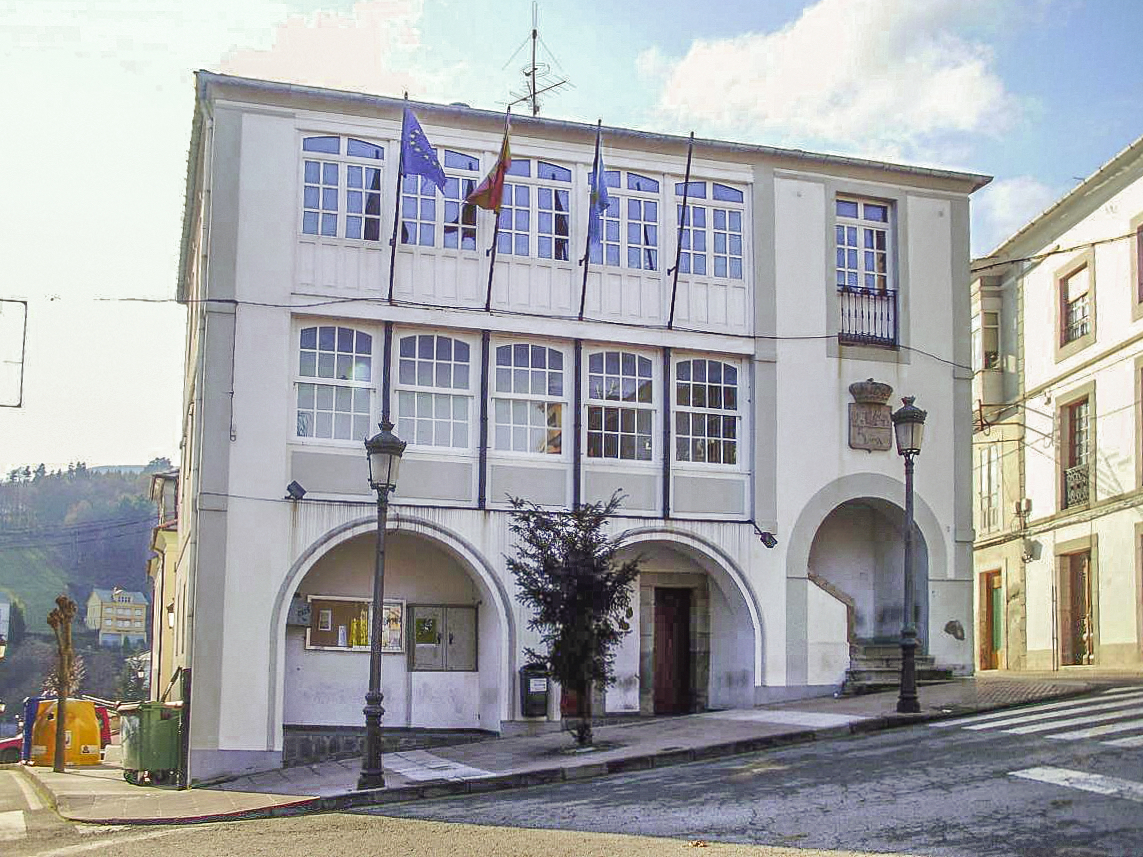
The town hall rises over a basement level and two upper floors, each level marked off by horizontal bands running across the facade. Its windows are topped with plain lintels, and above each one sits a small cartouche. A continuous balcony runs along the first floor, while the second floor carries the building's coat of arms, set within a smooth border and flanked by a pair of rampant lions. Above it all stands a square tower housing a clock inscribed with the date 1885.
Why does it look older than its municipal role?
The structure predates its current use by a full century: it was built in the 18th century by a branch of the Sierra Pambley family, long before it ever served as a seat of local government. Only in the 19th century did it take on the role of Casa de la Villa, the town hall proper — and the 1885 date on the clock face marks that later chapter. The coat of arms on the front wall is no decorative afterthought; it references three family lines woven into the area's history: Sierra, Avello, and Navia.
What sits right next to it?
Directly across the square stands the Casa de los Navia-Osorio, the residence of the family whose name the town carries. Next door to the town hall itself is another building, the Casa del Limonar, which now hosts the council's plenary sessions and other civic events — leaving the town hall to house the bulk of the municipal administrative offices.
How far back does local government here go?
The roots of Navia's civic life reach well beyond the current building. As early as the 12th century, scattered rural settlements known as "villae" began banding together into towns, giving rise to the first jurisdictions and early town councils. The council of Navia at that time governed not just the town itself but also the territory of Villayón and the sprawling parish of La Montaña — an arrangement that held until the 19th century, when the municipal structure shifted closer to what stands today.
How do you get there, and when's the best time to visit?
Navia sits directly on the Camino del Norte, the coastal branch of the Camino de Santiago pilgrimage route, so pilgrims walking through town pass the square as a matter of course. The Plaza de las Armas sits right in the heart of Navia, an easy walk from anywhere in the old town — no special trip required, just fold it into a stroll through the center.
Frequently asked questions
How old is Navia's town hall? The building itself dates to the 18th century, but it only became the town's seat of government — the Casa de la Villa — in the 19th century; the clock tower carries the date 1885.
What does the coat of arms on the facade represent? Framed by a smooth border and flanked by two rampant lions, it references three family lines tied to the region's history: Sierra, Avello, and Navia.
Can visitors go inside? The building is a working municipal office, so access is limited to administrative opening hours; council plenary sessions actually take place next door, in the Casa del Limonar.
What else is worth seeing nearby? Right across the same square stands the Casa de los Navia-Osorio, the family residence that gave the town its name — a natural starting point for exploring the rest of Navia's old town.
Nearby places

Earn badges for the places you visit
Download NextOnTrip, discover new places and check off your trails.