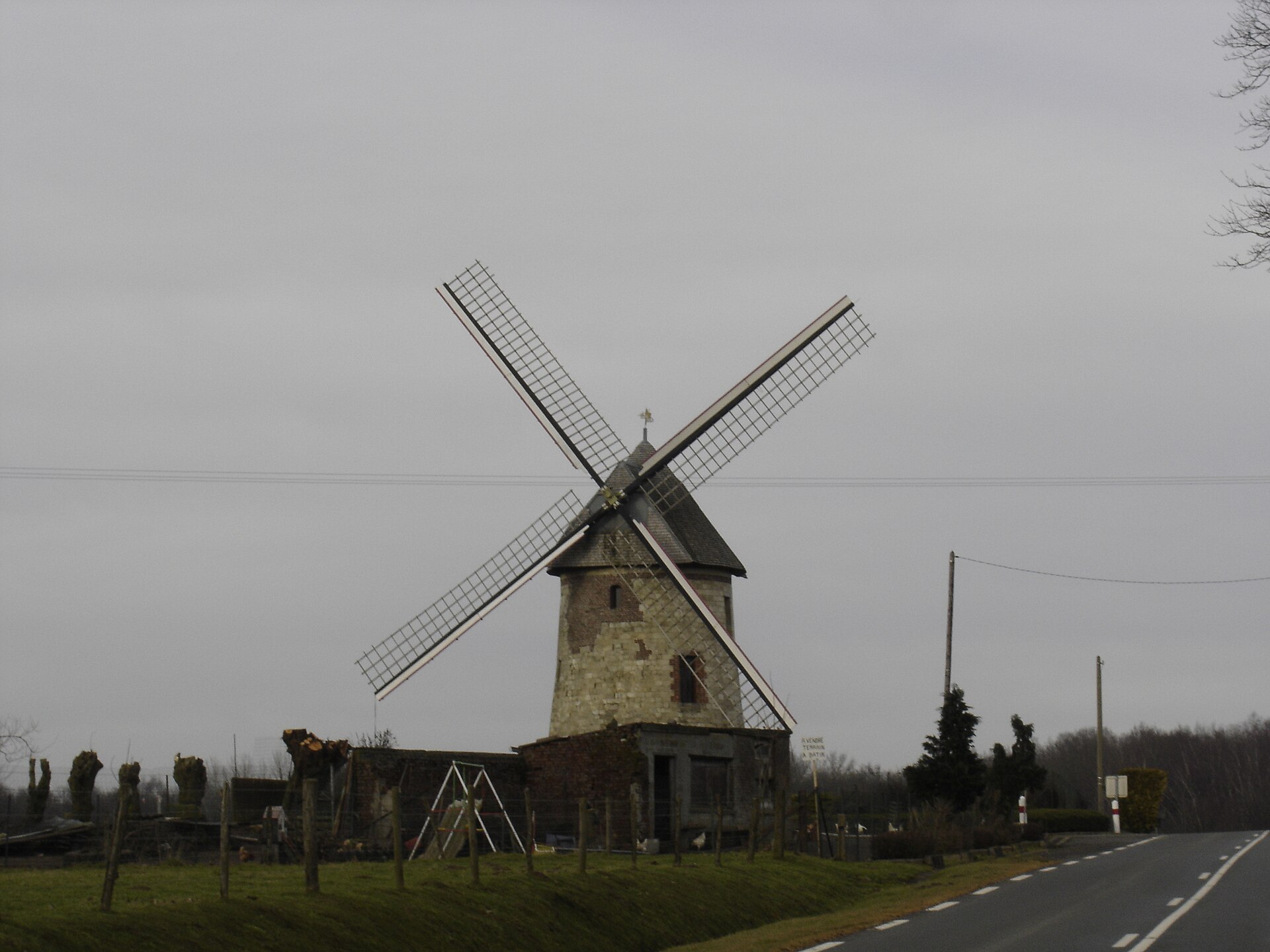
About this place
Moulin Brunet is a stone windmill standing at the edge of Walincourt-Selvigny, a small village in the Nord department of France, right on the departmental road D960 heading toward Guise. Its conical brick-and-stone tower has watched over the fields of the Cambrésis countryside for centuries, surviving war, decades of neglect, and an eventual community-led rescue.
Why is it called Moulin Brunet?
The name has nothing to do with color or setting — it comes from the mill's last working miller, Arthur Brunet, who operated it until 1914. He was the final person to grind grain there before the outbreak of the First World War brought milling on the site to an abrupt halt.
How old is the mill?
Milling on this spot goes back much further than the building itself. A stone windmill in Walincourt was already recorded in 1293, showing the site served the local community since the Middle Ages. The structure visitors see today dates from later, built in the 15th century between 1453 and 1480. For centuries it functioned as a "moulin banal" — a mill owned by the Lord of Walincourt that local peasants were obligated to use, one of the standard feudal dues of the era.
What happened after the French Revolution?
The Revolution of 1789 reshuffled property rights across France, and Moulin Brunet followed the pattern. Once feudal privileges were abolished, the mill passed into private hands and ran as a commercial operation until 1914, providing a living to successive generations of millers before the war interrupted it for good.
Why was the mill destroyed?
During the First World War, German forces occupying the area turned the mill's tall masonry tower into an observation post, its height giving a clear view over the surrounding land. In 1916, the Germans destroyed the mill. That act triggered a long decline that lasted, largely unbroken, until 1991 — nearly three quarters of a century during which the windmill stood abandoned.
How was Moulin Brunet saved?
The turning point came in the early 1990s, when local residents decided this piece of heritage should not be allowed to disappear. An association of Friends of the Old Mill formed and set the restoration process in motion. The decisive step came in 2000, when the mill underwent full rehabilitation through a partnership between the commune of Walincourt-Selvigny, the Friends of the Mill association, and ARAM, a regional association dedicated to preserving windmills. Thanks to that joint effort, a building once headed for total ruin was brought back to a state worth visiting.
What does the mill look like today?
Moulin Brunet is a brick-and-stone tower mill with a tapering, conical shape — a classic form for traditional windmills in northern France. Its sails are of the Flemish type, echoing the region's close ties to neighboring Belgium and a shared milling tradition along the border. The mill sits just south of the village center, clearly visible from the D960 toward Guise.
Why visit Moulin Brunet?
For anyone curious about French rural history, this mill is tangible proof of how the local economy of the Cambrésis once worked. For generations, mills like this one determined whether bread — the staple of the local diet — made it to the table. Moulin Brunet stands as a witness to three distinct eras: the medieval feudal system, 19th-century private enterprise, and the upheaval of the First World War. Its restoration is also a reminder of how much a small, determined local association can achieve to save a disappearing landmark.
Frequently asked questions
Where is Moulin Brunet located? The mill stands in Walincourt-Selvigny, in the Nord department, on the D960 departmental road toward Guise, at the edge of the village.
When was the mill built? The current structure dates from the 15th century, built between 1453 and 1480, though a windmill on this site was already recorded in 1293.
Who was the last miller? Arthur Brunet, who operated the mill until 1914 and whose name the mill still carries today.
Why was the mill destroyed? In 1916, during the First World War, German forces destroyed it after using its tower as an observation post.
When was the mill restored? Restoration efforts began after 1991 thanks to the Friends of the Old Mill association, with a full rehabilitation completed in 2000 in partnership with the commune and ARAM.
Nearby places

Earn badges for the places you visit
Download NextOnTrip, discover new places and check off your trails.