About this place
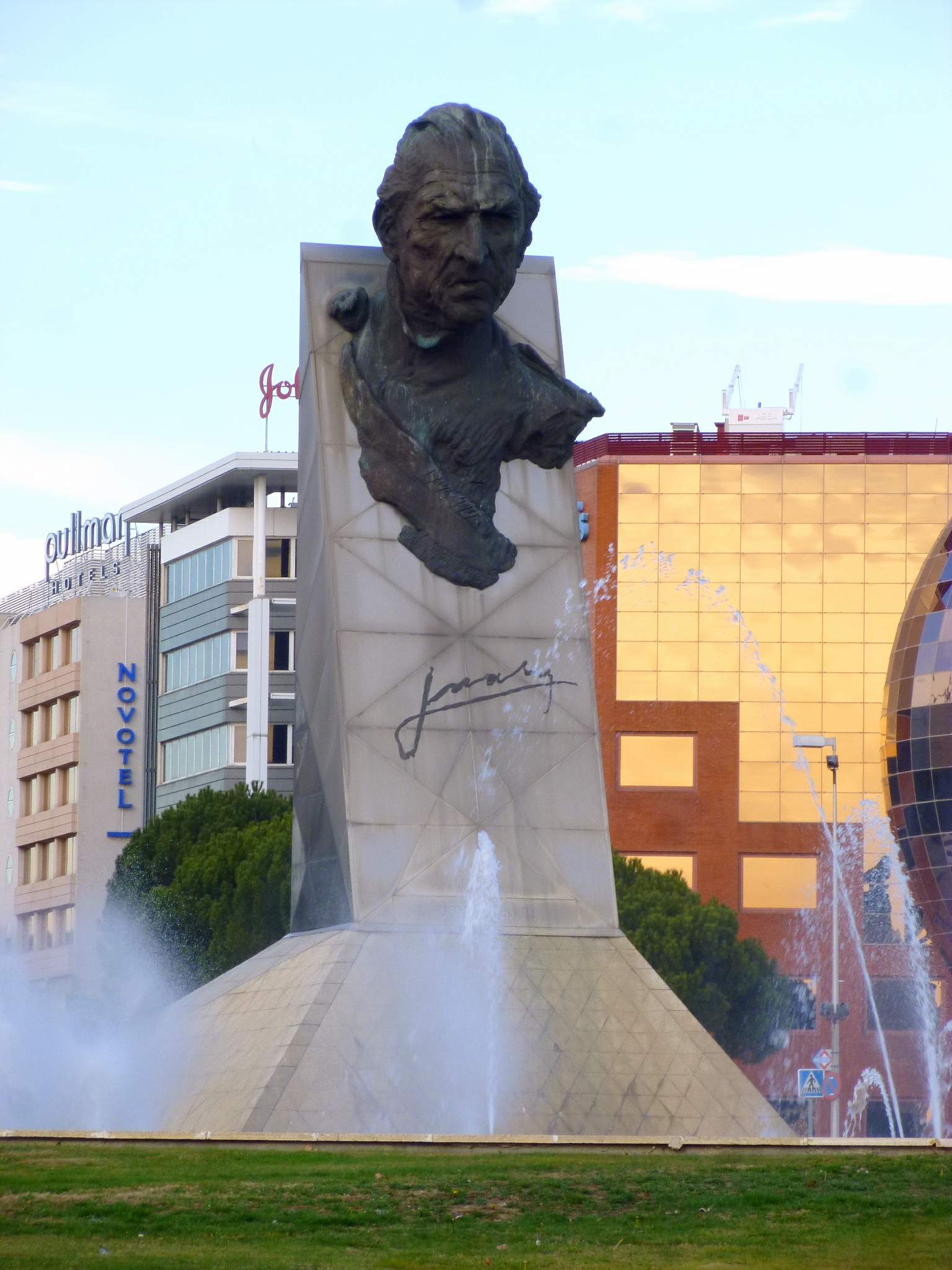
Monumento a don Juan de Borbón is a monument in Madrid, standing at the entrance to Parque Juan Carlos I, in the Campo de las Naciones district. It rises over the Glorieta de Don Juan de Borbón y Battenberg and is one of the few sites in the Spanish capital dedicated specifically to the father of King Juan Carlos I.
Who built the monument, and when?
The monument was erected in 1994 on the initiative of the newspaper ABC, which organized a public fundraising campaign to finance its construction. It was designed by Spanish sculptor and architect Víctor Ochoa. King Juan Carlos I personally unveiled it on 27 June 1994, less than a year after the death of his father, the Count of Barcelona, who passed away on 1 April 1993.
What will you see there?
The centerpiece is a monumental bronze bust weighing 7 tonnes, mounted on a tall steel monolith 16 metres high. The Count of Barcelona is portrayed at a mature age, gazing southward, in a firm and composed stance. The sculpture draws on Baroque artistic devices — strong contrasts of light and shadow, sharply defined facial features and a bold silhouette — which together emphasize the gravity and character of the man it depicts. Because of the scale of the monolith, the monument is visible from a considerable distance and serves as a clear landmark at the park entrance.
Who was don Juan de Borbón?
Don Juan de Borbón y Battenberg, Count of Barcelona, was the father of King Juan Carlos I and, by extension, the grandfather of Spain's current king, Felipe VI. Although he himself never formally reigned, he holds a key place in Spanish monarchist tradition as the figure who preserved the continuity of the Bourbon dynasty through the 20th century. The Madrid monument is symbolic in nature — it is not his burial site, but a public tribute to his role in the history of the Spanish monarchy.
How do you get there?
The monument stands in the Campo de las Naciones district, in the north-eastern part of Madrid, right next to Parque Juan Carlos I, one of the city's largest urban parks. The area is well connected to central Madrid by metro and city bus lines, and the monument itself is located at the park's main entrance, making it easy to combine a visit with a walk through the green spaces beyond.
When is the best time to visit?
Since the monument stands in an open space at the park entrance, it is best seen during daylight hours, when natural light brings out the sculpture's detail and the proportions of the monolith. Spring and autumn bring mild temperatures to Madrid, making them good seasons for a longer walk around the park combined with a stop at the monument.
Frequently asked questions
Who designed the monument? It was created by Spanish sculptor and architect Víctor Ochoa, who completed the work in 1994.
How much does the bust weigh? The bronze bust depicting don Juan de Borbón weighs 7 tonnes and sits atop a 16-metre steel monolith.
When was the monument unveiled? It was unveiled on 27 June 1994, in a ceremony led personally by King Juan Carlos I.
Is this the burial site of don Juan de Borbón? No, it is a symbolic monument honoring the father of King Juan Carlos I, not his burial place.
Nearby places

Earn badges for the places you visit
Download NextOnTrip, discover new places and check off your trails.