About this place
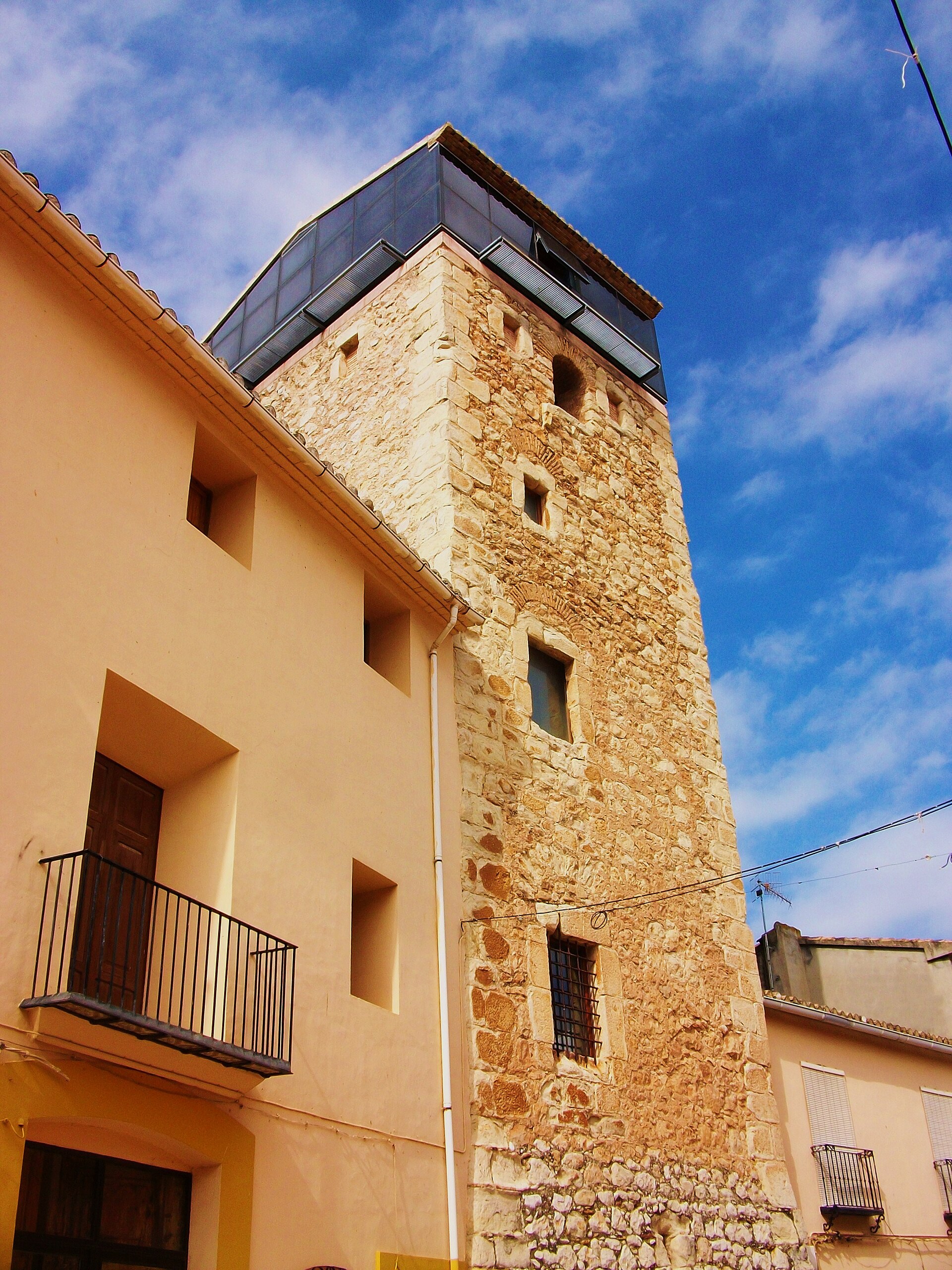
Masia fortificada de l'Albardanera is a fortified farmhouse standing on flat ground near the Montgó massif, north of Pedreguer, in the Marina Alta district of Alicante province, in the Valencian Community. The property has been listed in the Valencian Generalitat's Catalogue of Cultural Heritage Assets since 2003, making it a recognized example of the region's defensive rural architecture.
Where is the farmhouse located?
The building sits in the Albardaneres area, along the road connecting Pedreguer to Dénia, close to where the road crosses the old narrow-gauge railway line. The setting is open and flat, with the Montgó rising in the background. Its coordinates are 38.81874, 0.04634. The farmhouse currently serves as the summer residence of its owners, so it can only be viewed from the outside, from the public road.
Why does the farmhouse look defensive?
The rectangular building has two or three floors and retains features typical of defensive rural architecture, including corner turrets (garitons) that once served as lookout points. Fortified farmhouses like this one appeared across Marina Alta as a response to threats facing the countryside: bands of bandits that troubled the area during the 18th century, and, according to some accounts, earlier raids by Barbary pirates along the coast. The exact construction date has not been firmly established — some architectural details, including neoclassical elements, point to work carried out in the second half of the 19th century, suggesting the building took shape over several construction phases rather than a single period.
What can visitors see from outside?
Despite later renovations, some of the original defensive elements have survived, while others were removed during remodeling. To the right of the main tower stands a riurau, a traditional stone-pillared covered structure typical of Marina Alta farmhouses, historically used for drying grapes into raisins; at the Albardanera it also forms the main entrance to the property. The façade additionally features a covered porch draped in grapevines, and the interior is organized around a central courtyard.
What is the historical background of the area?
During the early modern period, Marina Alta faced recurring instability: coastal communities feared pirate raids, while inland routes between towns were troubled by bandit groups. Rural landowners responded by building farmhouses with defensive characteristics — thick walls, corner turrets, and few window openings on the lower floors. The Albardanera is one of the surviving examples of this practice, though today it functions purely as a private residence with no public access.
Frequently asked questions
Can visitors enter Masia fortificada de l'Albardanera? No. The building is privately owned and used as a summer home by its owners. It can only be seen from the outside, from the public road linking Pedreguer and Dénia.
How old is the building? The exact construction date is unknown. Some sources connect it to the 17th–18th centuries and fears of pirate or bandit attacks, while others point to architectural details more typical of the second half of the 19th century.
What does its "bien de interés cultural" status mean? It means the property is listed in the Valencian Generalitat's Catalogue of Cultural Heritage Assets, a designation it received in 2003 in recognition of its value as part of Marina Alta's architectural heritage.
What is the riurau next to the farmhouse? A riurau is a traditional stone-pillared covered structure common on Marina Alta farmhouses, historically used for drying grapes into raisins. At the Albardanera, it also serves as the main access point to the property.
Nearby places

Earn badges for the places you visit
Download NextOnTrip, discover new places and check off your trails.