About this place
The Marian Plague Column is a baroque sandstone column standing on Dolní náměstí (Lower Square) in Opava, right in front of the Church of St. Adalbert. It's easy to walk past without a second glance, yet the monument carries more than three and a half centuries of local history — plague outbreaks, wars, and repeated efforts to save it from ruin.
Where exactly is it?
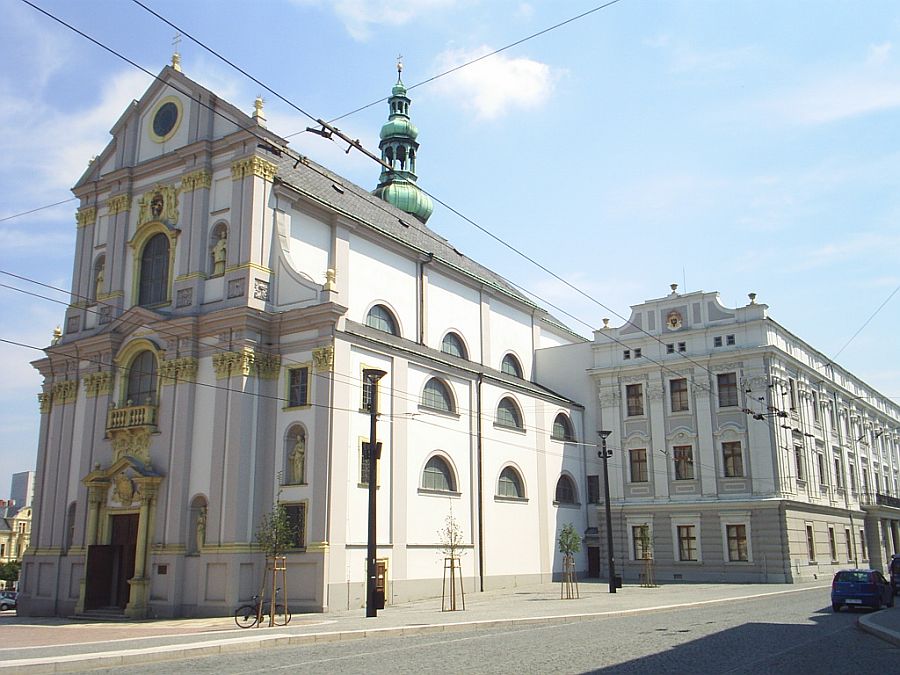
The column stands in the heart of the old town of Opava, on the Lower Square — one of the city's two historic main squares, alongside the larger Upper Square. Its position right next to the Church of St. Adalbert makes it a natural landmark for anyone exploring Opava's historic center on foot; heading south from the Upper Square, a short walk brings you straight to it.
Where did the column come from?
The monument was commissioned in 1675 by Count Jiří Štěpán of Vrbno, who modeled it on Vienna's Marian column "Am Hof" — one of the best-known baroque monuments of its kind in the Habsburg lands. Plague columns like this were erected across Central European towns during the same period, serving both as a votive offering of thanks for the end of a plague epidemic and as a symbolic plea for protection against future outbreaks. Unfortunately, the original 17th-century sculpture has not survived in its initial form; today it is known only through a handful of period depictions.
Why did it have to be rebuilt?
Over time the original column suffered severe damage, and in 1825 it was taken apart and removed from the square altogether. For several decades the Lower Square stood without it. The column was finally re-erected in 1869, combining surviving fragments of the old sculptures with newly carved elements. This time, the sculptors drew inspiration from a different Viennese model — the plague column "Am Graben," standing in the very center of the Austrian capital. Further major repairs followed in 1927, and a complete, comprehensive restoration was carried out in 1997 under the direction of Ladislav Werkman, a conservator from Olomouc.
What does it look like today?
The column rises from a triangular pedestal, its faces carved with inscriptions honoring the Virgin Mary alongside records documenting the monument's origin and subsequent repairs. From the pedestal grows a slender shaft, crowned by a statue of the Virgin Mary standing on a globe wrapped by a serpent — a motif typical of Immaculate Conception iconography, symbolizing triumph over evil. Since 1964, the Marian Plague Column has been listed as a protected cultural monument in the Czech Republic, which guarantees it formal conservation oversight.
Frequently asked questions
Where exactly does the Marian Plague Column stand? On Dolní náměstí (Lower Square) in Opava, directly in front of the Church of St. Adalbert.
Who commissioned the column, and when? It was commissioned in 1675 by Count Jiří Štěpán of Vrbno, modeled on Vienna's Marian column "Am Hof."
Why was the column dismantled in 1825? Because of severe damage to the original baroque structure — it was removed from the square and only rebuilt in 1869.
Is the monument protected today? Yes, it has been listed as a Czech cultural monument since 1964, and it underwent a complete restoration in 1997.
Nearby places

Earn badges for the places you visit
Download NextOnTrip, discover new places and check off your trails.