About this place
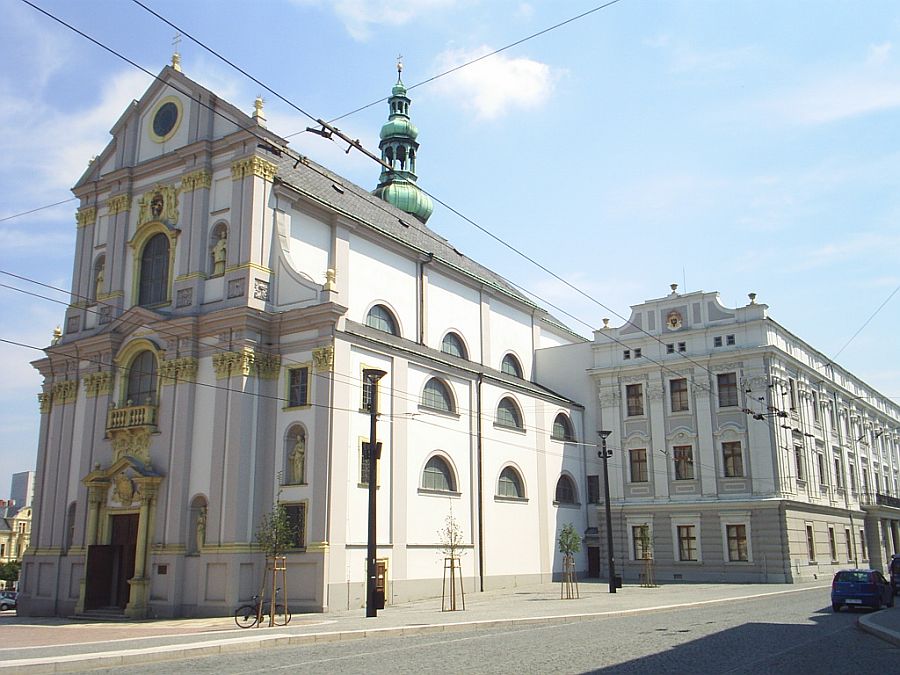
Church of Saint Adalbert in Opava is one of the oldest sacred buildings in the city, standing in the historic core of Opava right by the Lower Square (Dolní náměstí). Behind its Baroque facade lies a much older story, stretching back to the Middle Ages and through some of the sharpest religious conflicts in Central European history.
What is the history behind the church?
The first written mention of a church on this spot dates to 1429, though historians believe it was actually founded before 1350 as a subsidiary chapel of the parish of the Assumption of the Virgin Mary. It was originally dedicated to Saint George and belonged to the Teutonic Order. By the 16th century it had switched patronage to Saint Adalbert and served the city's Czech-speaking congregation — a Lutheran clergyman was already preaching there in 1532.
After Emperor Rudolf II issued his Letter of Majesty guaranteeing religious freedom, the church was formally returned to Protestant hands. Everything changed after the defeat of the Bohemian Revolt in 1620 and the early stages of the Thirty Years' War: Protestant priests were expelled from the city, and the newly summoned Jesuit order took charge of the church.
It was under Jesuit administration, between 1675 and 1681, that the building was rebuilt into the Baroque structure visitors see today, designed by the architect J. Brascha. The result is a single-nave church with side chapels and galleries, a tower on the northern side, and an ornately decorated western entrance — a layout typical of Jesuit church architecture of the period.
The 20th century brought further upheaval. In 1945, during the liberation of Opava at the end of the Second World War, the church was badly damaged by fire, which destroyed a large portion of its frescoes and its main altar. Much of what visitors see today is the result of a thorough restoration completed in 1995, which aimed to bring the building as close as possible to its original Baroque appearance.
What should visitors look out for?
The main draw is the architecture itself: a harmonious single-nave structure with a distinctive tower that stands out above the rooftops around the Lower Square. Despite the wartime losses, the interior still preserves the side-chapel-and-gallery layout characteristic of Jesuit churches, and the 1995 restoration gave it back a coherent Baroque character. The church remains an active place of worship, belonging to the parish of the Assumption of the Virgin Mary within the Diocese of Ostrava-Opava, so it's worth checking Mass times before visiting.
How to get there and when to visit?
The church sits in the oldest part of Opava, immediately next to the Lower Square, making it an easy stop on any walk through the historic centre. As a building listed among the Czech Republic's cultural monuments, it's best visited during the day, outside of service hours. Opava is a compact city, so a visit here pairs naturally with a stroll through the surrounding old town streets and its other sacred landmarks.
Frequently asked questions
How long does a visit take? Given the modest size of the single-nave building, seeing the exterior and interior typically takes 15 to 30 minutes.
Is the church original or rebuilt? The current structure dates from 1675–1681, but after a 1945 fire destroyed part of the frescoes and the main altar, the church underwent a thorough restoration in 1995 aimed at recovering its Baroque character.
Who was the church originally dedicated to? It was originally dedicated to Saint George; the patronage changed to Saint Adalbert in the 16th century.
Are services still held here? Yes, it functions as an active parish church within the Diocese of Ostrava-Opava, so it's worth factoring Mass times into your visit.
Nearby places

Earn badges for the places you visit
Download NextOnTrip, discover new places and check off your trails.