About this place
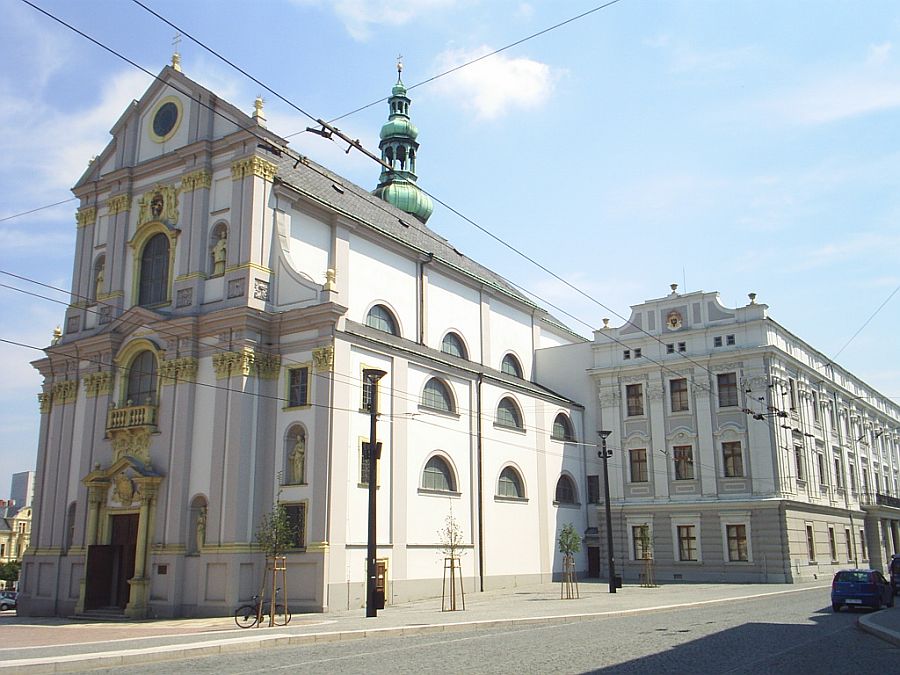
The Church of the Holy Spirit in Opava is one of the oldest surviving religious buildings in the city, forming part of a former Minorite monastery complex right in the historic centre.
Where did the church come from?
Franciscan friars of the Minorite order settled in Opava in the mid-13th century, and the first written mention of the church dates back to 1250. The land for the complex - a strip between the old cattle market (today's Masarykova Street) and the town's defensive walls - was most likely granted to the order by the Moravian margrave who later became Bohemian king, Přemysl Otakar II. The original building was raised in an early Gothic style, and its presbytery, completed around 1265, remains one of the oldest surviving parts of the structure.
How did the building change over time?
Before the mid-14th century, Duke Mikuláš II of Opava had the older presbytery demolished and replaced with a new stone choir rising more than twenty metres high. It was under his rule that the church took on a second role as a burial place for the ducal family.
Who is buried here?
Beneath the presbytery, Mikuláš II established a family tomb for the Opava branch of the Přemyslid dynasty. He himself was buried there in 1365, joined by his wife Jutta and sons Václav I and Přemek I, and later by his grandson Arnošt, the last member of the Opava Přemyslid line. That makes the church not just a place of worship but a genuine historical landmark tied to the medieval rulers of the region.
What damage did the city's fires cause?
The building's history includes several major fires that struck Opava. The 1431 fire seriously damaged the roofs of both the church and the adjoining monastery. Far greater destruction followed the catastrophic city fire of 1689, after which reconstruction - this time in the Baroque style - began a few years later and continued for most of the 18th century. That rebuilding gave the originally Gothic structure the Baroque appearance visitors still see today.
What is there to see on site?
The church is a single-nave building where traces of the original Gothic construction remain visible, especially in the tall presbytery, despite the later Baroque remodelling of the interior and facade. Together with the surrounding former monastery buildings, it forms one of the key stops on a walk through Opava's religious heritage sites in the town centre.
How do you get there?
The church stands right in the heart of Opava, within easy walking distance of the main square and the town's shopping streets, making it simple to fit into a walking tour of the centre. The immediate surroundings are dense historic townscape, so it is more convenient to park in one of the central car parks and continue on foot.
When is the best time to visit?
The interior and surroundings are best seen during the day, when natural light brings out the architectural detail of the presbytery. Opava as a whole is most pleasant to explore in spring and summer, when the streets and squares around its religious monuments are at their most inviting.
Frequently asked questions
Can visitors go inside the Church of the Holy Spirit? The building remains an active place of worship, so access to the interior depends on the current schedule of services and opening times - it is worth checking locally or with the tourist information point before visiting.
Why is this church historically significant? Because its presbytery holds the burial vault of the Opava branch of the Přemyslid dynasty, including Duke Mikuláš II - one of the few sites in the region directly linked to the burials of this medieval ruling house.
Is the building Gothic or Baroque? Both. Its structure and layout have Gothic roots going back to the 13th century, while the current exterior and part of the interior date from the Baroque reconstruction that followed the 1689 fire.
What else is located next to the church? The church is part of a former Minorite monastery complex, so the surrounding buildings that once belonged to the monastery are still part of Opava's historic town-centre fabric today.
Nearby places

Earn badges for the places you visit
Download NextOnTrip, discover new places and check off your trails.