About this place
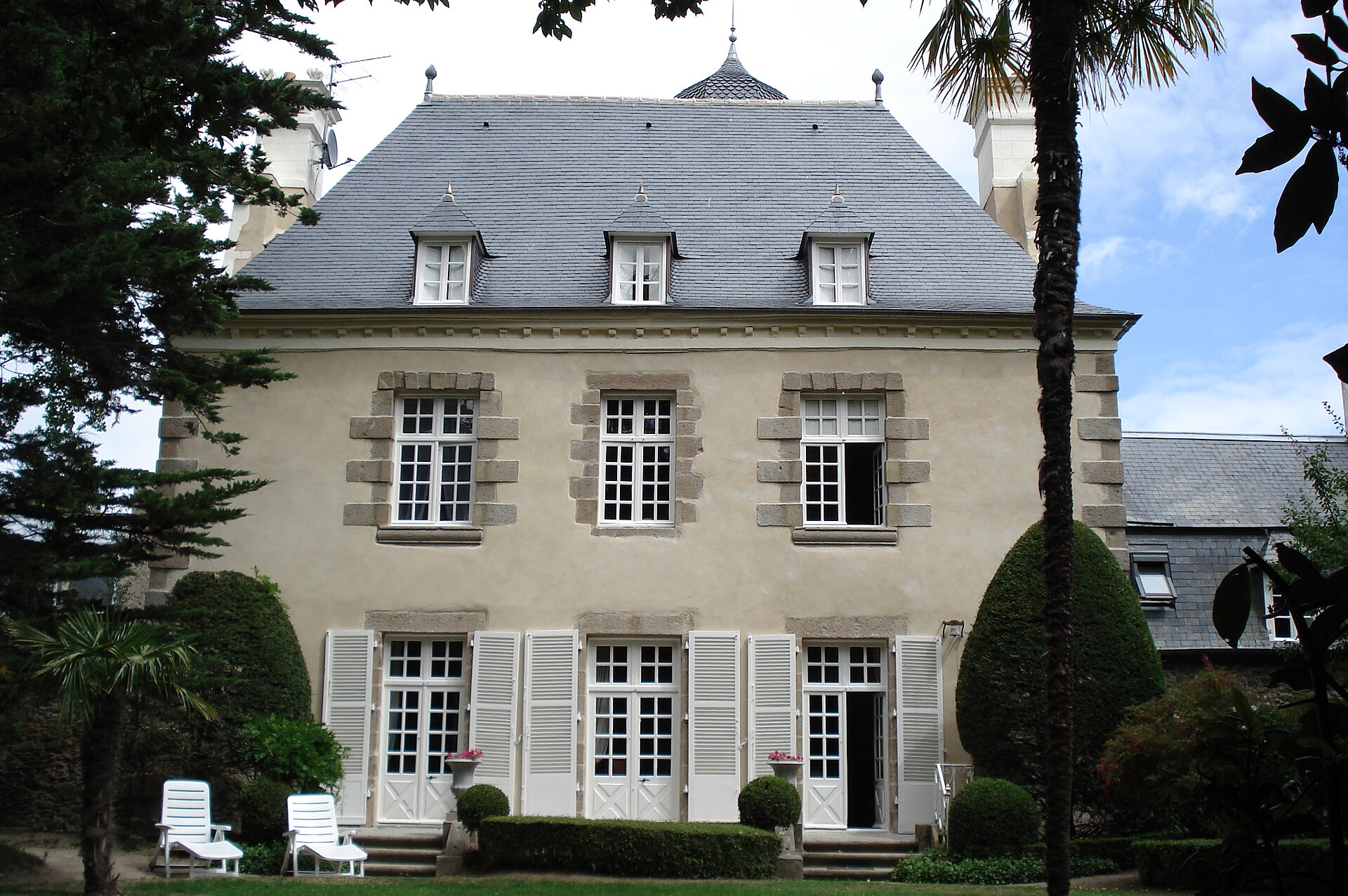
Malouinière de la Basse-Flourie is an 18th-century country manor in the Saint-Servan district of Saint-Malo, in the Ille-et-Vilaine department of Brittany. The house sits inside a walled, five-hectare park that slopes gently down toward the Troctin cove, looking out over the ever-changing colours of the Rance estuary and its tides.
Where does the estate come from?
A manor on this land is first recorded at the end of the 16th century, when it belonged to Charles Pépin (1570-1634), lord of Pré and Basse-Flourie, who married Jeanne Le Moyne in 1592. That earlier house was rebuilt in 1670 and included a residence, outbuildings, a dovecote, and a rectangular freshwater pond.
The malouinière visitors see today was built lower down, closer to the tidal Rance, in the early 18th century, for Alexandre Legrand (1681-1752), lord of Vergoncée, and his wife Hélène Jonchée (1697-1775). Country houses of this kind were raised by Saint-Malo's shipowners and privateers, wealthy families who used these residences on the town's outskirts to display the fortunes they had made from privateering and overseas trade.
Who lived at Basse-Flourie?
Ownership passed through several generations of Saint-Malo's maritime bourgeoisie. In 1784, Benjamin Dubois — builder of the Mont-Marin shipyard, which fitted out vessels for the American War of Independence — bought the house for his daughter Elisabeth. A later owner, Captain (and future rear admiral) Pierre Bouvet de Maisonneuve, an aide to the celebrated privateer Robert Surcouf, acquired the property in 1814 and wrote his memoirs there.
The house did not escape hardship: in 1942, during the German occupation, Basse-Flourie was requisitioned by the local Kommandantur, whose soldiers burned part of the floorboards to get through the harsh winter. In 1970, following a court-ordered sale, the estate was split into two separate properties — the 17th-century Manoir and the malouinière itself.
What is there to see?
The building follows the rectangular plan typical of malouinières, whose architecture is marked by austerity and an almost military rigour of line — the signature look of the country houses Saint-Malo shipowners built during the golden age of privateering and trade with the Indies. The five-hectare walled park descends toward the Troctin cove, giving onto one of the more striking views in the Saint-Malo area: the shifting light of the Rance estuary as the tide rises and falls.
Malouinière de la Basse-Flourie was listed as a monument historique by an order dated 31 July 2017, formally recognising its historical and architectural value.
How to get there, and when to visit?
The estate lies just a short distance from the walls of Saint-Malo, in the quiet Saint-Servan quarter, and is easily reached on foot or by bike along the paths that trace the Rance shoreline. Spring and summer are the best seasons to visit, when the park is at its greenest and the tidal Rance produces its most dramatic light at sunrise and sunset.
Frequently asked questions
What exactly is a malouinière? It is a type of country house built between the 17th and 18th centuries by wealthy Saint-Malo shipowners and privateers, typically austere in style and set within a walled park.
Is Basse-Flourie a protected monument? Yes — it was listed as a monument historique by an order of 31 July 2017.
Who was the estate's most famous owner? Rear admiral Pierre Bouvet de Maisonneuve, an aide to the privateer Robert Surcouf, who lived there from 1814 and wrote his memoirs at the house.
Where exactly is Basse-Flourie located? In the Saint-Servan district of Saint-Malo, overlooking the Troctin cove on the Rance estuary.
Nearby places

Earn badges for the places you visit
Download NextOnTrip, discover new places and check off your trails.