About this place
The Machsike Hadass Synagogue is the main house of worship of Antwerp's Orthodox Jewish community and the largest synagogue in Belgium. It stands at the heart of the city's Diamond District, home for generations to a large Hasidic community, and its sandstone Art Nouveau facade has shaped the religious rhythm of the neighborhood for over a century.
Where does the name Machsike Hadass come from?
The name belongs to the congregation itself, formed in 1892 when six smaller Antwerp shuls merged into a single Orthodox kehile. The united community took the name Machsike Hadass, roughly meaning "upholders of the faith," and in 1910 it received official legal recognition through a royal decree. The building described here was raised specifically to serve as this congregation's central synagogue.
Who designed the building, and in what style?
The synagogue was designed by Jewish architect Jules Hofman shortly before the outbreak of the First World War. Construction ran from 1910 to 1914, but the war delayed finishing work long enough that the formal dedication only took place in 1919, after the conflict had ended. Hofman combined an eclectic architectural plan with Art Nouveau detailing — a fashionable style in Antwerp at the time, but an unusual choice for a synagogue, since most Belgian synagogues of the era favored Neo-Romanesque or Orientalist forms instead. The sandstone facade features distinctive basket-shaped window arches, slender columns and twin corner towers, lending the monumental structure a surprising visual lightness.
What is inside the synagogue?
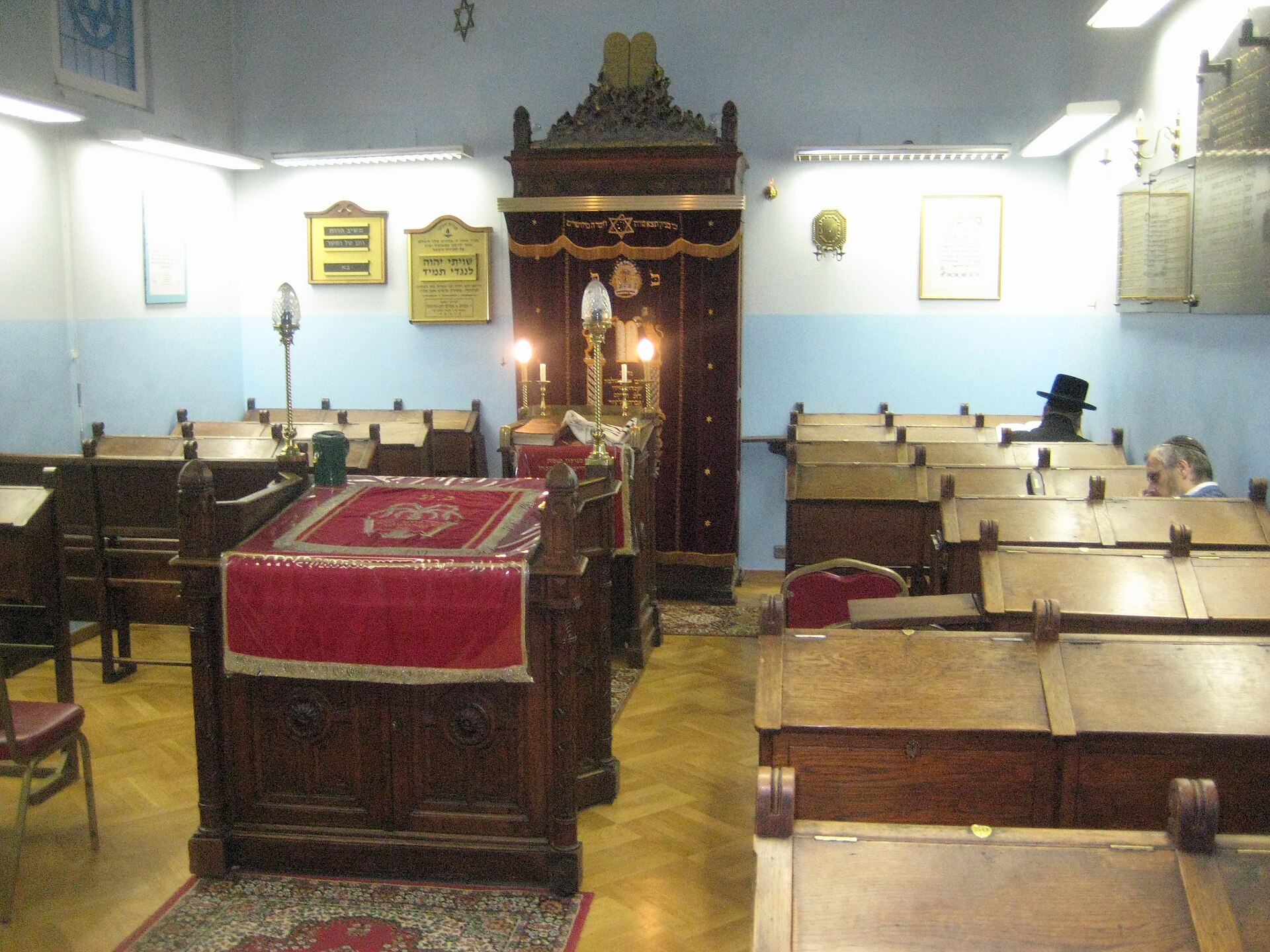
Behind the facade lie prayer halls designed to be filled with natural light, thanks to skylights fitted with colorful stained glass that give the interior a warm glow shifting throughout the day. One of the building's most recognizable features is the set of 70 chandeliers illuminating the main sanctuary, a striking piece of the original decorative scheme.
How did the community fare after the war?
Antwerp's Jewish community was devastated by the Holocaust, and Machsike Hadass rebuilt itself gradually in the postwar years — its yeshiva reopened as early as 1946. In 1954 the congregation appointed Chaim Kreiswirth as chief rabbi, a Talmudic scholar of international renown, cementing the synagogue's role as one of Orthodox Judaism's spiritual centers in Europe.
What did the recent restoration involve?
In 2016 the Flemish government granted more than €1.6 million toward restoring the synagogue, part of a broader €4 million program supporting two Antwerp synagogues. The multi-year project included the careful cleaning and repair of all 70 historic chandeliers in the main hall, along with extensive repairs to both the exterior facade and the interior. The work concluded with a reopening ceremony in May 2023, returning the building to full use as a place of worship and community life in the Diamond District.
Frequently asked questions
Can visitors tour the synagogue? As an active house of worship for an Orthodox community, visits typically require prior arrangement and observance of modest dress and customary conduct expected in a place of prayer.
Why is this building architecturally unusual? It is a rare example of a synagogue built in the Art Nouveau style, at a time when most Belgian synagogues of the period drew instead on Neo-Romanesque or Orientalist influences.
Is this the only synagogue run by the Machsike Hadass community? No — the congregation also maintains other prayer houses in Antwerp, but this building serves as its main, representative synagogue.
Nearby places

Earn badges for the places you visit
Download NextOnTrip, discover new places and check off your trails.