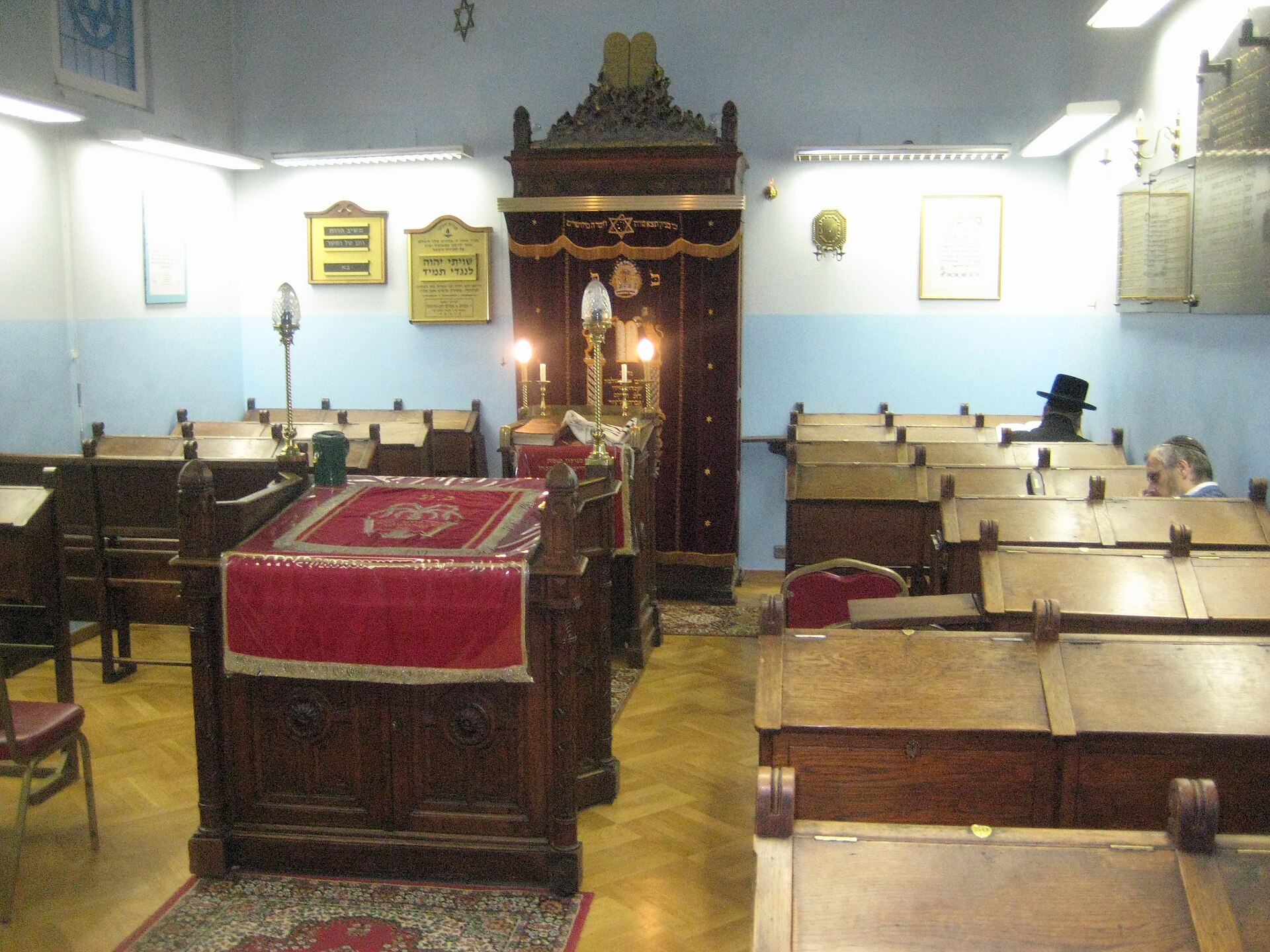
About this place
Eisenmann Synagogue is one of the oldest active synagogues in Antwerp and the only one in the city to have survived the Nazi occupation of Belgium and the Holocaust intact. It stands in the heart of Antwerp's Jewish quarter, near the central train station, an area that has been the center of the city's Orthodox Jewish community for well over a century.
Who founded the synagogue?
The building's history is inseparable from Jacob (Jacques) Samuel Eisenmann, who was born in Frankfurt am Main. He moved to Antwerp in 1884 and set up a company trading in dried fruit and industrial fibers imported from the Belgian Congo. His business grew substantial enough to make him a wealthy and influential figure — historical accounts describe him as having been close to King Leopold II. Before building his commercial standing, however, Eisenmann had received a religious education in Frankfurt as a student of Rabbi Samson Raphael Hirsch, one of the leading figures of nineteenth-century Orthodox Judaism. That grounding in Orthodox tradition shaped the character of the congregation Eisenmann would go on to establish in Antwerp.
When was the synagogue built?
The congregation gathered around Jacob Eisenmann was formally established in 1905, and the synagogue building itself was completed two years later, in 1907. The story did not end there: in 1908 Eisenmann purchased two adjoining buildings, allowing the synagogue to be expanded through the interiors of both structures combined. This method of construction — adapting and merging existing urban buildings rather than erecting a single purpose-built monumental structure — was common among synagogues of that era in Western Europe, where Jewish communities frequently converted existing townhouses for religious use instead of building grand new edifices from scratch.
What branch of Judaism does the congregation follow?
The community that worships at the Eisenmann Synagogue follows the Ashkenazi rite. The Orthodox character instilled by Rabbi Hirsch's teachings has persisted in Antwerp to this day — the city remains one of the most important centers of Orthodox Judaism in Europe, and the neighborhood around the central station is still alive with religious activity, home to numerous prayer houses, Talmudic schools, and kosher shops.
Why is this synagogue historically significant?
The Eisenmann Synagogue's greatest historical significance lies in the fact that it is the only synagogue in Antwerp to have survived the Nazi occupation of Belgium and the Holocaust. While other Jewish places of worship in the city were destroyed, looted, or permanently shut down as a result of persecution, the building founded on Eisenmann's property retained its religious function without interruption. For Antwerp's Jewish community — one of the few in Europe that managed to rebuild itself after the war in the very neighborhood it had inhabited before — the synagogue stands as a living symbol of continuity and survival.
What should visitors know before going?
The Eisenmann Synagogue is not a museum or a tourist attraction in the conventional sense — it remains an active place of worship serving the local Orthodox congregation. Visitors interested in the history of Antwerp's Jewish community should keep its religious function in mind and be mindful of appropriate conduct in and around the building. Its location within the Jewish quarter, just next to the central train station, makes it easy to combine a short walk through the area with visits to other sites connected to the history and present-day life of Antwerp's Jewish community.
Frequently asked questions
Is the Eisenmann Synagogue open to visitors? As an active place of worship, it primarily serves the local Orthodox congregation, so any visit by outsiders should take its religious character into account.
What makes this synagogue unique compared to others in Antwerp? It is the only synagogue in the city to have survived the Nazi occupation and the Holocaust in its original form.
Who founded the synagogue? The congregation and building were founded by Jacob Samuel Eisenmann, a Frankfurt-born businessman and student of Rabbi Samson Raphael Hirsch.
Which Jewish rite does the congregation follow? The congregation follows the Ashkenazi rite.
Nearby places

Earn badges for the places you visit
Download NextOnTrip, discover new places and check off your trails.